



Discovery of 18 Coelacanths Strengthens Marine Sanctuary Push in North Sulawesi
- 27 Jul 2026 13:29 WIB
- Voice of Indonesia
Key Points
- Scientists discovered 18 Coelacanths off Talise Island, including 11 in a single cave.
- The findings support efforts to establish a protected marine sanctuary in North Sulawesi.
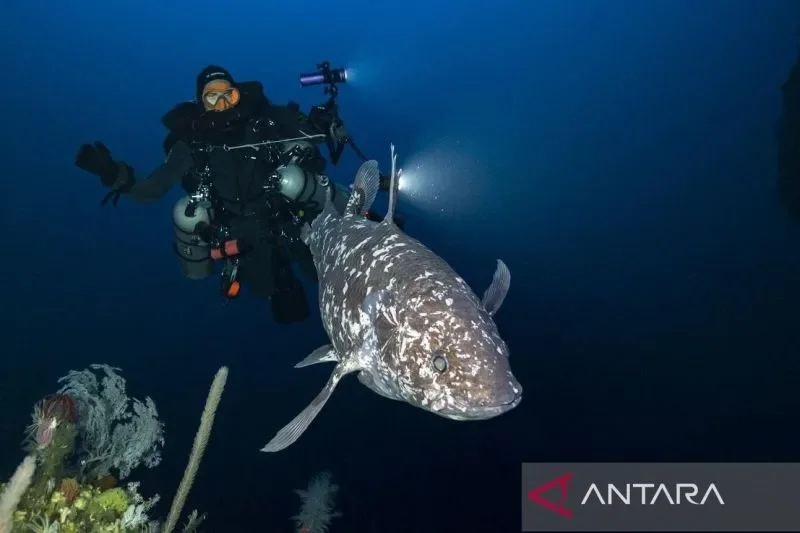
RRI.CO.ID, Jakarta - A landmark discovery of 18 living Coelacanths (Latimeria menadoensis) off Talise Island in North Sulawesi has provided scientists with crucial empirical evidence to establish a dedicated national marine sanctuary for one of the planet's rarest living fossils.
The breakthrough findings, presented at the National Research and Innovation Agency (BRIN) symposium on Thursday, July 23, 2026, mark a significant turning point in marine biology. The newly documented population strengthens Indonesia's status as a critical stronghold for a prehistoric species that has survived virtually unchanged for approximately 400 million years.
The research findings were presented jointly by a senior researcher at BRIN’s Biosystematics and Evolution Research Center, Alex Masengi of Sam Ratulangi University and Augy Syahailatua, during the Marine Futures Unlocked 2: From Insight to Impact symposium at BRIN’s headquarters in Jakarta.
Alex explained that systematic Coelacanth research in Indonesia has spanned more than two decades. Since field surveys began in 2004, the multi-institutional research team has identified at least 52 individual Coelacanths in Indonesian waters and four in South Africa through international collaborations.
"During 20 years of research, we have continuously strived to understand the life of the Coelacanth in its natural habitat. These latest findings show that Indonesia plays a very important role in the conservation efforts for this species," Alex said on Thursday, July 23, 2026, as quoted on BRIN’s official website.
The most extraordinary milestone came during a collaborative deep-sea expedition involving BRIN, global ocean exploration non-profit OceanX, and Japanese broadcaster NHK. Returning to explore underwater caves around Talise Island, a site first surveyed in 2009 when only four individuals were recorded, the team documented 18 Coelacanths, including a cluster of 11 live individuals sharing a single cave system.
Additionally, researchers documented a 26-centimeter juvenile Coelacanth in Amurang Bay, providing rare insights into the species' local breeding and nursery habitats. Field data confirms that the Coelacanth's geographic range in Indonesia stretches across deep-sea corridors from Biak in Papua to Buol in Central Sulawesi.
To unlock previously unknown biological traits, the scientific team deployed advanced technologies, including environmental DNA (eDNA) sampling to track genetic traces in deep water. Furthermore, a high-resolution CT scan performed on a preserved specimen revealed 22 unhatched eggs inside the female's body cavity.
"The success of finding 11 Coelacanth individuals in a single cave and the CT scan results showing 22 eggs are very valuable achievements for understanding the biology and reproduction of this species," Alex explained.
Augy Syahailatua emphasized that these discoveries reinforce the immediate necessity of establishing strict spatial protection around Talise Island.
"Coelacanth conservation aims not only to protect a rare species, but also to support the development of scientific research, education, and conservation-based ecotourism. The presence of the Coelacanth provides a major opportunity for Indonesia to strengthen its position as a global center for marine biodiversity research," Augy said.
The administrative drive to protect the habitat has gained momentum. In July 2026, the North Sulawesi Provincial Administration officially submitted approval documentation to the Ministry of Marine Affairs and Fisheries (KKP) to designate the waters of Talise Island as a dedicated Coelacanth habitat sanctuary.
Following national sanctuary designation, the administration and research teams plan to nominate the Talise Island Coelacanth habitat as a UNESCO World Heritage Site, anchoring its protection within the heart of the Coral Triangle. ***
News Recomendation
Loading latest news.....