



Rare Ganges Shark Rediscovered in North Kalimantan
- 25 Mei 2026 11:20 WIB
- Voice of Indonesia
Key Points
- Researchers recorded 43 Ganges sharks in the Sesayap River, confirming a rare surviving population.
- The discovery strengthens conservation efforts to protect one of the world’s rarest freshwater sharks.
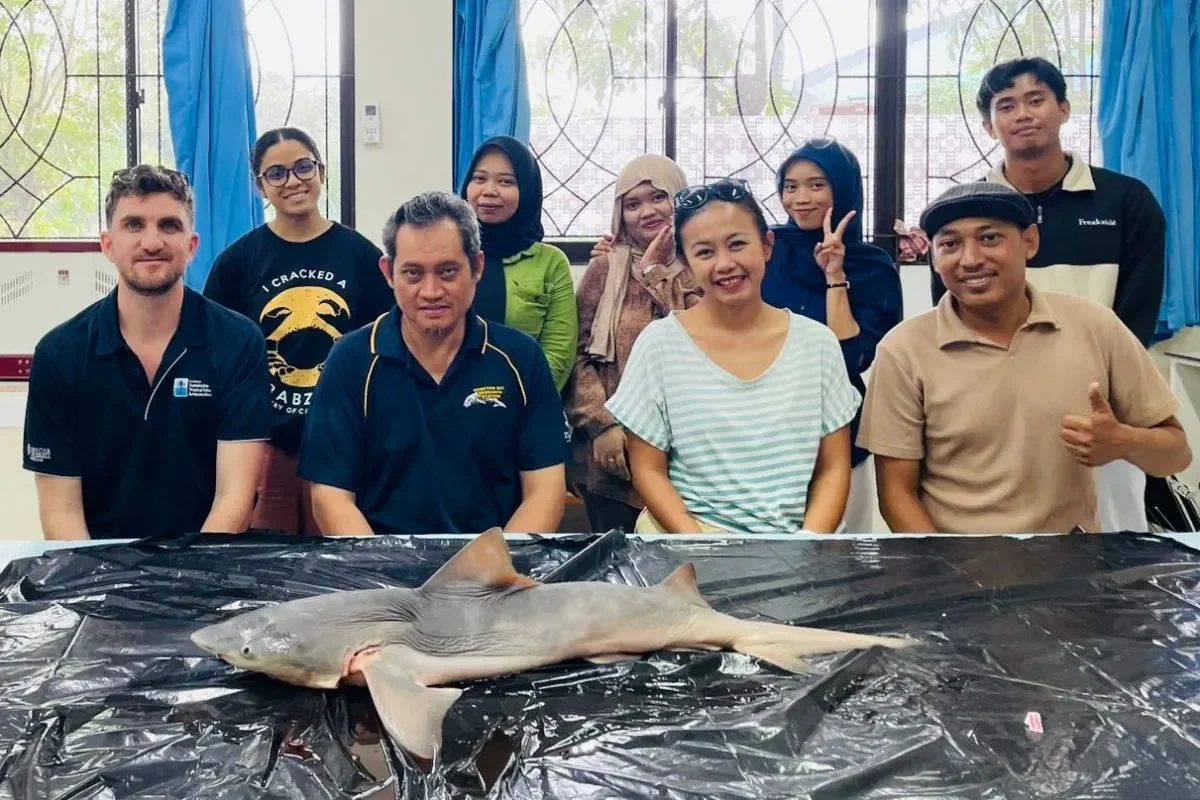
RRI.CO.ID, Makassar - A joint team of international researchers has rediscovered a population of the Ganges shark (Glyphis gangeticus) in the Sesayap River, Tana Tidung Regency, North Kalimantan. The freshwater shark species had been widely feared to be near extinction, having largely vanished from the world's waterways for years.
The high-stakes scientific expedition was led by Hasanuddin University (Unhas) in collaboration with James Cook University and Universitas Borneo Tarakan. The successful location of this critically endangered apex predator provides an unprecedented glimmer of hope for international biodiversity preservation.
The Ganges shark is considered one of the rarest shark species on the planet. Since the year 2000, confirmed sightings of the creature have occurred fewer than ten times across its entire historical distribution range, which stretches from Pakistan to Myanmar. Because of this extreme scarcity, the International Union for Conservation of Nature (IUCN) officially lists the species under its highest threat category as Critically Endangered.
However, field research conducted by the collaborative team yielded astonishing data that has rewritten the biological understanding of the species. The team recorded a surprise specimen density because, in a field observation window lasting less than three weeks, researchers successfully identified and documented 43 individual Ganges shark specimens.
This concentrated population officially establishes the Sesayap River complex as a vital global sanctuary, making it one of the most important remaining habitats left on Earth for the survival of the species.
Furthermore, regarding its international protection status, James Cook University researcher Michael Grant revealed that the Sesayap River was formally designated as an Important Shark and Ray Area (ISRA) in 2024. This prestigious ISRA status cements the global community's recognition of the river system as a crucial nursery ground where these rare river sharks can safely grow and reproduce.
For Hasanuddin University, this discovery validates a long-term institutional commitment to high-impact marine research and global environmental problem-solving. The partnership with Australia's James Cook University, which commenced in 2022, was designed from the outset to bridge the gap between hard academic data collection and real-world societal application.
Representing the Rector of Unhas, Rohani Ambo Rappe emphasized that saving the species requires looking beyond traditional, restrictive wildlife enforcement and moving toward a framework that actively empowers the people living alongside the river.
"This finding is not just about saving one endangered species, but also about how we build a conservation model that is fair, collaborative, and acceptable to the community," Rohani said in an official release on Monday, May 25, 2026, as quoted by Antara.
"Therefore, we encourage the establishment of a shark and ray research consortium in Kalimantan so that strengthening scientific data and policy can go hand in hand," she explained.
Moving forward, the academic coalition aims to utilize this discovery to establish a formal shark and ray research consortium in Kalimantan. This structural body will ensure that local government policies and international scientific data work hand-in-hand to shield the Sesayap River ecosystem while safeguarding the livelihoods of the local communities. ***
News Recomendation
Loading latest news.....