



UGM Researchers Pioneer Agrivoltaic Innovation for Sustainable Farming
- 26 Jun 2026 15:20 WIB
- Voice of Indonesia
Key Points
- Gadjah Mada University (UGM) researchers are advancing agrivoltaic technology that integrates solar panels with farmland.
- Smart farming boosts productivity with real-time data and precision tools.
- Drones and sensors are utilized to enhance crop monitoring, tackling climate challenges.
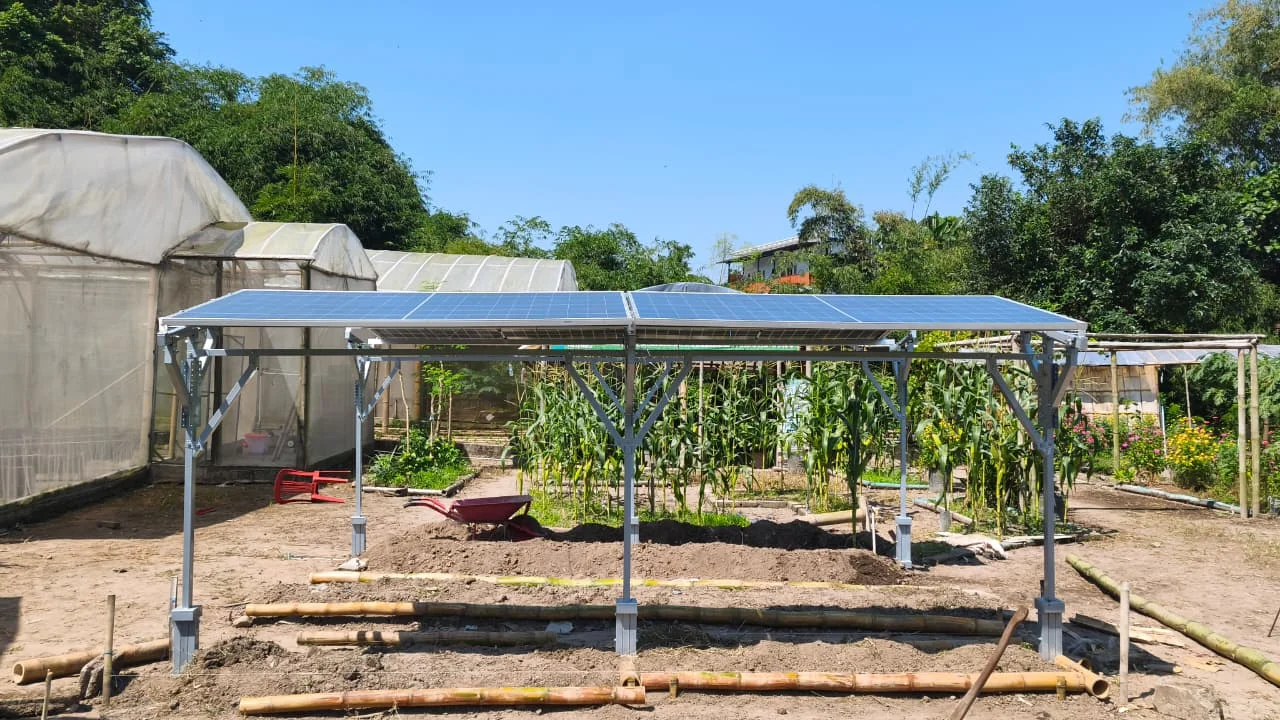
RRI.CO.ID, Yogyakarta - Researchers at Gadjah Mada University (UGM) are pioneering agrivoltaic technology that integrates solar panels with farmland, offering a sustainable solution to Indonesia’s agricultural productivity challenges.
A 2021 report by Indonesia's Central Bureau of Statistics (BPS) revealed that nearly 90 percent of farmland in the country has yet to meet sustainable productivity standards due to excessive chemical use, soil mismanagement, water overuse, and social conflicts.
Farmers also continue to face climate change impacts, including prolonged droughts linked to El Niño, expected to last until early 2027.
Inspired by the success of the Cirata floating solar power plant, UGM’s Renewable Energy Laboratory Head Ahmad Agus Setiawan introduced the agrivoltaic concept. The system has been implemented in Pandowoharjo Village, Sleman, where it is operated directly by local farmers.
UGM students participating in community service programs (KKN) are also set to bring solar panel packages combined with Starlink internet access to remote areas.
“We hope students grow together with communities by providing both energy and connectivity,” Setiawan said during the International Seminar “Smart Agrivoltaic Nusantara” at UGM’s Faculty of Engineering on Wednesday, June 24.
The innovation was developed with Professor Bayu Dwi Apri Nugroho of UGM’s Faculty of Agricultural Technology. Bayu explained that smart farming underpins the system through three pillars: a Management Information System (MIS) for decision-making, precision agriculture, and robotics.
He noted that smart farming improves productivity, delivers real-time data, enhances efficiency, and ensures better product quality. “Sensors can tell us when soil lacks nitrogen, so we apply the right fertilizer instead of the wrong one,” Bayu said.
Challenges remain in open-field applications, where unpredictable weather complicates operations compared to greenhouses. To address this, Bayu is integrating drones--both for mapping and spraying--with soil and weather sensors to provide precise, real-time crop data.
International collaboration is also part of the effort. Director of Malaysia’s Solar Research Institute, Nofri Yenita Dahlan, shared how large-scale agrivoltaic projects at her institute reduced electricity bills and supported farming.
Creeping plants like pegaga were cultivated under solar panels to prevent soil erosion, while solar power supplied greenhouse systems for automated cherry tomato production.
UGM’s Director of Community Service, Rustamadji, emphasized that such appropriate technologies should be carried nationwide through student programs. “It’s not just about bringing technology but also preparing communities and building ecosystems that support its sustainability,” he said. ***
News Recomendation
Loading latest news.....