



BRIN Synthesizes Water Filtration Membranes from Recycled PET Plastic Bottles
- 12 Jun 2026 13:39 WIB
- Voice of Indonesia
Key Points
- BRIN developed water filtration membranes from recycled PET plastic bottles.
- The technology helps purify water while reducing plastic waste.
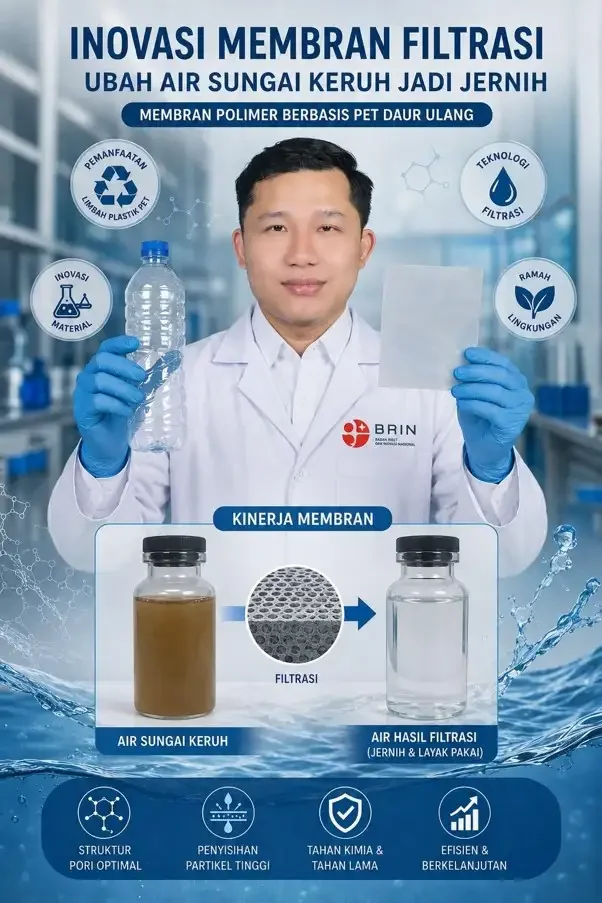
RRI.CO.ID, South Tangerang - The National Research and Innovation Agency (BRIN) has developed a dual-purpose environmental technology that converts discarded polyethylene terephthalate (PET) plastic bottles into high-performance water filtration membranes.
Engineered by BRIN's Research Center for Nanotechnology Systems, the innovation offers a cost-effective alternative for industrial wastewater treatment and river water purification while directly tackling Indonesia's plastic pollution crisis.
"Therefore, we tried to combine two problems into one solution, namely utilizing plastic bottle waste into membrane materials based on a circular and environmentally friendly economy," Badrut Tamam Ibnu Ali, a lead researcher at BRIN, said, as quoted on BRIN's official website.
BRIN chose PET plastic bottles as the baseline raw material due to their abundance in the environment. Through material engineering, the plastic is crushed, dissolved in organic solvents, and molded using a phase inversion technique to generate multi-layered filtration sheets measuring approximately 0.19 mm in thickness.
To fast-track practical applications, BRIN has partnered with regional water utility companies (PDAM) to process raw river water. By utilizing these membranes, municipal treatment plants can bypass resource-heavy conventional stages like chemical coagulation and sedimentation, allowing raw river water to be directly and efficiently filtered.
The engineered PET membranes underwent rigorous testing against highly turbid river water that originally failed to meet clean water quality baselines. The filtration process achieved dramatic reductions across all critical pollutant parameters, beginning with turbidity, which dropped from 440 NTU to 1.42 NTU, placing it well under the 25 NTU regulatory limit.
Additionally, the chemical oxygen demand (COD) was successfully reduced from 17.05 ppm to 2.45 ppm, comfortably outperforming the standard threshold of 10 ppm. Finally, the biochemical oxygen demand (BOD) decreased from 6.94 ppm to 1.24 ppm, falling safely below the required 2 ppm standard limit.
Beyond river purification, the membrane was tested against toxic heavy metals in industrial electroplating wastewater, successfully rejecting 70% of dangerous chromium (VI) ions.
The primary competitive edge of the BRIN membrane lies in its ultra-low production cost. Traditional commercial water filters made from ceramic or specialized polymers can cost millions of rupiah per square meter.
In contrast, BRIN can synthesize multiple filtration sheets from a single discarded plastic bottle that carries virtually no economic value.
Looking ahead, the research team is focused on adding specialized nanoparticles into the polymer matrix to further optimize fluid flux and selectivity. Badrut emphasized that this project proves that circular economy principles can yield low-cost, high-impact technologies for the public. ***
News Recomendation
Loading latest news.....