



BRIN Develops Digital Twin Framework for Autonomous Vehicle Safety
- 18 Mei 2026 15:58 WIB
- Voice of Indonesia
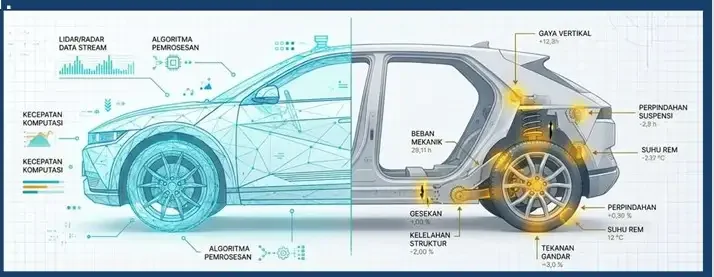
RRI.CO.ID, Jakarta - The National Research and Innovation Agency (BRIN) of the Republic of Indonesia is developing a digital twin framework. It aims to support the integration of structural and behavioral safety in autonomous vehicles.
According to an article published on BRIN’s official website on Monday, May 18, 2026, Associate Research Engineer at BRIN’s Research Center for Data and Information Sciences, Nimas Ayu Untariyati, explained that the study utilizes digital twin technology, a virtual representation of a vehicle capable of simultaneously monitoring interactions between autonomous system decisions and their impact on the vehicle’s physical condition.
According to her, the digital twin approach offers a new perspective in assessing autonomous vehicle safety. Until now, vehicle testing has mainly focused on the system’s ability to respond to road conditions.
“Through the digital twin approach, we integrate behavioral aspects and the vehicle’s physical condition simultaneously, allowing potential structural damage to be monitored and predicted at an early stage,” she said in an interview with BRIN’s Public Relations team on Wednesday, May 13, 2026.
She added that the system utilizes built-in vehicle sensor data, enabling efficient implementation without requiring additional complex devices.
“The development of autonomous vehicles has shown significant progress in AI-based decision-making capabilities. However, safety testing has so far focused mainly on behavioral aspects, such as collision avoidance,” she said.
The digital twin framework developed by BRIN consists of three stages: the behavioral stage, which represents vehicle system decisions; the physical motion stage, which calculates load distribution caused by maneuvers; and the structural condition stage, which evaluates potential damage to the vehicle’s chassis and suspension system. These stages operate continuously while the vehicle is running.
One of the advantages of this approach is its ability to utilize built-in vehicle sensors without requiring additional hardware. The system can estimate stress levels and accumulated damage in real time as the basis for vehicle condition analysis.
The research is expected to support the development of predictive maintenance systems for autonomous vehicles, improve integrated safety standards between systems and structures, and encourage the design of more adaptive autonomous vehicles.
News Recomendation
Loading latest news.....