



BRIN Develops Earthquake Damper Innovation for Buildings
- 30 Okt 2025 18:24 WIB
- Voice of Indonesia
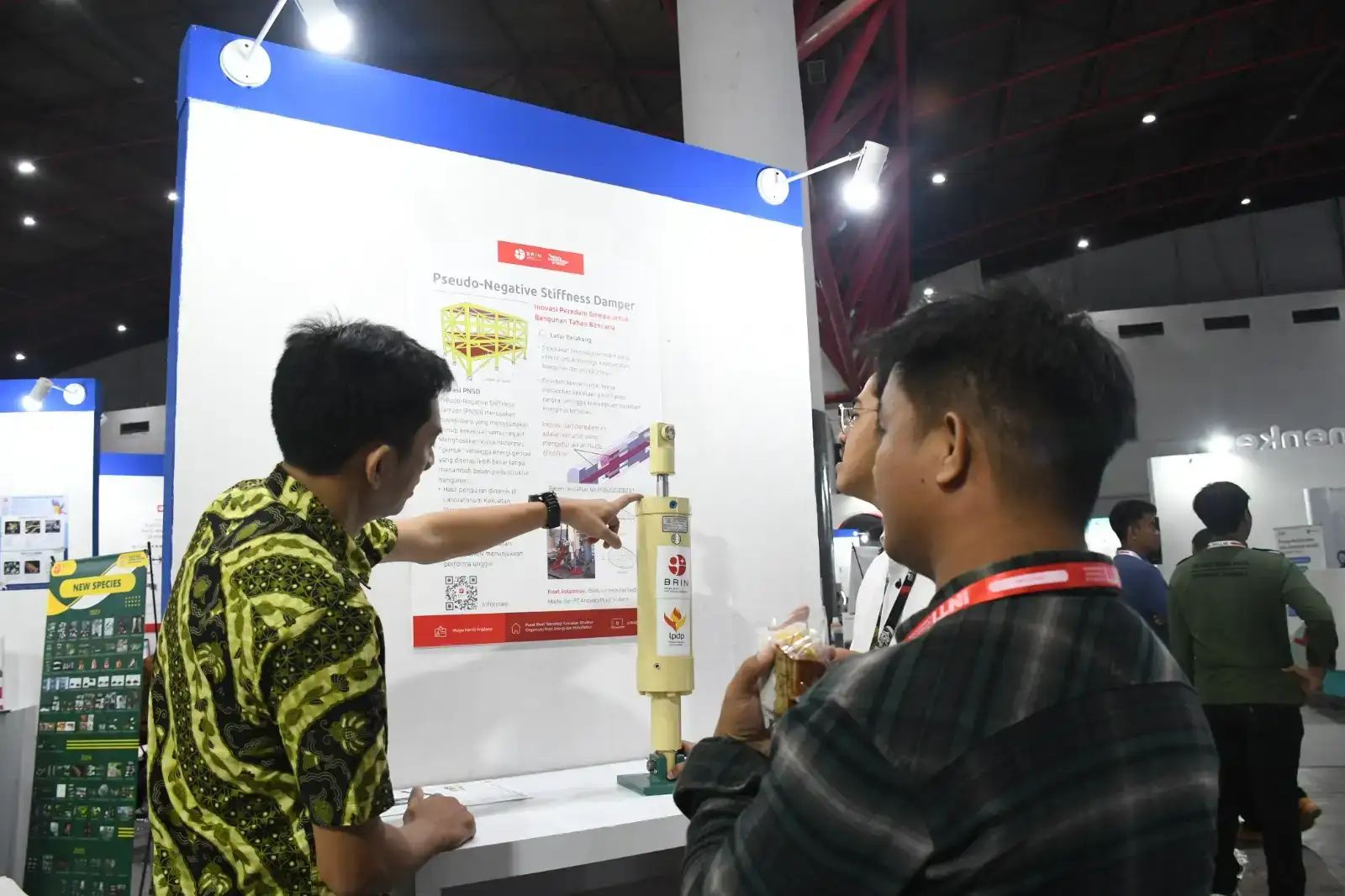
KBRN, Jakarta: The Indonesian National Research and Innovation Agency (BRIN) research team introduced the Pseudo-Negative Stiffness Damper (PNSD), an innovative earthquake damper that can absorb more energy without adding weight to the building frame.
This technological innovation aims to enhance building structural resistance, given Indonesia's high earthquake risk.
Leonardus Setia Budi Wibowo, a researcher at BRIN's Structural Strength Technology Research Center, explained that PNSD is the result of collaboration between BRIN, Gadjah Mada University (UGM), and PT Andalan Fluid System.
Leonardo explained that PNSD differs from conventional dampers, which only have zero stiffness. “PNSD actually has pseudo-negative stiffness, so it can dampen greater earthquake energy without increasing the force on the building structure,” he explained at the Indonesia Research and Innovation Expo (InaRI Expo 2025), JIEXPO, Jakarta, on October 28, as quoted by brin.go.id on Thursday, October 30, 2025.
This damper operates on the principle of dynamic fluid, utilizing a special cone that regulates fluid flow through an orifice to create an efficient damping force. With this concept, the vibration energy from earthquakes can be absorbed more optimally, while the building structure remains stable.
The idea for this device originated from Mulyo Harris Pradono's research while studying in Japan in 2003. It was then realized as a prototype through cross-institutional research team collaboration after a lengthy process, including testing at the BRIN Structural Strength Laboratory. “We want to ensure that this device can perform under dynamic load conditions such as during an earthquake,” added Leonardus.
Laboratory testing has proven that one PNSD unit produces half of the hysteresis curve, while two paired units produce a whole curve for optimal absorption. Leonardus added that this device is relevant for both new and existing buildings that need to be retrofitted for earthquake resistance.
PNSD has been registered as a patent with the Directorate General of Intellectual Property (DJKI) and has received research funding from LPDP through the RISPRO RIIM-4 program. After two years of research since 2023, the team plans to test its effectiveness in a full-scale structure simulation.
Leonardus emphasized that the device can be installed as an upgrade without dismantling old buildings, thereby increasing safety without adding significant costs. BRIN hopes this innovation will become the national standard for earthquake-resistant construction design.
Through this breakthrough, BRIN strengthens its commitment to collaborative research for the safety and sustainability of development in earthquake-prone areas of Indonesia. “This technology is expected to be widely used in the construction world and become part of the standard design for earthquake-resistant buildings,” said Leonardus. ***
News Recomendation
Loading latest news.....