



Indonesia Remains Southeast Asia’s Top Rice Producer, FAO Reports
- 20 Jun 2026 15:39 WIB
- Voice of Indonesia
Key Points
- Indonesia recorded the largest rice production increase among the world’s top producers, surpassing growth in India, Brazil, and Bangladesh.
- National rice reserves reached 5.2 million tons, helping curb imports and stabilize domestic food prices.
RRI.CO.ID, Jakarta - The National Food Agency (Bapanas) has cited a new global assessment by the Food and Agriculture Organization (FAO), confirming that Indonesia has established itself as the largest rice producer in Southeast Asia and the fourth-largest globally, trailing only behind India, China, and Bangladesh in 2025.
Among the top four global agrarian powers, only China and Indonesia are projected to sustain positive trajectories in rice yields. When comparing production forecasts between the 2024/2025 and 2025/2026 cycles, Indonesia leads the world's primary producers with the single highest production increase.
The archipelago's rice production surge is expected to exceed 4 million tons, outstripping the growth margins of India (1.7 million tons), Brazil (1.5 million tons), and Bangladesh (1.1 million tons).
Head of Bapanas, who also serves as the Minister of Agriculture, Andi Amran Sulaiman, verified the international recognition in a statement released in Jakarta on Saturday, June 20, 2026.
"The FAO has once again ranked Indonesia as the highest rice producing country in Southeast Asia and the fourth highest in the world after India, China, and Bangladesh," Amran said, as quoted by Antara.
In its June 2026 edition of the Food Outlook, the FAO reported that Indonesia’s surging rice inventories have become a stabilizing anchor for global buffer stocks. The UN food agency estimates that worldwide rice reserves by the end of the 2026/2027 cycle could reach 213.8 million tons, marking the second-highest record in the past decade.
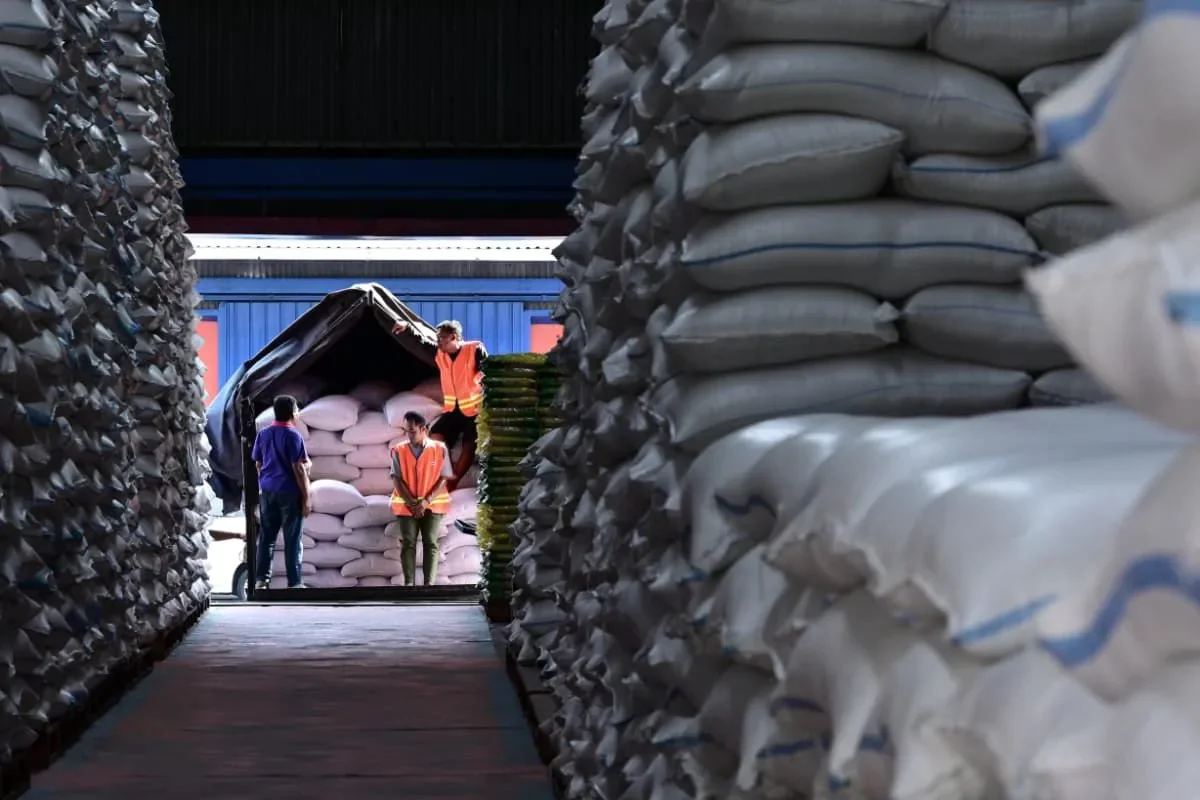
Domestically, Minister Amran confirmed that the Government Rice Reserve (CBP), managed by state logistics agency Perum Bulog, currently hovers at an exceptionally safe level of over 5 million tons. This abundant supply has successfully eliminated the need for medium-grade commercial rice imports.
"Our (CBP) stock as of June is around 5.2 million tons, and our stock is secure. But most importantly, no medium-grade rice import permits have been issued since 2025," he said.
Amran challenged skeptics to directly inspect state storage infrastructure across the country, noting that the sheer volume of harvested grain has forced the government to expand its physical storage footprint.
"Bulog's (warehouse) capacity is only 3 million tons. But our stock is 5.2 million tons. This means Bulog is currently renting a warehouse with a capacity of 2.2 million tons. (So) for those who are unsure, please visit Bulog's warehouses throughout Indonesia," Amran added.
The FAO's June 2026 projections estimate that Indonesia's closing stocks could touch 7.5 million tons during the 2025/2026 period and potentially swell to 7.8 million tons in the 2026/2027 cycle, paving the way for Indonesia to transition into a major rice exporter.
Crucially, the national harvest boom has successfully insulated domestic consumers from macroeconomic shocks. For two consecutive years, rice has ceased to be a primary driver of domestic inflation.
"And one more thing, rice is no longer the main contributor to inflation. This has been the case for two years in a row," he said.
Monthly rice inflation has leveled off significantly over the last 24 months. After peaking at 3.59 percent in May 2024, price indices stabilized. While minor fluctuations occurred in July 2025 at 1.35 percent, the latest figures from May 2026 show rice inflation squeezed down to a marginal 0.38 percent.
Importantly, low consumer inflation has not come at the expense of local agricultural income. The FAO report pointed out that robust, stable producer prices in Indonesia, South Korea, Pakistan, and the Philippines have heavily incentivized farmers to stick with rice cultivation over alternative cash crops. This stands in stark contrast to regional competitors like Cambodia, India, Myanmar, Nepal, Sri Lanka, and Thailand, which are all projected to experience production contractions.
According to data from Center Bureau of Statistics (BPS), the price index received by local rice farmers in May 2026 reached 147.97—the highest level recorded in seven years. Concurrently, the Farmers' Terms of Trade (NTP) for food crops hit 113.79 in May, marking a peak for the calendar year and confirming that the agricultural boom is directly boosting rural purchasing power. ***
News Recomendation
Loading latest news.....