



Key Points
- WWF Indonesia launched a TFCCA project to strengthen leatherback turtle conservation on Buru Island.
- The program combines habitat protection with community involvement and sustainable economic benefits.
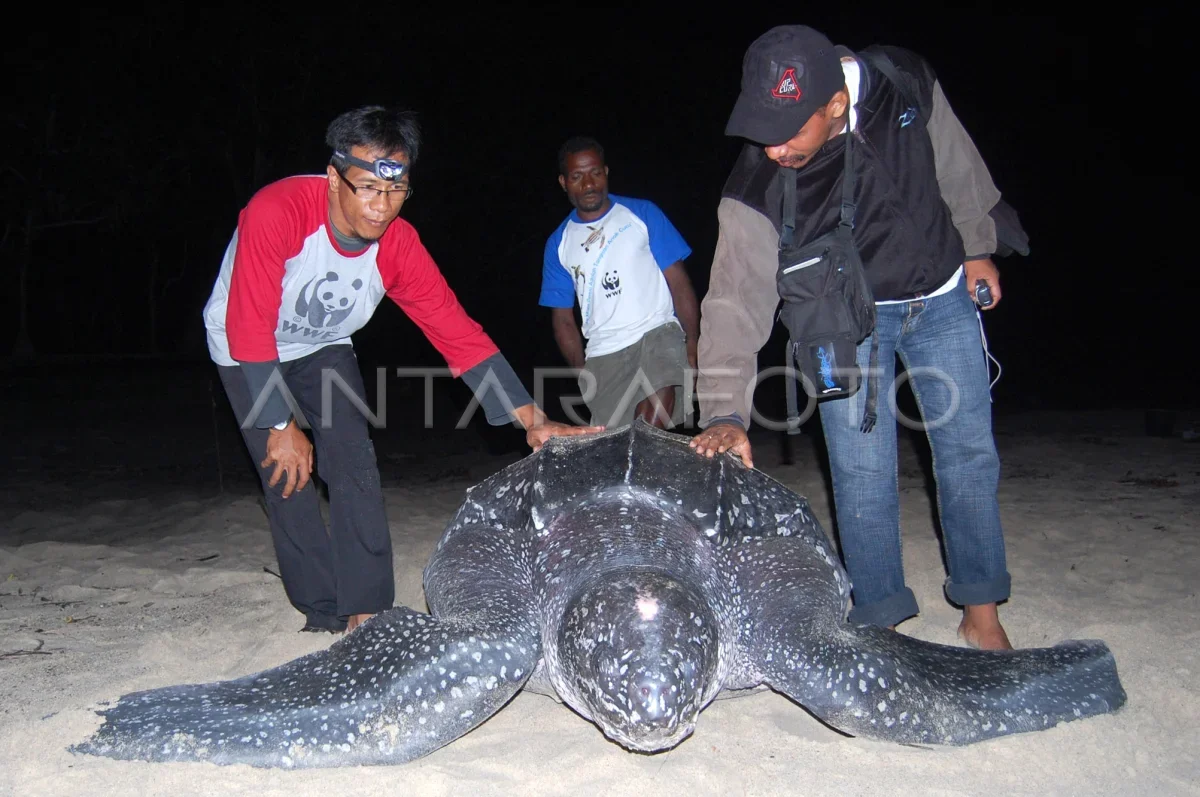
RRI.CO.ID, Ambon - The World Wide Fund for Nature (WWF) Indonesia has stepped up its ecological conservation programs to protect the critically endangered leatherback sea turtle (Dermochelys coriacea) on Buru Island, Maluku. The initiative is being driven through the official implementation of the Tropical Forest and Coral Reef Conservation Act (TFCCA) Project.
The reinforcement program was formalized during a project kick-off assembly held in Wamlana Village, Fena Leisela Subdistrict, Buru Regency. The initiative bridges central and regional government bodies, academic researchers, and local community groups to align structural work plans and bolster multi-party collaborations along the northern coast of Buru Island.
WWF Indonesia Inner Banda Arc Seascape Manager, M. Budi Santosa, emphasized that the marine reptiles serve as an essential indicator of regional ocean health.
"Leatherback turtles play a vital role in maintaining the balance of the marine ecosystem. If they are no longer found laying eggs in their natural habitat, it could be an indicator of environmental damage," said WWF Indonesia's Inner Banda Arc Seascape Manager, M. Budi Santosa, in Ambon on Wednesday, June 17, 2026, as quoted by Antara.
Buru Island stands as one of the most critical nesting strongholds for leatherback turtles across the Indonesian archipelago, alongside the iconic Jamursba Medi beach in Southwest Papua. A specific 14-kilometer stretch of coastline in the Fena Leisela District serves as a vital nesting ground for four distinct turtle species: the leatherback, olive ridley, green, and hawksbill turtles, with conservationists documenting an average of 250 active nests annually.
The leatherback sea turtle is currently designated as Critically Endangered on the International Union for Conservation of Nature (IUCN) Red List, necessitating urgent and sustainable protective measures across institutional levels.
Head of the Maluku Provincial Marine and Fisheries Agency, Erawan Asikin, explained that the newly introduced TFCCA project is expected to significantly optimize the spatial management of the Buru Marine Conservation Area, which was recently established under Ministry of Marine Affairs and Fisheries Decree Number 69 of 2025.
Asikin noted that the newly gazetted marine zone requires immediate structural governance upgrades, ranger capacity building, and intensive public socialization campaigns.
"With this TFCCA project, we are not only protecting and preserving turtles, but we also hope to provide economic benefits to the community," he said.
Moving forward, WWF Indonesia, alongside government authorities and local villagers, will focus heavily on accelerating the operational capacity of conservation area managers, implementing rigorous monitoring networks for protected marine life, and raising public awareness regarding Endangered, Threatened, and Protected (ETP) species.
The international conservation organization reiterated that wide-ranging stakeholder collaborations are essential to ensure that turtle protection on Buru Island shifts from a basic species-saving operation into a high-value, long-term investment for the sustainability of Maluku's entire marine ecosystem.
This newly launched phase builds upon a foundational conservation framework started in 2017. Over the last nine years, WWF Indonesia, in partnership with the local Sugiraja Watulu Turtle Conservation Group, has managed ongoing population assessments, mapped seasonal nesting activities, run community educational workshops, and strengthened the operational capacity of grassroots conservation groups across Northern Buru. ***
News Recomendation
Loading latest news.....