



Indonesia Posts Billions of Dollars in Trade Surplus
- 03 Jul 2026 14:16 WIB
- Voice of Indonesia
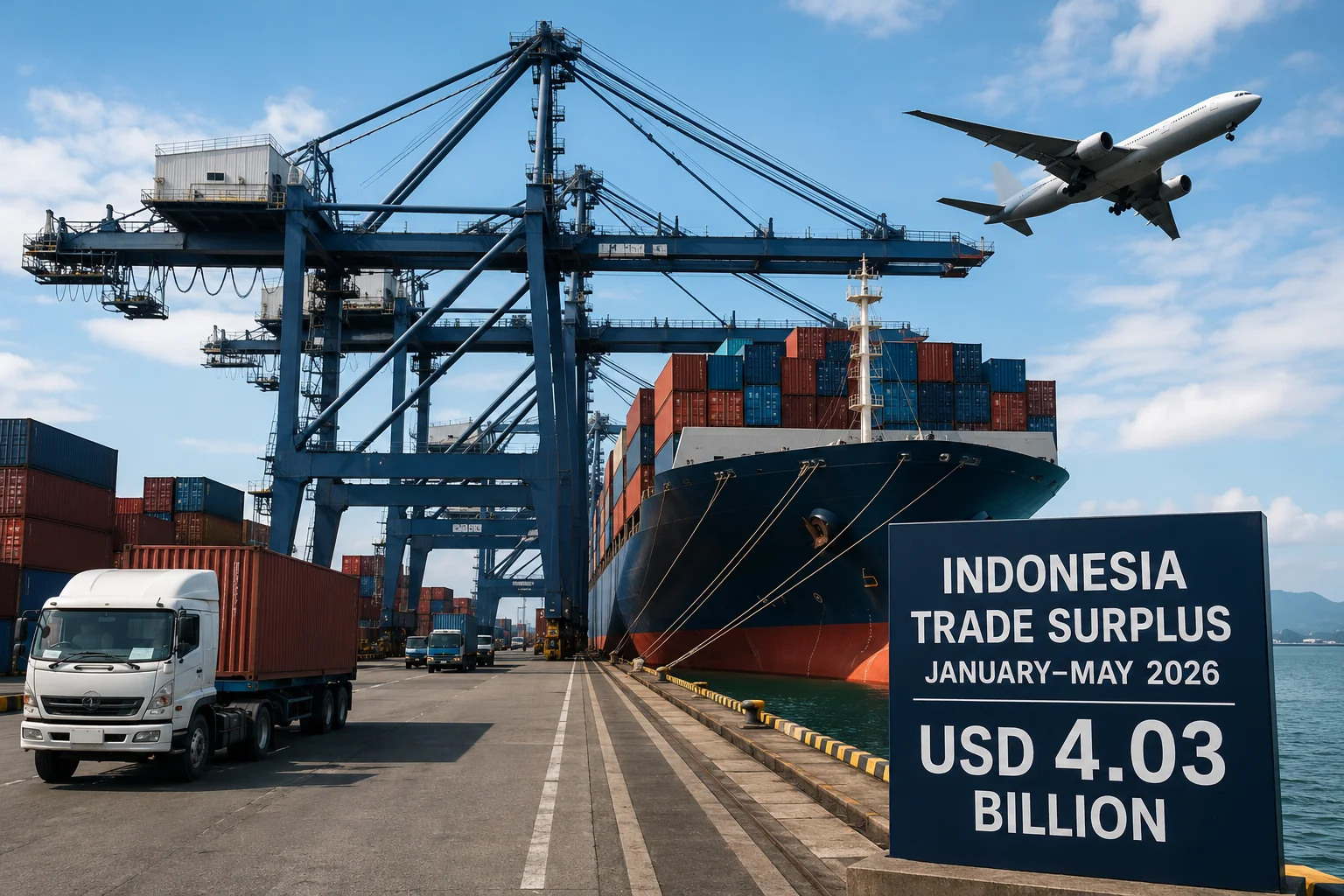
RRI.CO.ID, Jakarta - Indonesia’s foreign trade remained resilient in the first five months of 2026. Although the country recorded a $1.61 billion trade deficit in May, mainly due to a wider oil and gas deficit, Indonesia still posted a cumulative surplus of $4.03 billion from January to May. The result was supported by a $16.31 billion non-oil and gas surplus, which offset a $12.28 billion deficit in the oil and gas sector.
Indonesia's Trade Minister, Budi Santoso, said non-oil and gas trade continued to serve as the backbone of Indonesia’s external trade performance. “Although the trade balance recorded a deficit in May 2026, Indonesia’s cumulative trade performance remains in surplus. This proves that Indonesia’s non-oil and gas trade remains strong amid global challenges,” he said, quoted from an official statement on Thursday, July 2, 2026.
May’s deficit was driven largely by a $3.76 billion oil and gas deficit, comprising a $3.40 billion shortfall in refined petroleum products and a $700 million deficit in crude oil. Natural gas, however, still recorded a $350 million surplus. Meanwhile, non-oil and gas trade posted a $2.15 billion surplus in May, led by mineral fuels, animal and vegetable fats and oils, as well as iron and steel.
From January to May, Indonesia’s largest non-oil and gas surpluses came from animal and vegetable fats and oils at $13.92 billion, mineral fuels at $10.88 billion, and iron and steel at $7.09 billion. The United States was Indonesia’s largest source of non-oil and gas surplus at $8.47 billion, followed by India at $5.34 billion and the Philippines at $3.42 billion.
Indonesia’s exports reached $23.20 billion in May, down 8.30 percent month-on-month and 5.73 percent year-on-year, mainly due to a 34.38 percent monthly drop in oil and gas exports and a 7.05 percent decline in non-oil and gas exports. Still, cumulative exports from January to May rose 3.02 percent year-on-year to $115.36 billion, driven by a 3.89 percent increase in non-oil and gas exports to $110.19 billion.
Manufacturing remained a key driver of export growth. Exports from the sector grew 6.80 percent in the January–May period, led by aluminium and aluminium products, up 64.33 percent; nickel and nickel products, up 60.88 percent; and organic chemicals, up 31.04 percent.
“Moving forward, the government will continue expanding export market access while increasing the added value of national products to maintain export performance,” Budi said. He added that the steady growth of manufactured exports reflects the positive results of downstream industrialisation and stronger competitiveness in Indonesia’s manufacturing sector.
Several sectors, however, saw weaker exports during the first five months of the year. Agricultural exports fell 24.95 percent, oil and gas exports dropped 12.71 percent, and mining and other exports declined 8.14 percent. Cocoa and cocoa preparations, as well as coffee, tea and spices, recorded the sharpest drops in agricultural exports, while ores, slag and ash posted the deepest decline in mining exports.
Indonesia’s non-oil and gas exports nevertheless grew strongly in several markets, including Romania, up 409.78 percent; Hong Kong, 34.01 percent; Egypt, 33.73 percent; Thailand, 19.32 percent; and China, 17.68 percent. Positive growth was also recorded in Central Asia, North Africa, East Asia, South America and West Africa.
On the import side, Indonesia recorded $24.81 billion in imports in May, down 1.59 percent from April but up 22.16 percent year-on-year. The monthly decline was caused by weaker imports of consumer goods and raw materials, which fell 8.42 percent and 5.72 percent respectively. In contrast, capital goods imports jumped 21.12 percent.
“The increase in capital goods imports reflects stronger investment activity and national production capacity. This is expected to support stronger industrial competitiveness and Indonesia’s exports in the future,” Budi said.
From January to May, Indonesia’s imports reached $111.33 billion, up 15.24 percent year-on-year. The increase was supported by a 27.89 percent rise in oil and gas imports and a 13.16 percent increase in non-oil and gas imports. By use category, imports of capital goods grew 17.53 percent, consumer goods rose 17.05 percent, and raw materials and intermediate goods increased 14.41 percent.
The sharpest increases in non-oil and gas imports were recorded in aircraft and aircraft parts, up 808.56 percent; salt, sulphur, stone and cement, up 73.94 percent; ores, slag and ash, up 58.63 percent; mineral fuels, up 40.48 percent; and miscellaneous chemical products, up 34.94 percent. China, Japan and Australia remained Indonesia’s largest sources of non-oil and gas imports, accounting for a combined 52.68 percent share.
News Recomendation
Loading latest news.....