



Shallow Volcanic Earthquakes at Mount Awu Surge to 41 Incidents per Day
- 29 Mei 2026 09:56 WIB
- Voice of Indonesia
Key Points
- Shallow volcanic earthquakes at Mount Awu increased to 41 incidents per day during May 16–22, 2026.
- Authorities maintained a Level III alert and enforced a four-kilometer exclusion zone around the crater.
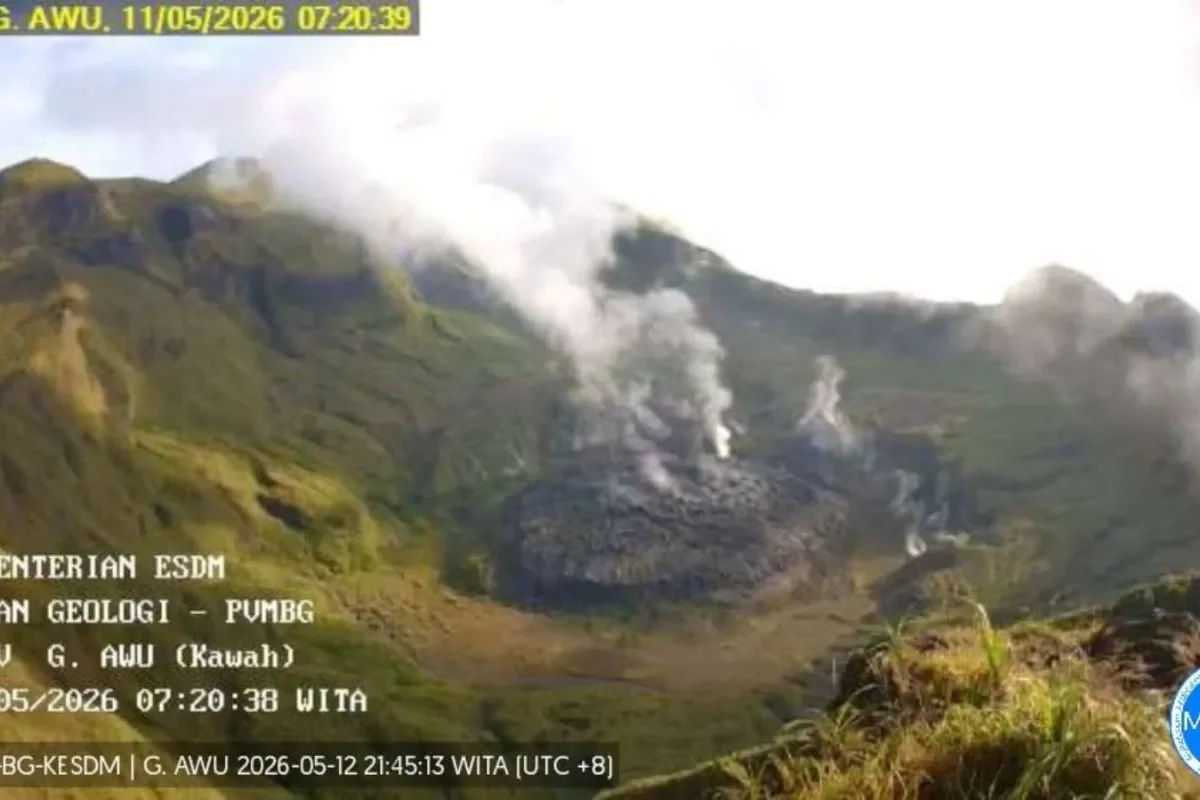
RRI.CO.ID, Manado - The Indonesian Ministry of Energy and Mineral Resources (ESDM) announced that shallow volcanic earthquakes at Mount Awu, located in the Sangihe Islands Regency, North Sulawesi, have surged to an average of 41 incidents per day during the observation period from May 16 to May 22, 2026.
This marks a notable escalation from the previous observation period, which recorded a daily average of 29 seismic events. The Acting Head of the Geological Agency, Lana Saria, confirmed the spike in a comprehensive activity evaluation report received in Manado.
"The current condition of shallow volcanic earthquakes has increased compared to the previous period, with the average number of incidents increasing from 29 incidents per day to 41 incidents per day," Lana Saria said, as quoted by Antara.
During this specific seven-day window, seismographs recorded a total of 291 shallow volcanic earthquakes (VB), 19 deep volcanic earthquakes (VA), one felt earthquake measuring at scale I MMI, and 191 distant tectonic earthquakes (TJ).
Despite the significant uptick in subsurface seismicity, visual observations of Mount Awu's crater have shown no major changes since early July 2024. Crater smoke emissions were not visible from the Awu Volcano Observation Post (PGA), indicating that gas and steam activities remain contained within the crater bowl and have not increased compared to prior weeks.
However, geologists warn that the underlying data tells a more dangerous story. A rapid succession of shallow and deep volcanic earthquakes, classified as a Spasmodic Burst, was heavily recorded on May 19, 2026. This phenomenon proves that ongoing magmatic activity within Mount Awu has caused a severe build-up of pressure at shallow depths, which threatens to compromise the volcano's existing lava dome.
Officials emphasize that sudden seismic swarms and an increase in low-frequency earthquakes must be closely monitored over the coming days. This danger is compounded by the fact that regional tectonic activity remains highly volatile across North Sulawesi and Maluku.
According to the Geological Agency, the primary hazards associated with Mount Awu include several critical threats to the surrounding area. First, explosive magmatic eruptions pose a severe danger, as they can violently eject incandescent material or generate deadly pyroclastic flows. Additionally, effusive magmatic eruptions present a risk by producing dangerous lava flows that pour down the volcano's slopes.
The region must also prepare for phreatic eruptions, which consist of sudden blasts dominated by volcanic gas steam and recycled materials from previous eruptions.
Furthermore, there is a distinct potential for lava dome destruction, meaning a collapse or blowout of the dome can occur if internal magmatic pressure continues to escalate significantly. Finally, toxic gas emissions remain a major concern, as the release of concentrated volcanic gases presents a lethal threat to human life if breathed in past safe threshold levels.
Following a thorough analysis of all seismic and visual data up to May 22, 2026, authorities have maintained Mount Awu’s activity status at Level III (Siaga/Alert). In response to the current threat matrix, the Ministry of Energy and Mineral Resources has issued strict safety recommendations for the public.
The state explicitly warns all residents, visitors, and tourists to stay away from the active hazard zone, mandating that no one enter or conduct any activities within a strict four-kilometer radius from the center of Mount Awu’s crater.
The public is urged to comply with all official emergency directives published by the Geological Agency through the Center for Volcanology and Geological Mitigation (PVMBG). Citizens are cautioned to remain calm, disregard unauthorized or irresponsible rumors regarding the volcano's activity and rely strictly on verified guidance from authorized agencies.
The Geological Agency will continue to closely coordinate its monitoring efforts with the National Disaster Management Agency (BNPB), the Meteorology, Climatology, and Geophysics Agency (BMKG), local administration, and other relevant ministries. ***
News Recomendation
Loading latest news.....