



BRIN Urges More Monitoring Toward Mount Anak Krakatau
- 17 Sep 2026 15:52 WIB
- Voice of Indonesia
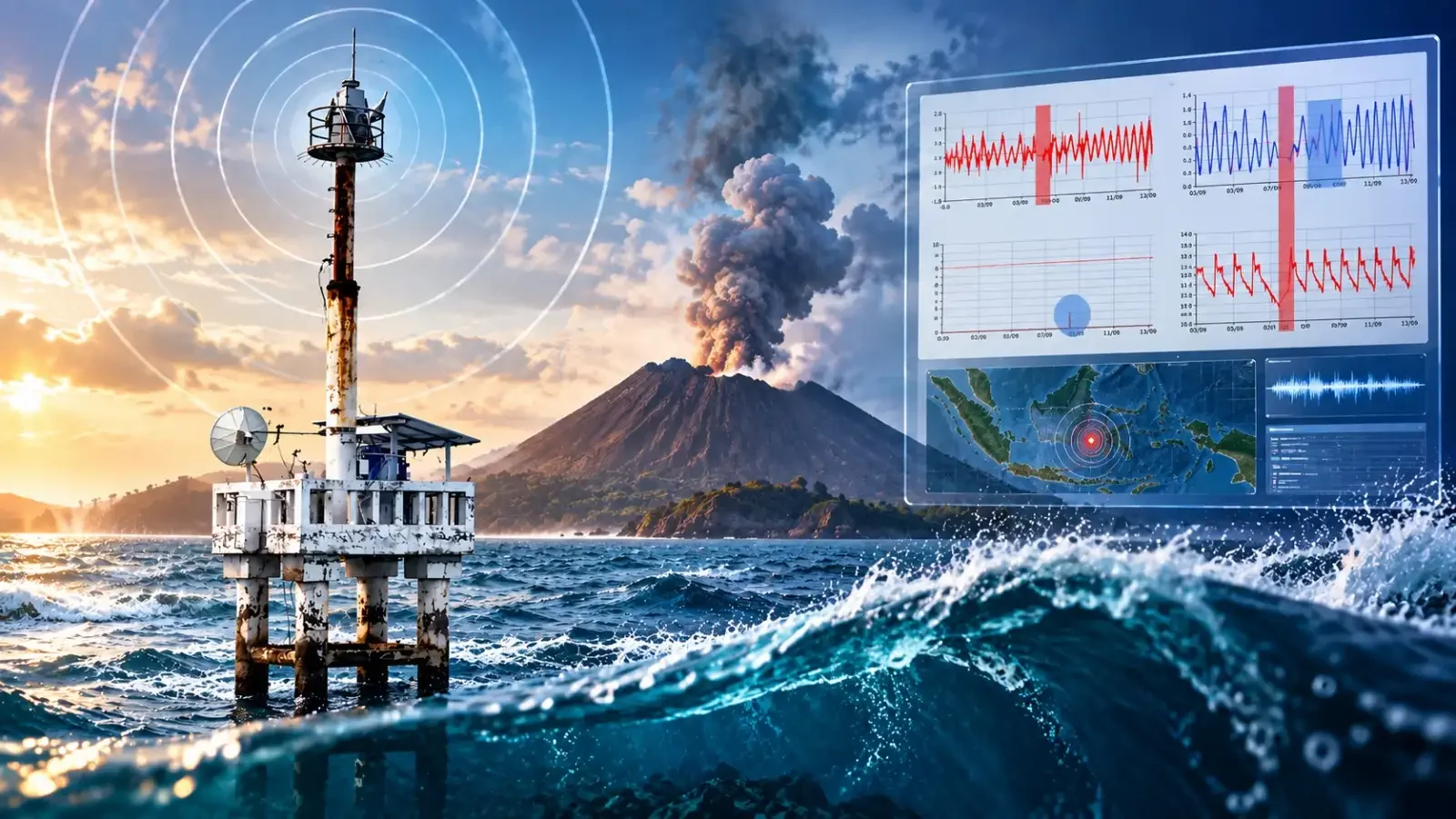
RRI.CO.ID, Bandung - The National Research and Innovation Agency (BRIN) has confirmed that the rise in volcanic activity of mount Anak Krakatau in the Sunda Strait since early September 2026 has not been accompanied by any sea level anomaly that would indicate a potential tsunami. The conclusion was drawn from monitoring using the Inexpensive Device for Sea Level Measurement (IDSL), locally known as PUMMA, installed around the volcano, including on Rakata Island and previously Panjang Island.
Senior Researcher at BRIN's Geological Disaster Research Center, Semeidi Husrin, shared the findings with the BRIN Public Relations Team on Wednesday, September 16. "Overall, during the period of increased activity at Anak Krakatau, we did not find any anomaly capable of triggering a tsunami wave," he said.
Even so, the monitoring work has faced technical obstacles in the field. Volcanic material produced during the heightened activity covered the solar panels and disrupted the power supply of the PUMMA devices, causing a data gap of about 11 hours on September 6, 2026.
Semeidi also revealed that on Monday, September 7, the same day a journalist lost contact in the area, his team detected an unusual reading. "We picked up something strange because there was an anomaly, but we confirmed it was not a tsunami," he added.
According to him, this situation shows that an early warning system cannot rely on sensor technology alone. It also needs strong supporting infrastructure, regular device maintenance, and an adequate backup system so that data collection remains uninterrupted.
One supporting tool considered essential is CCTV, which allows visual confirmation whenever a sensor detects an anomaly. However, the CCTV camera on Rakata Island has reportedly been inactive for more than a year and needs repair.
Semeidi also noted that the current number of PUMMA units, just one on Rakata Island, is not sufficient to support optimal monitoring of the area. He said the ideal setup would involve at least six units spread across Sertung, Panjang, and Rakata Islands to widen coverage and provide backup should any single sensor fail.
Strengthening the tsunami early warning system in the Sunda Strait, Semeidi added, also depends on cross sector collaboration, from device maintenance and data updates to refining standard operating procedures and coordinating among institutions. "It takes cooperation from many parties, local stakeholders, relevant ministries and agencies, international partners such as the JRC EC, and community groups like Balawista," he said.
For context, BRIN has contributed to strengthening early detection capacity through the development of IDSL/PUMMA technology, designed specifically to quickly capture changes or anomalies in sea level rather than simply measure tides. Because of this function, the device requires frequent data sampling intervals and a fast transmission system so that potential tsunamis can be detected as early as possible.
News Recomendation
Memuat berita terbaru.....