



Indonesia Trains Future BUMN Leaders to Navigate Global Challenges
- 21 Agt 2026 14:49 WIB
- Voice of Indonesia
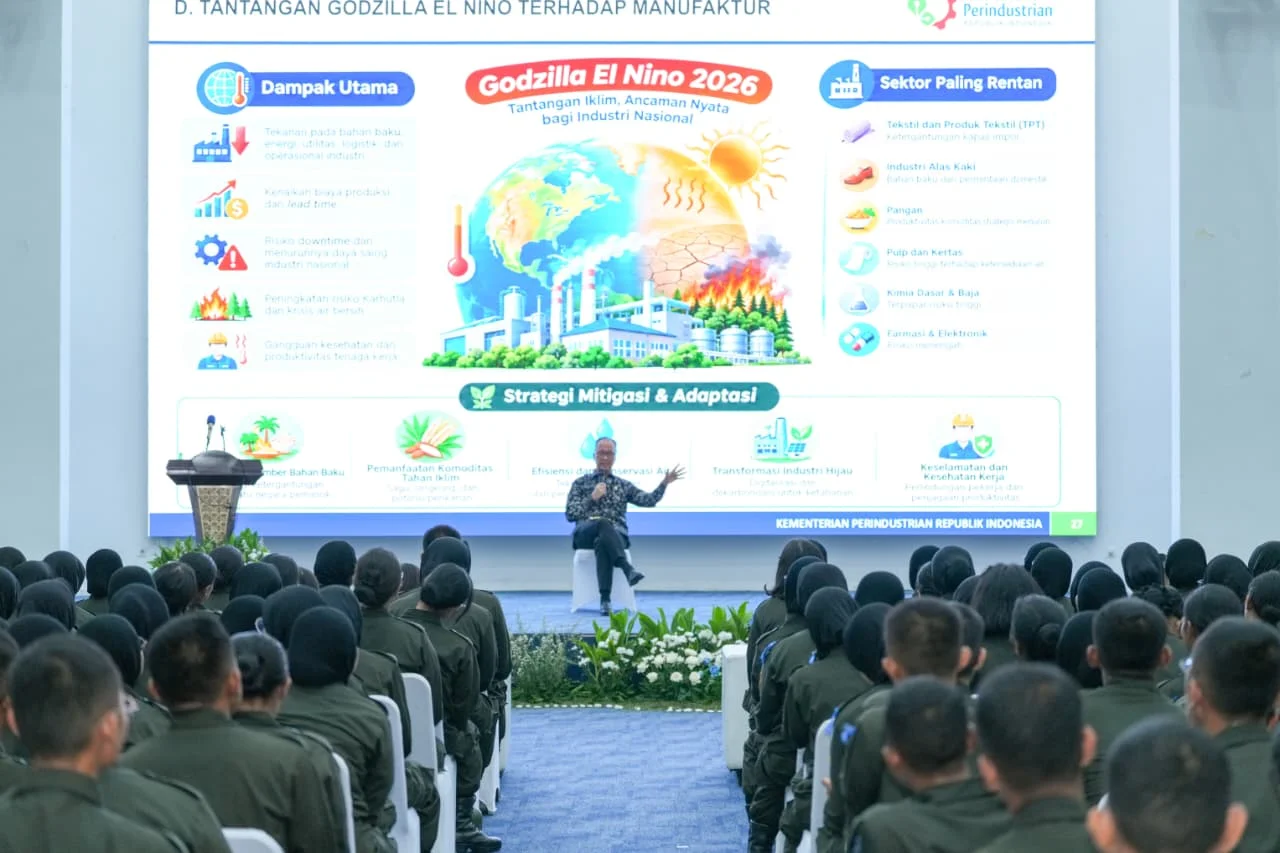
RRI.CO.ID, Jakarta - Minister of Industry, Agus Gumiwang Kartasasmita, emphasized President Prabowo Subianto’s strong commitment to substantively improving the governance of state-owned enterprises (SOEs) by developing reliable and patriotic human resources. He said the President’s Program for Future Leaders (P3MD) is an out-of-the-box initiative that demonstrates President Prabowo’s commitment to investing in SOE leadership development to address global challenges.
The Minister made the remarks while delivering a briefing for participants of the 2026 Batch 1 P3MD program for SOE employees at the Indonesian Armed Forces Training and Education Command (Kodiklat TNI) in Serpong on Wednesday, August 19, 2026.
He affirmed that prospective SOE leaders must be able to anticipate change and ensure that the businesses they manage remain relevant over the long term. This ability is increasingly important amid rapid geopolitical and geoeconomic shifts that can quickly reshape competition, supply chains, technology, and business models.
“When you return to your respective companies, there is a fundamental question that must be answered: Will our company’s business still be relevant five or ten years from now? This question must be a top priority because the world is changing faster and uncertainty is increasing,” Agus said.
The Minister added that a company’s large assets, workforce, capital strength, or past achievements do not automatically guarantee its future sustainability and competitiveness. Business history has shown that many major companies have lost their positions because they failed to anticipate change, held on to outdated assumptions for too long, and were slow to transform.
According to the Minister, these challenges are increasingly complex because SOEs occupy a strategic position in Indonesia’s economy and industrialization. SOEs are not merely state-owned business entities but also control key sectors such as infrastructure, energy, financing, logistics, minerals, telecommunications, construction, and food. Therefore, the quality of SOE leadership not only determines the future of individual companies but can also influence the direction of national economic development.
“In a rapidly changing world, size is not security. A company’s size is not a guarantee of security. Likewise, past success is not a guarantee of future relevance. Past success does not automatically guarantee a company’s relevance in the future,” he stressed.
The Minister explained that today’s business environment is vastly different from that of one or two decades ago. Geopolitical developments can change energy prices within days, conflicts between countries can disrupt global trade routes and supply chains, while trade wars can cause products that were previously competitive to suddenly lose market access.
At the same time, changes in interest rates can affect project feasibility, currency movements can alter cost structures, and technological developments, particularly artificial intelligence (AI), can transform work patterns, workforce requirements, cost structures, and even entire business models. The energy transition could also make assets that are highly valuable today less competitive in the years ahead.
Global regulatory changes concerning emissions, traceability, sustainability, labor standards, anti-bribery measures, cybersecurity, and data protection are also becoming increasingly important. These factors have become requirements for gaining access to markets, financing, and international partnerships.
“What makes the challenge even more difficult is that these risks do not come one at a time. Companies may face currency depreciation, rising energy prices and interest rates, declining demand, supply chain disruptions, cyberattacks, and regulatory changes simultaneously. This is what I call compound risks,” Agus said.
Therefore, the Minister stressed that past experience alone is no longer sufficient to deal with today’s business complexity. A business-as-usual mindset is also inadequate, as company leaders must be able to anticipate interconnected risks that can amplify one another’s impact.
News Recomendation
Memuat berita terbaru.....