



Exploring the Untamed Wilderness of Kutai National Park
- 15 Jun 2026 09:36 WIB
- Voice of Indonesia
Key Points
- Prevab Mentoko offers visitors the chance to observe endangered orangutans and other endemic wildlife in their natural habitat.
- Sampemarta Cave features underground rivers, limestone formations, and unique cave-dwelling species, making it a popular adventure tourism destination.
RRI.CO.ID, Kutai Timur - Exploring a conservation forest opens up a space for reflection on the grandeur of creation, which provides vital life sources for humanity alongside a rich biodiversity that must be protected to maintain planetary balance.
This reality becomes clear when traveling through Kutai Timur, East Kalimantan. Moving past the massive mining sites and industrial hubs that power the national economy, the region reveals a pristine natural heartbeat inside the dense boundaries of Kutai National Park (TNK).
To truly experience this conservation forest, one cannot rely on literature or digital maps alone. It requires firsthand immersion, breathing in the damp earth and navigating thick jungle trails.
The special-interest exploration of Kutai National Park is far from a standard vacation. Instead, it serves as an expedition to witness the true land ecosystem of Kalimantan. The journey targets two primary locations that offer distinct visual and emotional experiences, ranging from the active endemic wildlife of the Prevab Mentoko forest to the deep subterranean channels of the Sampemarta Cave.
The expedition begins with a trip down the Sangatta River aboard a ketinting, a traditional motorized wooden boat. As the boat cuts through the brownish water, urban civilization slowly fades into the background. The journey takes 30 minutes from Kabo Hamlet in Sangatta, passing quiet riverside villages and anchored wooden fishing boats.
As the vessel pushes further, the surroundings turn silent, leading to Prevab Mentoko, an ecological research forest and eco-tourism destination within the national park.
"Foreign tourists often explore this forest, coming from France to Belgium, just to research the endemic orangutan species," Head of the Kutai National Park Office, Syaiful Bahri, noted, as quoted by Antara.
"For conservation researchers and eco-tourism enthusiasts, Prevab is a delightful jungle charm. Here, the endemic wildlife of Kalimantan serves as the ultimate host, and humans are merely guests who must maintain proper etiquette," Syaiful emphasized
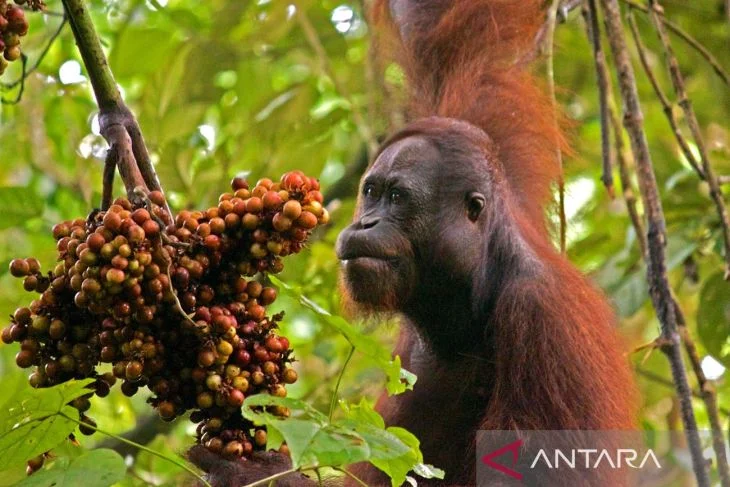
Spotting wildlife in Prevab requires sharp vision and attentive listening. High up in the towering meranti tree canopies, the East Kalimantan orangutan (Pongo pygmaeus morio) serves as the main highlight for visitors. This subspecies is currently classified as Critically Endangered, making the lowlands of Prevab and Sangkima critical strongholds for their survival.
Beyond the great apes, the Prevab jungle supports an array of wildlife. Visitors can spot wild boars digging through damp leaf litter, sambar deer moving cautiously through the brush, long-tailed macaques creating small disturbances in the branches, and river crocodiles sunbathing along the muddy banks. At night, the forest hosts night safaris where travelers can observe tarantulas, tarsiers, and roosting birds.
Despite its remote setting, Prevab offers adequate facilities for eco-tourists. The site features well-maintained lodging structures built entirely from durable ironwood (ulin), designed to blend seamlessly into the forest environment. The accommodations provide a safe haven for visitors to rest after long treks, alongside dedicated grounds for camping.
The next morning, the expedition shifts toward Martadinata Village, located roughly 30 minutes by car from the initial park staging point. While the previous day focused on tree canopies, this leg of the journey demands a different kind of endurance as visitors descend into the Sampemarta Cave.
The surrounding landscape features distinct karst topography, complete with underground rivers that disappear directly into the limestone foundations. Unlike a casual river boat ride, caving in Sampemarta is a challenging adventure. The deep darkness and ancient rock structures require strict adherence to safety protocols.
Because of the technical terrain, the park mandates a strict accompaniment policy using local guides from the Martadinata Village Tourism Awareness Group (Pokdarwis), alongside technical support teams from Bontang Satria Punggawa. Every participant must wear standard caving safety gear, including protective helmets, specialized footwear, and reliable headlamps.
Entering the mouth of the cave feels like stepping through a portal in time. The air temperature drops instantly, replaced by a cool, humid mist. Visitors move in a single-file line, navigating the interior with extreme caution for 15 to 20 minutes.
Inside the earth, beneath a cave ceiling rising roughly four meters high, flashlight beams illuminate a geological art gallery. The lights reflect off hanging stalactites and rising stalagmites, formed over thousands of years by mineral-rich water droplets.
The cave system remains a highly active ecosystem. A massive colony of bats packs the upper ceilings, while large freshwater eels glide through pools on the cave floor.
Sampemarta Cave has become home to various unique species such as bats, cave crickets, spiders, and cave moss that have adapted to life in eternal darkness," Syaiful Bahri explained.
Emerging back into the midday sun provides a deep sense of accomplishment. The journey through Prevab Mentoko and Sampemarta Cave offers more than just a physical challenge; it serves as a lesson in patience and teamwork, reminding visitors of the importance of protecting the ancient natural systems that support life on Earth. ***
News Recomendation
Loading latest news.....