



ITB Students Create AI Tool to Bridge Deaf Communication
- 11 Agt 2026 21:27 WIB
- Voice of Indonesia
Key Points
- ITB students developed SignWave, an AI device bridging classroom communication for deaf and mute learners.
- SignWave translates speech to text and sign language to voice, enabling inclusive, low‑latency interaction in schools.
- SignWave operates on local hardware to provide offline functionality for schools in Indonesia's remote 3T regions.
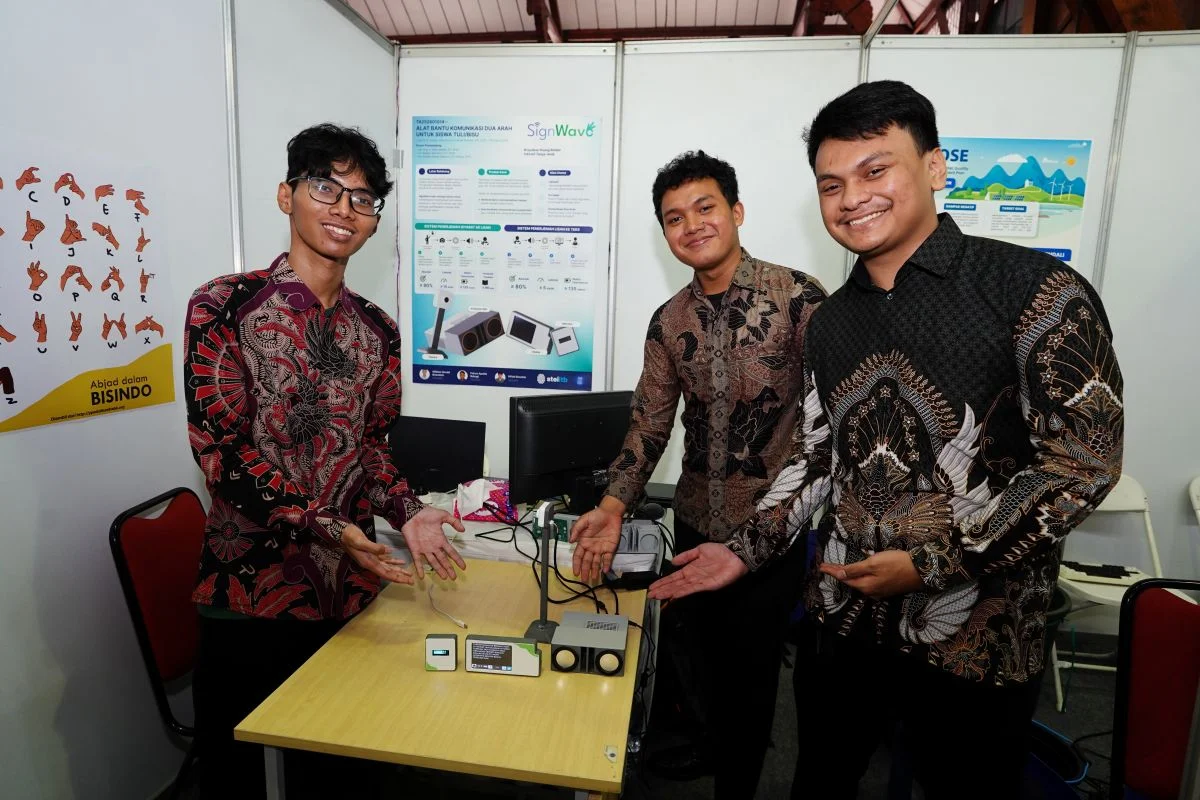
RRI.CO.ID, Bandung – Three electrical engineering students at Bandung Institute of Technology (ITB) have developed SignWave, an AI‑powered device designed to break classroom communication barriers for deaf and mute students by translating speech into text and sign language into voice.
SignWave was created by William Gerald Briandelo, Fairuz Apiulla Rahagi, and Hifzhi Dinullah, students of ITB’s School of Electrical Engineering and Informatics, as part of their Capstone Design project showcased at EE Days 2026.
The innovation addresses limited access to inclusive education, particularly in regions lacking special schools or reliable internet.
By processing data locally on embedded devices, SignWave operates with low latency and without dependence on fast connectivity, making it suitable for remote schools in Indonesia’s 3T areas (frontier, outermost, and disadvantaged regions).
Inspired by the challenges faced by a deaf student at ITB who relied on lip‑reading and handwritten notes, the team designed SignWave to enable natural, two‑way classroom interaction.
The system integrates two core functions: sign‑to‑speech translation, where gestures captured by a camera are converted into voice, and speech‑to‑text translation, where spoken words are transcribed for display on a screen.
“The process of lip‑reading and writing manually on paper was very difficult and time‑consuming. SignWave is here to close that gap so classroom interaction can flow naturally and smoothly,” Hifzhi Dinullah said recently, as quoted on ITB's official website on Sunday, August 9, 2026.
Initial tests show at least 80 percent accuracy, latency of 5-10 seconds, and operational time of 135 minutes. The system currently recognizes 86 sign language terms, with users able to add new vocabulary. Beyond basic communication, SignWave has been tested to interpret technical subjects, from algebra to electrical engineering concepts.
Compact and portable, the device combines a camera, minicomputer, screen, and microphone. The team emphasized three guiding values: inclusivity, portability, and two‑way communication--ensuring equal classroom participation and more natural exchanges between teachers and students. ***
News Recomendation
Loading latest news.....