



Australia–Indonesia Dialogue Explores AI Beyond Technology
- 22 Jul 2026 14:05 WIB
- Voice of Indonesia
Key Points
- FISIPOL UGM and the University of Melbourne hosted the 6th Australia-Indonesia in Conversation (AIC) 2026 to discuss AI ethics.
- UGM Dean Wawan Mas'udi and Melbourne's Edwin Jurriëns highlighted the strategic decade-long partnership between both institutions.
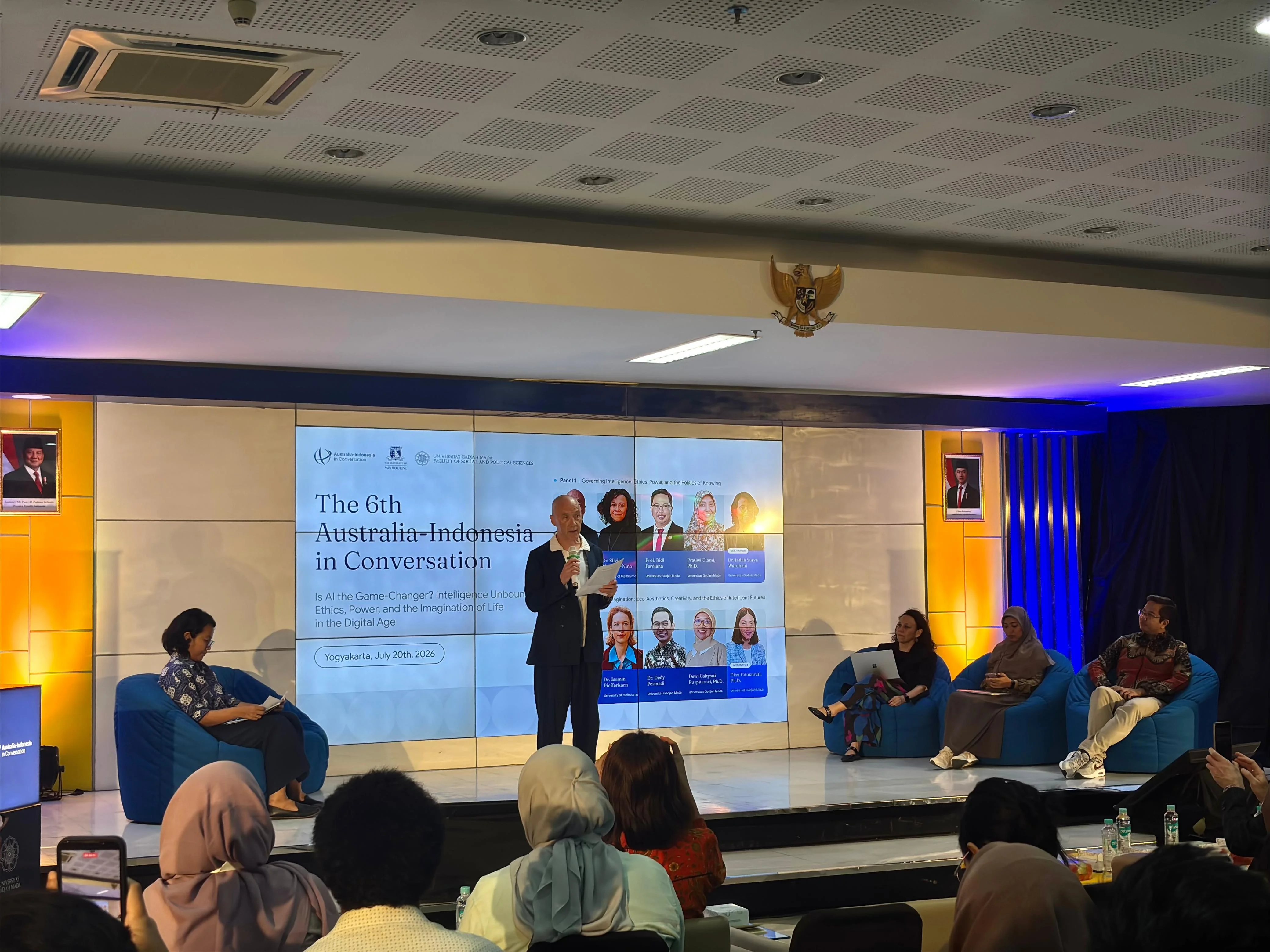
RRI.CO.ID, Yogyakarta - The 6th Australia-Indonesia in Conversation (AIC) 2026, hosted by Gadjah Mada University's Faculty of Social and Political Sciences (FISIPOL UGM) and the University of Melbourne's Faculty of Arts, placed artificial intelligence at the center of a dialogue that looked beyond technology.
With the theme “Is AI the Game-Changer? Intelligence Unbound: Ethics, Power, and the Imagination of Life in the Digital Age,” the forum examined AI through ethics, governance, creativity, and ecological sustainability, bringing together scholars and practitioners from both countries.
Dean of FISIPOL UGM, Wawan Mas'udi, emphasized the depth of collaboration between the two institutions. “The relationship between the University of Melbourne and UGM has lasted for more than 10 years and covers almost all aspects of the Tri Dharma Perguruan Tinggi, from joint and double degree programs to exchanges and collaborative research,” he told the media earlier this week.
Wawan underlined that UGM and the University of Melbourne are strategic partners and founding members of the Global Humanities Alliance (GHA). “Together with six other universities across continents, we are building a network that strengthens humanities, social sciences, human rights, and the decolonization of knowledge,” he explained.
The other six universities include Ashoka University (India), Mahidol University (Thailand), Pontificia Universidad Católica de Chile (Chile), The University of Manchester (UK), University of Nairobi (Kenya), and University of Toronto (Canada).
The Dean also stressed that AI presents challenges not only for UGM but for universities worldwide. “This is a challenge not just for UGM, but for all universities in Indonesia and globally as we prepare students and alumni to face AI’s development," he said.
"AI must be seen as a tool, but we also need to instill ethical foundations so that technology does not replace humanity,” he added, explaining that his faculty has begun integrating AI and Big Data analytics into teaching while emphasizing human-centered values.
Edwin Jurriëns of The University of Melbourne highlighted that the partnership extends beyond education and research into sustained public engagement. He stressed that the challenge today is not whether machines can think, but whether societies can critically reflect on AI and use it responsibly in shaping the future of human relations and social life.
He said that the AIC forum serves as a bridge between different contexts of AI use in Indonesia and Australia. “In Conversation means we try to navigate differences, exchange knowledge, and inspire each other across social, political, economic, and cultural landscapes,” Edwin said, reaffirming the forum’s role in fostering dialogue and shared understanding.
Edwin also highlighted that AI must be understood in the context of historical power relations and resource exploitation. “Without ecological and ethical awareness, AI risks becoming a new instrument that reinforces global inequality,” he warned, while emphasizing that technology should expand human creativity rather than replace it.
Through AIC 2026, FISIPOL UGM and the University of Melbourne reaffirmed their role as strategic partners and founding members of the Global Humanities Alliance. The discussions underscored that the future of AI depends not only on computational advances but also on humanity’s ability to uphold ethics, justice, imagination, and sustainability in shaping intelligent futures. ***
News Recomendation
Loading latest news.....