



Purwokerto Students Develop Solar-Powered Electric "E-Cak" Rickshaw
- 25 Apr 2026 18:47 WIB
- Voice of Indonesia
Key Points
- Students from Putera Harapan (Puhua) 3 Language High School in Purwokerto developed "E-Cak," an electric rickshaw that integrates solar energy with traditional transport.
- The project aims to modernize the iconic rickshaw to prevent it from becoming obsolete due to rapid technological advancements in the transportation sector.
- The vehicle uses a 48-volt battery system supplemented by solar panels, which serve as an eco-friendly auxiliary charging method.
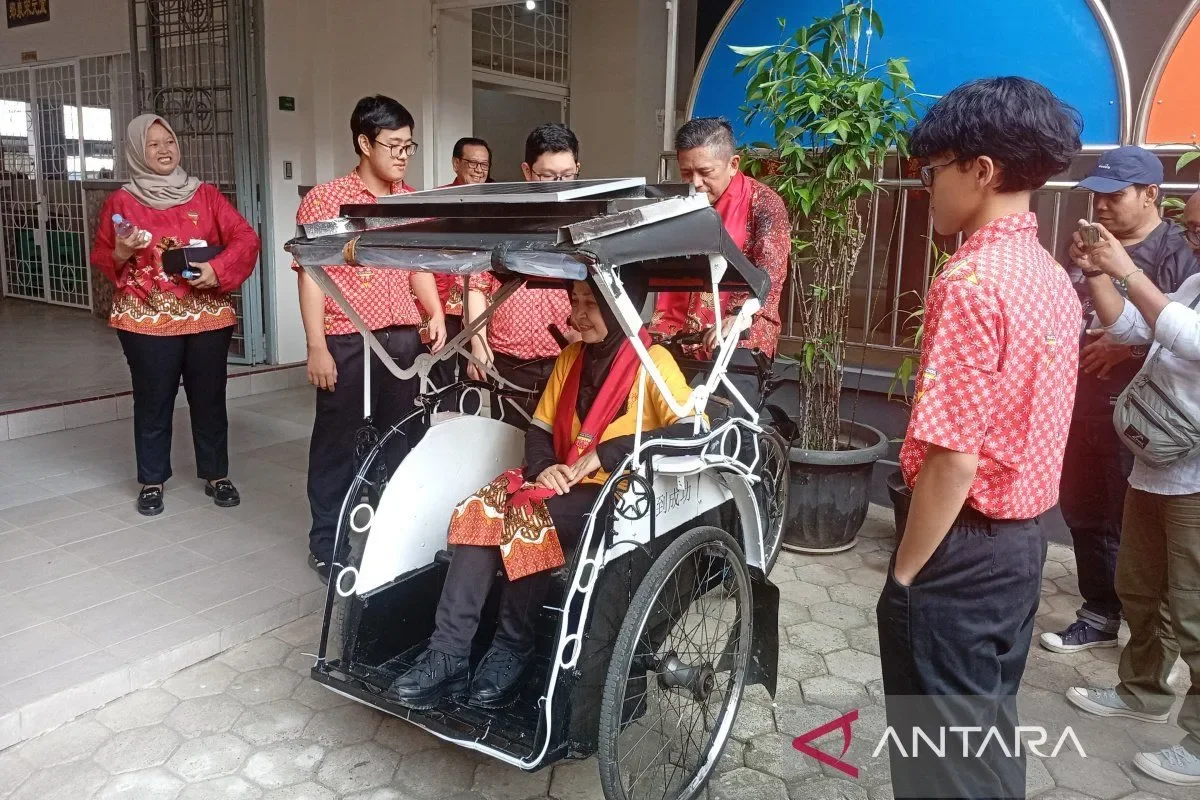
RRI.CO.ID, Purwokerto - High school students in Purwokerto, Central Java are breathing new life into traditional transportation by integrating renewable energy with local heritage.
A team of six students from Putera Harapan (Puhua) 3 Language High School has successfully developed "E-Cak," an innovative electric rickshaw powered by solar energy, designed to keep the iconic rickshaw relevant in a rapidly evolving technological landscape.
The prototype was officially unveiled during the National Forum of 3-Language Schools at Puhua School on Saturday, April 25, 2026. Lead innovator Joseph Jefferson Setyako explained that the project was born out of concern for the declining presence of traditional rickshaws.
"This innovation is a way to answer the challenges of the times, as technological developments risk leaving traditional rickshaws behind. Therefore, we developed a rickshaw based on electricity and solar energy," said Joseph during the event, as quoted by Antara.
To ensure the project remained cost-effective, the team utilized repurposed materials and accessible components. Each unit costs between IDR 3 million (USD 173.37) and IDR 4 million (USD 231.16) to produce.
The students sourced used rickshaw frames for approximately IDR 600,000 (USD 34.78) and equipped them with a motor dynamo of similar value. While the primary power source consists of four lead-acid batteries providing 48 volts, the team integrated solar panels as a sustainable supplementary charging method.
Joseph noted the practical trade-offs made during development. "There is an option for lithium batteries, but due to cost constraints, we chose more affordable lead-acid batteries."
The E-Cak demonstrates impressive utility for its budget, capable of carrying a 150-kilogram load at speeds of up to 40 kilometers per hour. A full charge provides a range of 10 to 15 kilometers, with the solar panels serving to extend efficiency and promote eco-friendly operation.
While a standard electrical outlet charges the vehicle in six hours, the solar panels can reach an 80% charge in about 10 hours, depending on sunlight intensity. Notably, the vehicle retains its traditional pedals, allowing it to be operated manually if the battery is depleted.
The development process was a rigorous month-long endeavor conducted after school hours, where the students utilized Artificial Intelligence (AI) to assist in research and design phases.
However, the team maintained a hands-on approach for all physical testing and assembly. Through this project, the young innovators hope to offer a viable model for modernizing traditional Indonesian vehicles while contributing to the nation's broader goals for green transportation. ***
News Recomendation
Loading latest news.....