


BRIN Develops Decentralized AI to Secure Indonesia's Food
- 11 Mar 2026 18:47 WIB
- Voice of Indonesia
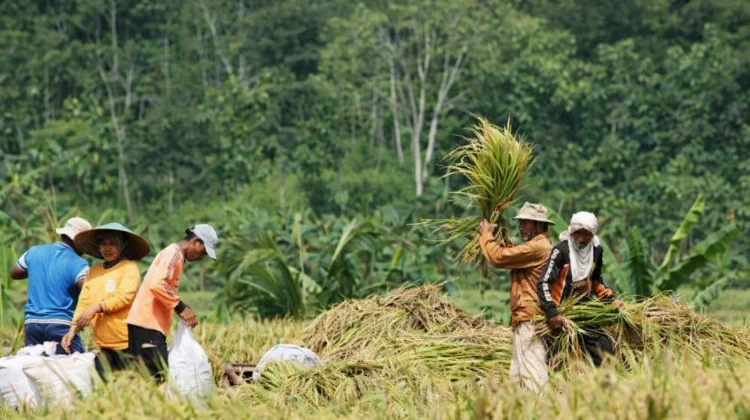
RRI.CO.ID, Jakarta - The National Innovation and Research Agency (BRIN) is developing a decentralized artificial intelligence framework to strengthen Indonesia’s food security. The initiative is designed to address challenges posed by climate variability and land-use changes.
The agency’s Data Science and Information Research Center (PRSDI) is moving away from costly, manual field surveys and is building a high-tech agricultural management system to stabilize national rice production through precision monitoring.
“The integration of multi-dimensional data and AI-based federated learning technology opens up opportunities to build a more adaptive, collaborative, and data-driven agricultural system,” said Head of PRSDI BRIN, Esa Prakasa, during a virtual discussion in Jakarta on Tuesday, March 10, 2026, as quoted by Antara.
He explained that the innovation supports rapid and accurate decision-making while reinforcing the long-term sustainability of the nation’s food supply.
Central to the initiative is the automation of rice phenology monitoring, which tracks crop life cycles from planting and vegetative growth to reproduction and harvest.
Conventional methods often face limited spatial coverage and high operational costs, while BRIN’s approach uses remote sensing technology. By analyzing optical and radar satellite imagery, including vegetation indices (NDVI) and radar polarization (VV, VH), the system can automatically classify crop growth stages in real time.
To address data privacy and logistical challenges, BRIN is applying Federated Learning (FL), a distributed machine learning paradigm.
This “bringing the code to the data” approach enables farmers, government agencies, and research institutions to train AI models collaboratively without centralizing or sharing sensitive raw data. The decentralized method ensures local data security while contributing to a national intelligence network.
Esa said the technology has potential across Indonesia’s diverse agricultural regions, offering localized yet unified oversight.
“When combined with multi-dimensional data and GeoAI tool algorithms, this approach has the potential to produce a more adaptive rice phenology modeling system. This system is expected to be a scalable and participatory solution for various agricultural regions in Indonesia,” he said. ***