


Indonesia Expands Role in International Lunar Observatory Project
- 11 Mar 2026 11:16 WIB
- Voice of Indonesia
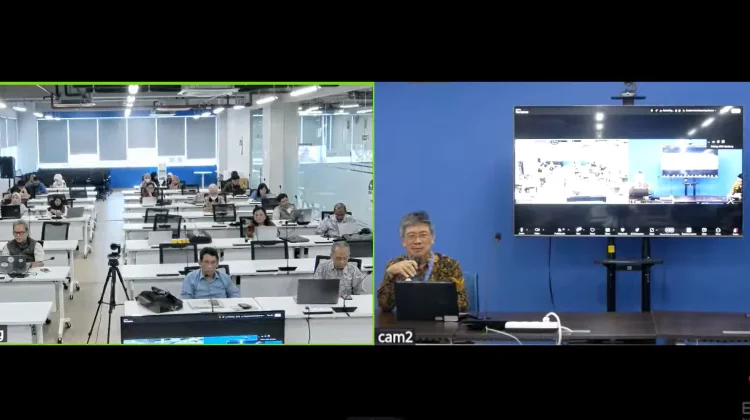
RRI.CO.ID, Bandung - Indonesia is exploring a larger role in an international effort to build astronomical observatories on the Moon. Researchers from Indonesian institutions, including scientists linked to the International Lunar Observatory Association (ILOA), discussed ways to expand the country’s involvement in lunar science missions.
It was held during a virtual colloquium held by the National Research and Innovation Agency’s (BRIN) Space Research Center on March 10, 2026. The event, titled “International Lunar Observatory Association Missions to the Moon,” focused on opportunities for Indonesia to contribute to future missions, particularly those targeting the Moon’s south pole.
The lunar observatory project aims to place small telescopes and cameras on the Moon to observe the universe from a location with minimal atmospheric interference. One of the planned landing areas is Malapert Mountain, a high ridge near the edge of the Shackleton Crater.
Scientist from Indonesia’s Astronomy Study Group, Chatief Kunjaya, who is also linked to ILOA, said the site offers major advantages for long-term observation and communication with Earth. “Malapert Mountain receives sunlight about 90 percent of the time. In a 24-hour period it gets around 22 hours of sunlight,” he explained during a research discussion. “The peak is also continuously visible from Earth, allowing uninterrupted communication.”
He continued by stating that such conditions are critical for lunar instruments that rely on solar energy and constant data transmission. Nearby permanently shadowed craters could also contain frozen water deposits, making the region strategically important for future human exploration.
“In areas near the South Pole that never receive sunlight, there may be deposits of frozen water,” the scientist said. “That water could eventually be used as drinking water for astronauts or even broken down into hydrogen and oxygen to produce fuel.”
Kunjaya also stated that expanding participation in lunar programs could open the door for Indonesia to move beyond Earth-orbiting satellites toward deeper space missions.
“For near-Earth space, the agency's LAPAN has already carried out activities, including launching satellites into low Earth orbit,” he said. “But for deep space exploration such as missions to the Moon or asteroids, and by participating in the ILOA program we can gain many opportunities to learn.”
Beyond scientific discovery, Kunjaya said lunar exploration could also help inspire younger generations to pursue careers in science and technology. He encouraged Indonesia to pursue the advancement in moon research, stating “the Moon has great potential. If we don't get involved now, we will be left behind.”
The colloquium highlighted the roles of the International Lunar Observatory Association (ILOA) and Indonesian National Institute of Aeronautics and Space (INASA) in advancing space research. ILOA is an international organization that promotes astronomical observations from the Moon through collaborative missions involving scientists and institutions worldwide.
Meanwhile, INASA serves as Indonesia’s national platform to coordinate space activities and collaboration among government agencies, research institutions, and universities, including initiatives discussed in the forum.