



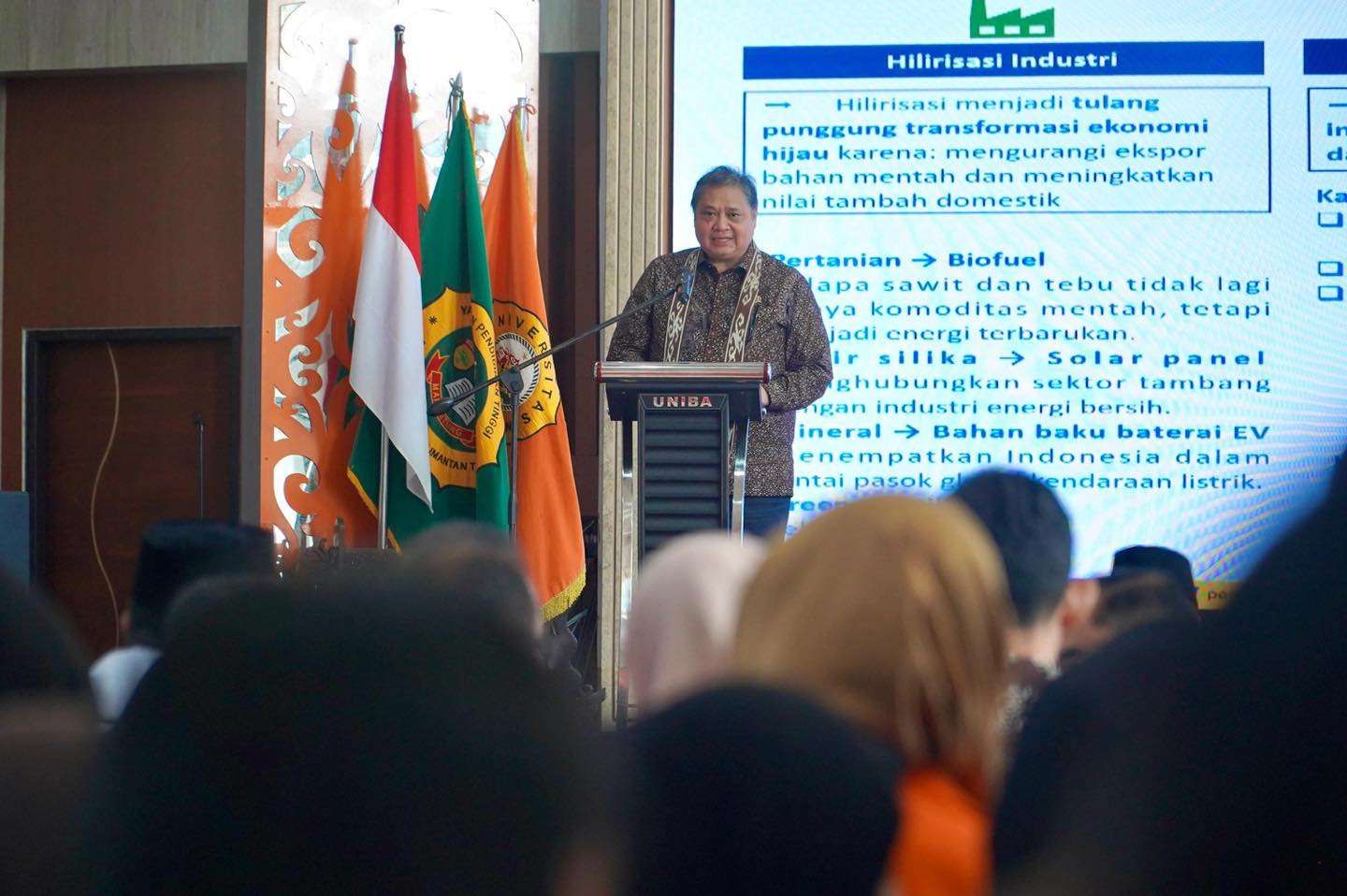
RRI.CO.ID, Balikpapan - Coordinating Minister for Economic Affairs, Airlangga Hartarto, revealed that the Government continues to push the green transition as part of a national strategy to strengthen national self-reliance and enhance economic competitiveness. It is in line with the Asta Cita vision.
He made the statement at the National Seminar on a Just Energy Transition and Opportunities for Green Jobs and the Green Economy in East Kalimantan and Indonesia at the University of Balikpapan on Tuesday, 27 January 2026.
According to him, this commitment is also aligned with Indonesia’s target to reduce greenhouse gas emissions under its Nationally Determined Contribution (NDC) by 31.89 percent by 2030 through independent efforts, and up to 43.20 percent with international support. The transformation toward a green economy is being implemented through three main pillars: the development of Green Energy, the strengthening of the Green Economy, and the creation of Green Jobs, to ensure that the transition is inclusive, equitable, and delivers tangible benefits to society.
However, to achieve this ambition, a solid macroeconomic foundation is required to ensure the transformation can proceed sustainably.
“Such a major ambition certainly requires a solid macroeconomic foundation so that this transformation can proceed sustainably,” Airlangga Hartarto, stated.
Furthermore, Airlangga added that accelerating the energy transition is a concrete step for Indonesia toward energy sovereignty while simultaneously creating new sources of clean and sustainable economic growth. With its abundant natural resources, Indonesia has renewable energy potential of up to 3,686 GW, with Kalimantan contributing around 517 GW.
He explained that to optimize this potential, the government is encouraging the development of a green super grid spanning approximately 70,000 kilometres, the expansion of B40–B50 biofuels, and the use of environmentally friendly aviation fuels.
In addition, the utilization of hydrogen, nuclear energy, green ammonia, and Carbon Capture and Storage/Carbon Capture, Utilization, and Storage (CCS/CCUS) technologies continues to be developed to reduce emissions from the industrial sector.
News Recomendation
Loading latest news.....