



Indonesia Leads Regional Training on Food Security Innovation
- 20 Apr 2026 09:43 WIB
- Voice of Indonesia
Key Points
- Indonesia, through BRIN, is leading regional efforts to tackle malnutrition by hosting international training on nuclear-based crop innovation and research collaboration.
- The program brings together scientists from 13 countries to develop nutrient-rich, climate-resilient crops using advanced techniques like mutation breeding and biofortification.
- This initiative strengthens Indonesia’s role in global food security by combining science diplomacy, international partnerships, and sustainable agricultural innovation.
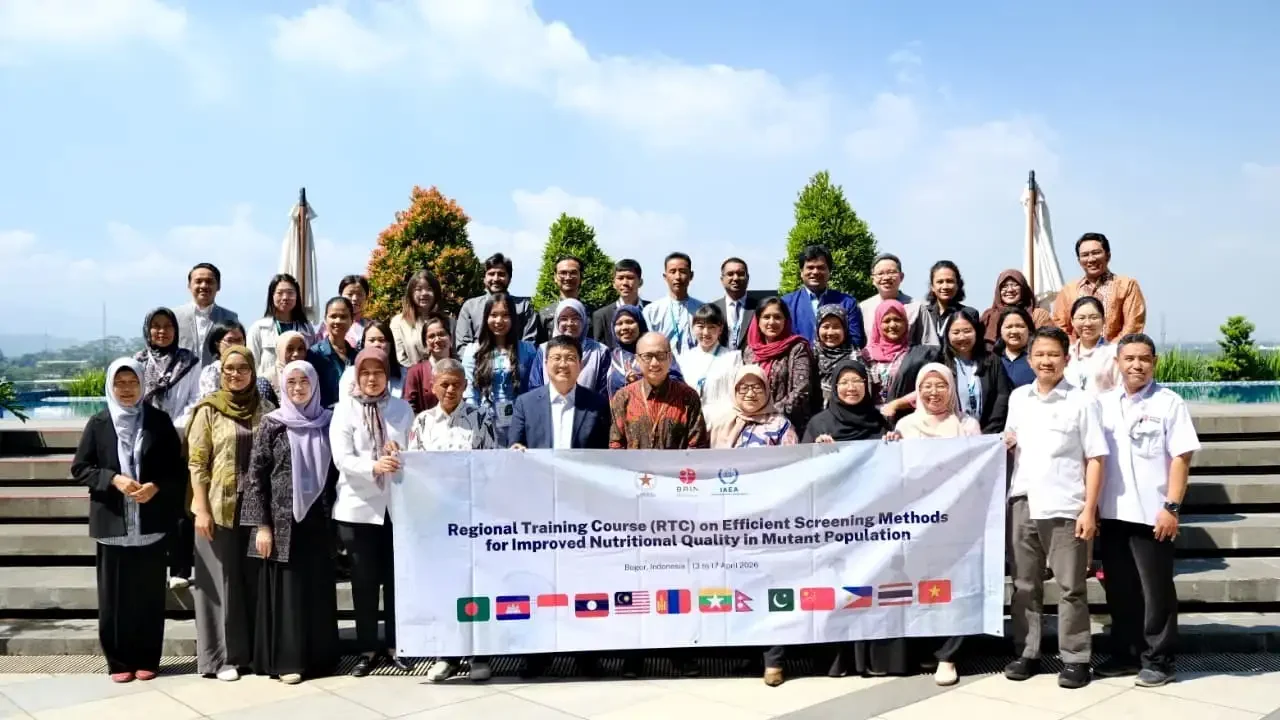
RRI.CO.ID, Jakarta - The National Research and Innovation Agency (BRIN) is strengthening Indonesia’s contribution to global food security challenges through the Regional Training Course (RTC) Efficient Screening Methods for Improved Nutritional Quality in Mutant Populations, held on April 13-17, 2026, in Cibinong, West Java. The initiative aims to enhance research capacity across the Asia-Pacific region to address malnutrition and long-term food crises.
The international training was organized in collaboration with the International Atomic Energy Agency and Indonesian Ministry of State Secretariat under the South-South and Triangular Cooperation (SSTC) framework. A total of 25 participants from 13 member countries of the Regional Cooperative Agreement (RCA) took part, strengthening regional research networks.
BRIN Deputy for Human Resources in Science and Technology, Edy Giri Rachman Putra, emphasized that the world is facing major challenges, including hunger, malnutrition, and limited access to nutritious food, which affect billions of people globally. “We are at a critical point in history, where hunger, malnutrition, and access to nutritious food continue to impact billions,” he said, as quoted on BRIN's official website.
He added that BRIN is committed to supporting national development goals and the Sustainable Development Goals (SDGs) by strengthening an open research ecosystem through collaboration, infrastructure, funding, and researcher mobility across countries.
This approach highlights science diplomacy as a key instrument in strengthening Indonesia’s global position. “BRIN not only focuses on research and innovation but is also open to collaboration through infrastructure support, funding, and researcher mobility, including students,” he continued.
Acting Director of Competency Development at BRIN, Rahma Lina, noted that the training serves not only as knowledge transfer but also as a platform to build professional networks among researchers, opening long-term collaboration opportunities in developing climate-resilient, nutrient-rich crops. “This is a valuable opportunity to strengthen professional networks that can lead to future collaborations,” she said.
From a policy perspective, Head of the International Technical Cooperation Bureau at the Ministry of State Secretariat, Noviyanti, highlighted climate change and biodiversity loss as major threats to global food security. She stressed the importance of addressing “hidden hunger”, or micronutrient deficiency, through cross-sector innovation.
According to her, nuclear technology using mutation biofortification offers a promising solution to improve the nutritional quality of crops. “Through South-South and Triangular Cooperation with BRIN and IAEA, Indonesia is committed to strengthening research and sharing knowledge to develop more nutritious, adaptive, and sustainable crops,” she said.
Executive Director of International Nuclear Agency Indonesia, Dimas Irawan, described the training as an important step in enhancing human resource capacity in the food and agriculture sector across the Asia-Pacific region. “Going forward, we hope this collaboration continues, not only in human resource development but also in creating new technologies to support regional food security,” he said.
Technically, the training combines theory and practice in mutation breeding and biofortification, covering molecular-assisted selection, RNA-seq analysis, multi-omics approaches, and phenotypic, biochemical, and molecular screening methods. Participants also studied case examples of rice and cassava biofortification in Indonesia.
Through this initiative, BRIN reinforces its role in the global research ecosystem, particularly in applying nuclear technology for sustainable agriculture, contributing to a healthier, more inclusive, and sustainable global food future. ***
News Recomendation
Loading latest news.....