



Investigation Begins After Two Whale Sharks Strand in Cilacap
- 02 Jun 2026 15:13 WIB
- Voice of Indonesia
Key Points
- Two whale sharks stranded along the Cilacap coast within one week, prompting a multi-agency environmental investigation.
- Necropsy findings revealed propeller injuries, plastic ingestion, and possible signs of chemical or environmental poisoning.
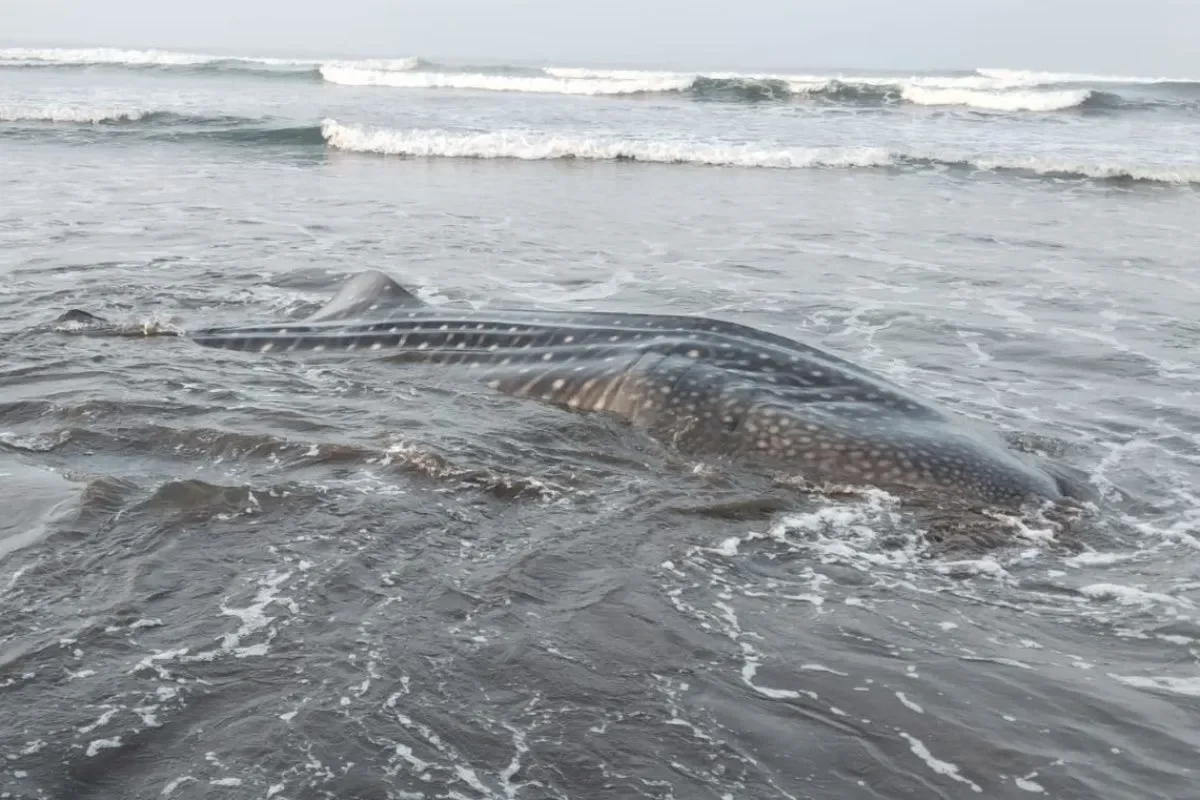
RRI.CO.ID, Cilacap - A joint task force consisting of multiple government agencies, marine conservationists, and academic experts has launched an investigation to determine the exact cause behind the strandings of two whale sharks (Rhincodon typus) along the coast of Cilacap Regency, Central Java. The two marine giants washed ashore within a mere seven days of each other in May 2026, triggering deep ecological concerns.
The first incident was recorded on May 17, 2026, when a whale shark measuring approximately four meters in length stranded on the coastline. Just days later, on May 23, 2026, at around 5.30 a.m. local time, a second whale shark, measuring roughly eight meters, was discovered stranded at Banjarsari Beach, Nusawungu Subdistrict. The two stranding locations sit along the exact same coastline, separated by a distance of only about six kilometers.
Darmawan, an official from the Semarang Working Area of the Pontianak Marine Resources Management Balai, highlighted that consecutive beaching events are an ongoing challenge for the region.
"If we look back, whale shark strandings in Cilacap Regency are quite frequent. In fact, a series of strandings like this also occurred in 2022, specifically on October 5, 12, and 31, followed by another on November 5, 2022," he said, as quoted by Antara.
The response and evacuation of the massive marine creatures required the activation of the Cilacap Regency Stranded Marine Biota Handling Network.
The extensive coalition brought together the Cilacap Fisheries Agency, the Cilacap Marine and Fisheries Resources Surveillance (PSDKP), the Pontianak Marine Resources Management Balai, the Indonesian Navy (TNI AL), the National Police (Polri), local veterinarians, researchers from Jenderal Soedirman University (Unsoed) Purwokerto, conservation volunteers, and local residents. Due to the immense size of the animals, the team had to deploy heavy machinery, including an excavator, to safely move the carcasses.
Head of the Cilacap Regency Fisheries Agency, Indarto, emphasized that managing large-scale stranded marine biota demands swift, cross-institutional coordination to ensure all operations are executed safely and accurately. After a rigorous two-hour evacuation process, the team successfully secured the carcasses to a safe location, allowing veterinarians and conservationists to immediately perform a detailed necropsy.
The examination of the second whale shark confirmed it was a male, measuring 8.36 meters in length with a girth of approximately 3.71 meters. The medical team discovered five distinct slash wounds across its body, which are strongly suspected to have been caused by ship propellers. Furthermore, the necropsy revealed foreign plastic debris lodged inside the shark's stomach, alongside an undigested mass of small anchovies within its digestive tract.
While physical trauma and pollution were clearly evident, researchers believe the underlying cause of death may point to an environmental contaminant. Dwi Suprapti, a Marine Megafauna Specialist from the Sealife Indonesia Foundation, said that the field observations and initial necropsy data strongly point toward acute intoxication as the primary catalyst for the whale sharks' demise.
To verify this hypothesis, scientists have harvested and dispatched samples of the animals' internal organs, stomach contents, and surrounding seawater to specialized laboratories. These samples will undergo histopathological testing, chemical contamination screening, and heavy metal analysis. Concurrently, the findings have prompted academics from Unsoed to initiate broader oceanographic and water quality studies along the Cilacap coast to evaluate the health of the local marine environment.
The whale shark holds the title of the largest fish species in the world and has been granted full protected status under Indonesian law since 2013. Internationally, the species remains highly vulnerable, sitting firmly on the Red List of the International Union for Conservation of Nature (IUCN) due to its globally endangered population. ***
News Recomendation
Loading latest news.....