



Libraries: Trusted Guardians of Information in the Era of Artificial Intelligence
- 05 Agt 2026 13:42 WIB
- Voice of Indonesia
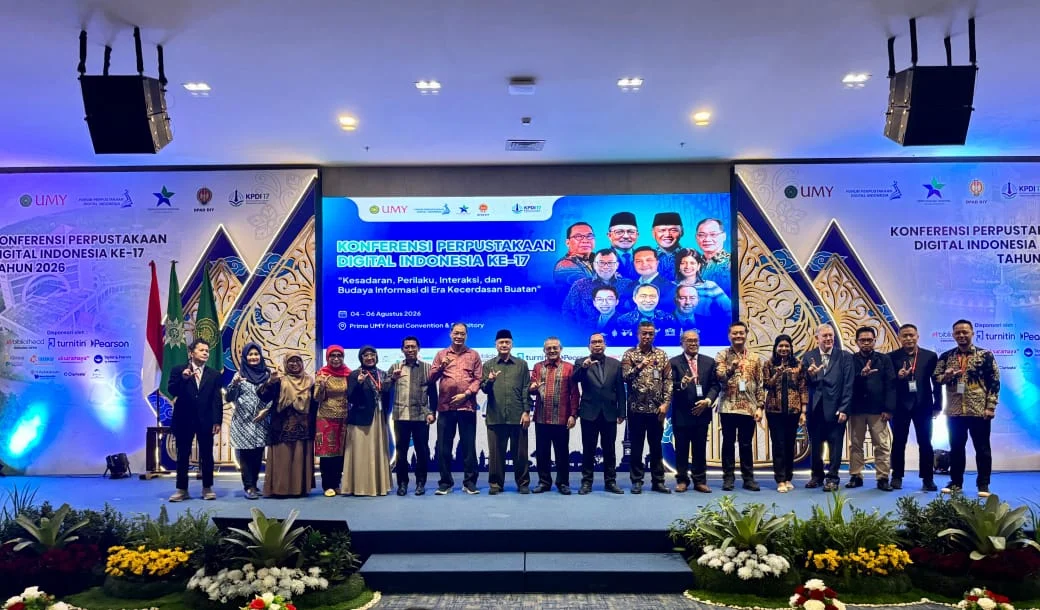
RRI.CO.ID, Yogyakarta – The surge in the use of Artificial Intelligence (AI) has transformed the way the public acquires, comprehends, and utilizes information. Amidst these changes, libraries can no longer merely serve as providers of access to information; instead, they must become trusted institutions that ensure the public obtains authentic information while also fostering the critical thinking skills needed to navigate the flow of digital information.
The Director of the National Library of the Republic of Indonesia, E. Aminudin Aziz, stated that the development of AI is bringing about fundamental changes to the information ecosystem. “The challenges facing libraries today go beyond merely managing collections and providing access to information; they now involve ensuring that the public can distinguish accurate information from misleading information,” he stated while opening the 17th Indonesian Digital Library Conference (KPDI) at the Universitas Muhammadiyah Yogyakarta (UMY) Hotel on Tuesday, August 4, 2026.
Director Aminudin, explained that far more fundamental questions have now emerged—questions we must answer together—that go beyond the mere mechanics of how information is stored, managed, delivered, and accessed. This includes ensuring that the public, as library users, obtains authentic, correct, and valid information, thereby avoiding the trap of misleading information.
He affirmed that critical thinking skills form the fundamental basis of literacy in an era of information overload. Consequently, libraries and librarians bear a strategic responsibility to cultivate the public's ability to sift through, verify, and critically evaluate information before utilizing it.
"When we speak of literacy, we are essentially discussing Higher Order Thinking Skills (HOTS). Ensuring that information users possess a high level of critical acumen is a crucial task for libraries and librarians," Aminudin said.
He also cautioned that technological advancements must not displace human values. In his view, AI is merely a technology that operates based on algorithms; ethical and moral values, as well as responsibility, remain determined by humans—the creators and users of the technology alike.
"AI, or artificial intelligence, inherently possesses no ethics, morals, or values. These elements only emerge when humans—as its creators—embed such values into the algorithms being built," he asserted.
Consequently, he considers the strengthening of literacy to be a non-negotiable investment. Improving the quality of human resources is key to enabling society to utilize AI responsibly without compromising integrity, ethics, or human values.
This view aligns with that of Dadang Kahmad, the Muhammadiyah Central Board Chairperson for Libraries, Informatics, and Digitalization, who observes that AI has transformed the way humans seek, produce, and utilize information. In his view, this shift requires libraries to transform from mere repositories of knowledge into spaces for knowledge creation capable of fostering a healthy information culture.
"Modern libraries must be capable of helping the public sift through accurate information, understand information critically, use information technology responsibly, and generate useful new knowledge," said Dadang at a forum themed 'Awareness, Behavior, Interaction, and Information Culture in the Era of Artificial Intelligence.'
According to Dadang, amidst the abundance of information generated by search engines and AI, the public needs the ability to verify every piece of information. In this context, the role of librarians is also undergoing a transformation.
Librarians no longer merely manage collections; they have become digital literacy facilitators who guide the public in crafting precise prompts, verifying the validity of AI-generated answers, and understanding the ethics of technology use.
"AI is merely a tool; it is humans who determine how that tool is utilized. Technology evolves rapidly, yet human values must not be left behind. The two must go hand in hand to ensure libraries remain relevant and capable of delivering maximum benefit to the community," he concluded.
According to a release received by Voice of Indonesia on Wednesday, August 5th 2026, the 17th Indonesian Digital Library Conference (KPDI) was held from August 4–6, 2026, through a collaboration between the Indonesian Digital Library Forum (FPDI), the National Library of the Republic of Indonesia, Universitas Muhammadiyah Yogyakarta (UMY), and the Library and Archives Agency of the Special Region of Yogyakarta. This year's event drew 281 participants from diverse backgrounds across Indonesia.
News Recomendation
Loading latest news.....