



What to Expect from the Massive East-West MRT Line Development?
- 29 Sep 2026 23:12 WIB
- Voice of Indonesia
Key Points
- The East-West MRT Line links Balaraja, Banten to Cikarang, West Java, spanning 48 planned stations as a designated National Strategic Project to enhance regional mobility.
- Construction from Tomang to Medan Satria relies on international co-financing from JICA and the ADB, targeting a daily ridership of 284,900 passengers.
RRI.CO.ID, Jakarta – Following the completion of the North-South MRT Line Phase 1 connecting Lebak Bulus to the Bundaran HI, MRT Jakarta is currently constructing Phase 2A from the Bundaran HI to Kota. The East-West MRT Line, connecting Balaraja in Banten to Cikarang in West Java, serves as the next major project, according to a written press release issued on Monday, September 28, 2026.
The East-West MRT Line was officially established under the Minister of Transportation Decree Number 203 of 2022 concerning the Determination of the Cikarang-Balaraja East-West Corridor Mass Rapid Transit Trace. Spanning approximately 84 kilometers, this route has also been designated as a National Strategic Project under the Coordinating Ministry for Economic Affairs Regulation Number 16 of 2025.
| Baca juga: Red Chili Prices Soar across North Sumatra |
Across this 84-kilometer route, the East-West MRT Line is planned to feature 48 stations. Construction of this line is being carried out in phases, namely Phase 1 Stage 1, Phase 1 Stage 2, and Phase 2 (covering the Banten and West Java sections).
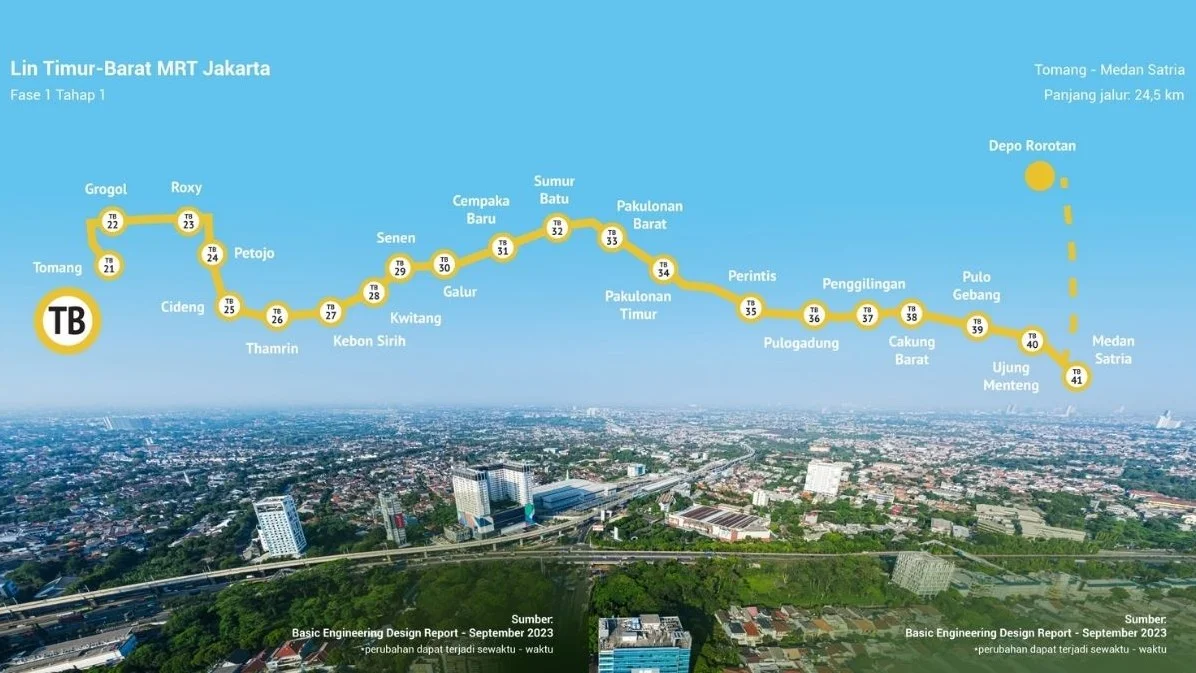
In Phase 1 Stage 1, the route will stretch from Tomang in West Jakarta to Medan Satria in Bekasi City, covering a distance of 24.5 kilometers with 21 stations. The design of the stations and rail tracks will incorporate a combination of elevated tracks, underground paths, and at-grade facilities.
The Phase 1 Stage 1 of the East-West MRT Line is targeted to achieve a ridership capacity of up to 284,900 passengers per day. Its elevated tracks will encompass the Tomang–Grogol and Cempaka Baru–Medan Satria areas.
Meanwhile, the underground section will run from Roxy to Galur. Additionally, this project includes the construction of depot access and a main depot in the Rorotan area.
This construction stage is supported by co-financing from the Japan International Cooperation Agency (JICA) and the Asian Development Bank (ADB) through a three-sub-level agreement scheme. This arrangement involves the Central Government through the Ministry of Transportation, the Ministry of Finance, and Bappenas as the executing agency, the Provincial Government of Jakarta as the implementing agency, and MRT Jakarta as the sub-implementing agency.
Currently, for the Thamrin–Kwitang segment, the Jakarta Provincial Government is undertaking land acquisition preparations and coordinating with relevant landowners. These steps are necessary to facilitate various construction requirements, including cooling tower ventilation tower (CTVT) facilities and station entrances. This process marks a crucial milestone in preparing for the infrastructure development of the East-West MRT Line.
News Recomendation
Loading latest news.....