



Crematoriums Gain Popularity for Bali’s Sacred 'Ngaben' Rituals
- 17 Jul 2026 12:01 WIB
- Voice of Indonesia
Key Points
- BRIN research shows more Balinese families are choosing crematoriums for 'Ngaben' as a more affordable and practical alternative while preserving the ritual's spiritual significance.
- Researchers say the shift reflects adaptation to modern lifestyles, urbanization, and economic realities without diminishing Balinese cultural and religious values.
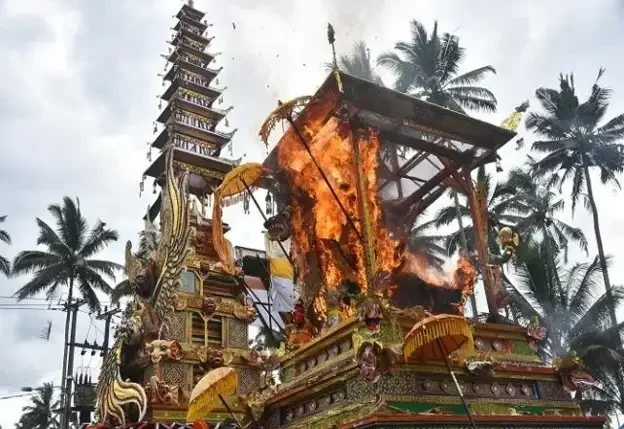
RRI.CO.ID, Jakarta - The sacred Balinese funeral ritual of Ngaben is undergoing a significant contemporary transformation as shifting socioeconomic conditions, urban migration, and lifestyle changes prompt a growing number of families to opt for modern crematoriums over conventional grand processions.
For centuries, the prestige of Ngaben has been deeply intertwined with massive community expenditures and the construction of elaborate bade (ritual towers used to transport the deceased).
However, recent research highlights that modern Balinese households are increasingly turning to enclosed crematoriums as a pragmatic, cost-effective alternative that fulfills all religious mandates without compromising the underlying spiritual gravity of the ancestral send-off.
A researcher at the Center for Manuscript, Literature, and Oral Tradition Research (PRMLTL) under the National Research and Innovation Agency (BRIN), I Made Budiasa, presented these findings during an international workshop titled "Collective Memory, Heritage, and Community" in Jakarta on Tuesday, July 14, 2026.
I Made Budiasa explained that the Balinese younger generation is currently navigating a delicate balance between ancestral preservation and the demands of modern economic realities.
While a conventional, full-scale communal Ngaben ceremony can easily cost between IDR 80 million (USD 4.9) and IDR 100 million, utilizing a specialized crematorium allows families to complete the religiously sanctioned ritual for approximately IDR 32 million.
"The younger generation tends to be more open to using crematoriums. This choice does not mean reducing respect for ancestors, but rather a form of adjustment so that families can still carry out religious obligations without sacrificing other important needs," I Made Budiasa stated, as quoted on BRIN's official website.
"Here we see a dynamic that scientists call the religious marketplace, which is when religious practices and services adapt to the needs, preferences, and socio-economic conditions of modern society," he added.
The study further identified rapid urbanization as a primary catalyst for this cultural shift. Balinese professionals residing in major urban centers often face strict employment schedules and lack the extensive time required to participate fully in the traditional ngayah (communal mutual aid) systems managed by rural custom villages.
Under these circumstances, modern crematorium facilities provide a dignified avenue to perform the ritual properly within tighter spatial and temporal constraints.
"Conventional execution of Ngaben requires long preparation, involves many people, and requires large costs. Changes in modern life patterns then encourage some people to look for a more efficient form of ritual execution," I Made Budiasa continued.
The academic forum, organized by BRIN in collaboration with the University of Indonesia’s Faculty of Humanities (FIB UI), concluded that the rise of crematoriums represents far more than a technical alteration in funeral logistics.
Instead, it signals a deeper evolution in how contemporary society negotiates cultural inheritance, land limitations, and occupational mobility amid rapid modernization.
"That situation is a form of technological leap that brings efficiency in the execution of rituals. The shift from open burning to closed crematoriums is a cultural innovation that does not eliminate the philosophical essence of Ngaben," I Made Budiasa remarked.
"What changes is the medium, while the spiritual meaning is maintained. In fact, this approach has the potential to be more environmentally friendly," he said, adding that the challenge ahead is to understand how society continues to interpret the sanctity of rituals amidst social change and modernity.
Commenting on the research, prominent member of the Indonesian Academy of Sciences (AIPI) and Professor Emerita at FIB UI, Melani Budianta, lauded the adaptation as a prime example of cultural resilience.
The academic consensus emphasizes that the transformation of Ngaben is a complex ongoing negotiation connecting tradition, theology, technology, and regional economics.
These insights are expected to enrich Southeast Asian island studies while serving as a blueprint for policymakers working to preserve intangible cultural heritage in an increasingly urbanized world. ***
News Recomendation
Loading latest news.....