



Indonesia Debuts Printing the Unprinted at Venice Biennale 2026
- 10 Mei 2026 19:40 WIB
- Voice of Indonesia
Key Points
- The Indonesian Pavilion at the Venice Biennale Arte 2026 features Printing the Unprinted, a collection of graphic prints showcased at Scuola Internazionale di Grafica, Venice.
- Curated by Aminudin TH Siregar, the exhibition centers on a fictional 14-year voyage (1472–1486) from Sumatra to Europe, told through an "imagined manuscript."
- Seven multi-generational artists, including Agus Suwage, Syahrizal Pahlevi, and R.E. Hartanto, contributed individual chapters to this visual story.
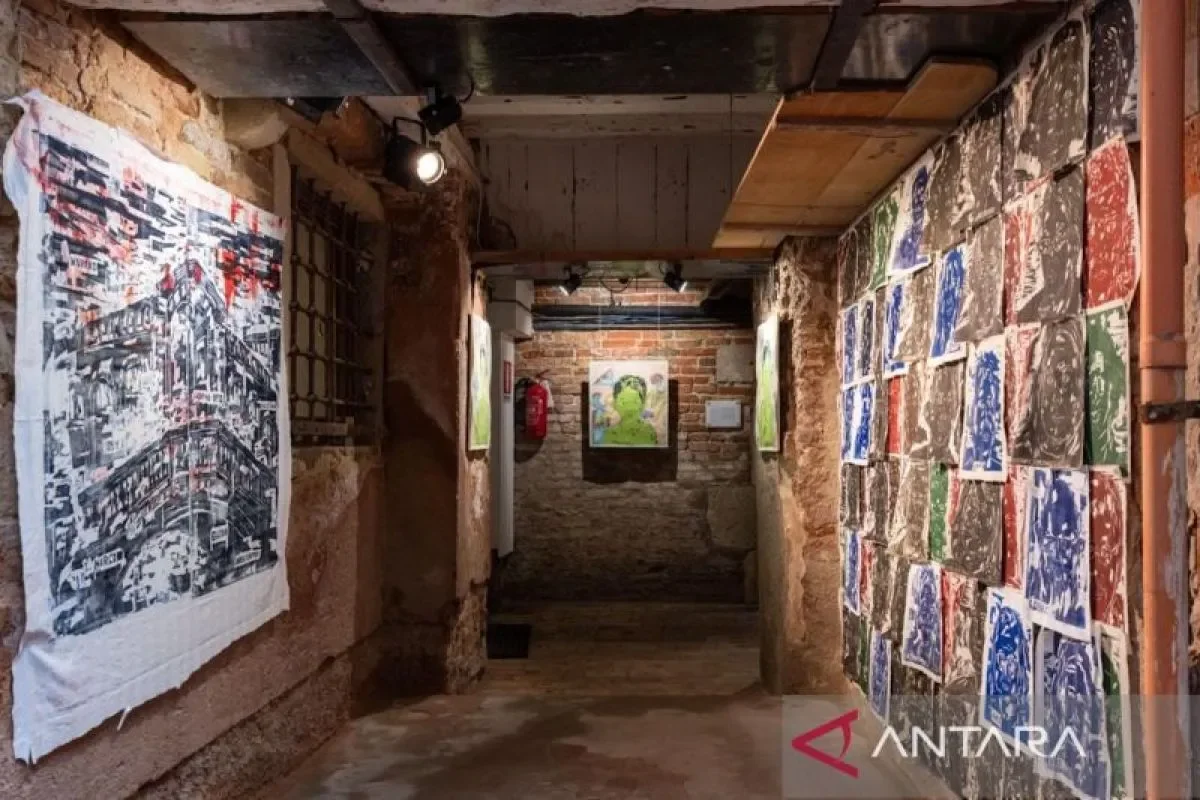
RRI.CO.ID, Jakarta - The Indonesian Pavilion at the Venice Biennale Arte 2026 presents Printing the Unprinted, a captivating exhibition of graphic print works by seven artists spanning generations. The display is currently on view at the Scuola Internazionale di Grafica in Venice, Italy.
The exhibition brings together seven Indonesian artists across generations to reconstruct a collective manuscript chronicling a 14-year maritime journey (1472–1486) from Lake Toba to the heart of Europe.
As reported by Antara, the show is presented at the Scuola Internazionale di Grafica in Venice, in a collaboration between Indonesia's Ministry of Culture and Danantara Indonesia Trust Fund, curated by Aminudin TH Siregar. This work was created in collaboration by seven artists, including Agus Suwage, Syahrizal Pahlevi, Nurdian Ichsan, R.E. Hartanto, Theresia Agustina Sitompul, Mariam Sofrina, and Rusyan Yasin.
At its heart is an imagined archive, which is a manuscript attributed to Datu Na Tolu Hamonangan, a fictional archivist from the Harajaon Pusuk Buhit kingdom in Sumatra. He documented an armada's passage through the Strait of Malacca, the Bay of Bengal, Gujarat, Hormuz, the Red Sea, Alexandria, and finally Venice and Central Europe.
Based on a press release received in Jakarta on Sunday, May 10, 2026, the manuscript, as conceived by the artists, contains 21 etchings divided across eight chapters, each narrated from a distinct perspective.
The journey's central figure is Admiral Mangaraja Laut Mangiring, who in 1472 studied star routes and Arab maps in Malacca before setting sail with a crew of Batak navigators, Malay helmsmen, Tamil interpreters, and Persian astronomers. R.E. Hartanto visualises this chapter through three etchings, which are Departure Under the Southwest Monsoon Wind (1472), Storm Off Hormuz, and The Aging Admiral's Face.
The works trace a commander who weathered catastrophic storms in the Strait of Hormuz and returned fourteen years later, white-haired, carrying the knowledge that distant worlds are connected by sea.
The manuscript unfolds through the hands of six other artists. Syahrizal Pahlevi charts the voyage's astronomical and cartographic dimensions in Rewriting the Circle of the World, Library of Florence, and The Inversion of the World Map. Rusyan Yasin turns to the natural world with Camphor Specimens and Andalas Wood, Encounters in the Alps, and Garden of Two Climates.
Mariam Sofrina captures the human dimension of the journey, such as Batak sailors tasting European cheese and bread, Europeans handling ulos cloth at a Venetian winter market. Her works include Port of Malacca, Winter Market in Venice, and West Gorga.
Nurdian Ichsan explores the technological exchanges that deepened across continents in Forging Iron at Lake Toba, Glass and Mechanical Clocks, and The Hybrid Emblem of Harajaon. Theresia Agustina Sitompul closes the manuscript with its most inward chapter, which are Pre-Departure Ritual, Cathedral and the Echo of Gondang, and Return to Silence works that render the spiritual undercurrent running through the entire voyage.
Beyond the collective narrative, each artist also produced individual works during the residency, expanding the exhibition's scope beyond the manuscript's fictional frame.
The pavilion positions printmaking not merely as an artistic medium, but as what its organisers describe as a space for rereading history, knowledge, and the collective imagination of the Nusantara. Indonesia's participation in Venice, they say, affirms culture's role as a bridge for dialogue, the exchange of ideas, and the country's growing presence on the international art stage. ***
News Recomendation
Loading latest news.....