


BRIN-Ministry Launch Strategic Research into Ancient Civilizations and Language
- 11 Mar 2026 15:04 WIB
- Voice of Indonesia
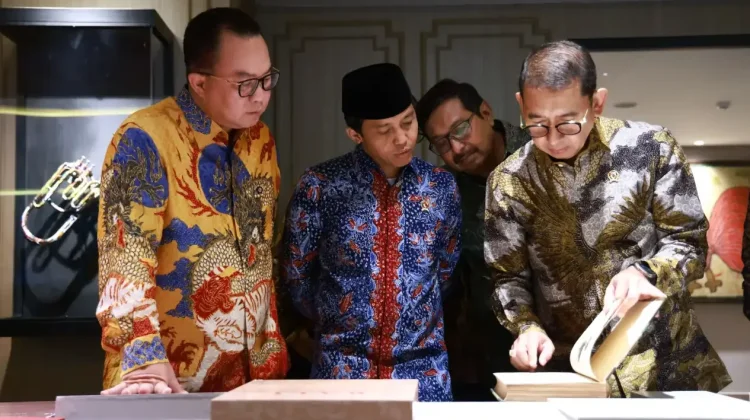
RRI.CO.ID, Jakarta - The National Research and Innovation Agency (BRIN) and the Ministry of Culture have established a strategic collaboration to uncover the deep roots of Indonesian civilization and secure the future of local languages through digital innovation.
Announced on Tuesday, March 10, 2026, this partnership focuses on demonstrating Indonesia’s status as a hub of global civilization while addressing technical gaps in Artificial Intelligence (AI) linguistic accuracy.
A primary objective of this collaboration is the scientific validation of the "Nusantara Civilization," which BRIN researchers estimate may date back 1.8 million years. Proving this timeline would reposition Indonesia as a critical site for understanding human evolution and global migration.
BRIN’s Arbastra Research Organization (Archaeology, Language, and Literature) is currently leading the mechanical process of archaeological excavation and data verification.
With 1,340 ethnic groups and a significant portion of the world's linguistic diversity, Indonesia sits at the meeting point of the Pacific and Indian Oceans, acting as a historical "shuttle" for global cultural exchange.
“It is the task of BRIN to be able to prove these allegations. So the archaeological researchers at BRIN are now working hard to find the best works of our society from the past,” BRIN Head Arif Satria said, as quoted on BRIN's official website.
The partnership also addresses a modern technical crisis: the "digital invisibility" of Indonesian and local languages within global AI ecosystems.
Arif Satria highlighted a significant disparity in how current AI models process data, noting that English currently achieves the highest performance, with approximately 80 percent accuracy. This figure drops significantly for the Indonesian Language, which sits at roughly 60 percent accuracy, reflecting a gap in regional data integration.
Most concerning is the performance of Local Languages, which currently achieves only about 42 percent accuracy, a statistic that underscores the urgent need for the digital preservation and linguistic mapping of Indonesia's diverse regional dialects.
This low accuracy for local languages presents a barrier to digital inclusivity. BRIN and the Ministry of Culture intend to digitize the nation’s 708 local languages, ensuring they are integrated into the global digital ecosystem. This effort will allow AI models to better recognize and preserve Indonesia's "social diversity" as a model for the world.
Minister of Culture Fadli Zon emphasized that preserving culture is a constitutional mandate under Article 32, Clause 1 of the 1945 Constitution. He noted that this responsibility extends beyond his ministry to include a cross-sectoral alliance with the Ministry of Communication and Digital, the Ministry of Forestry, and the Creative Economy Agency.
A key focus for the Ministry moving forward is converting cultural assets into Intellectual Property (IP).
“These cultural assets, when later translated into Intellectual Property (IP), are still few, and we haven't maximized them at all. With BRIN, I think there are many new studies recently announced,” Minister Fadli Zon remarked.
By combining BRIN's research data with the Ministry’s cultural management resources, the government aims to optimize the management of Indonesia’s heritage in the digital age, transforming ancient history into modern economic and cultural value. ***