



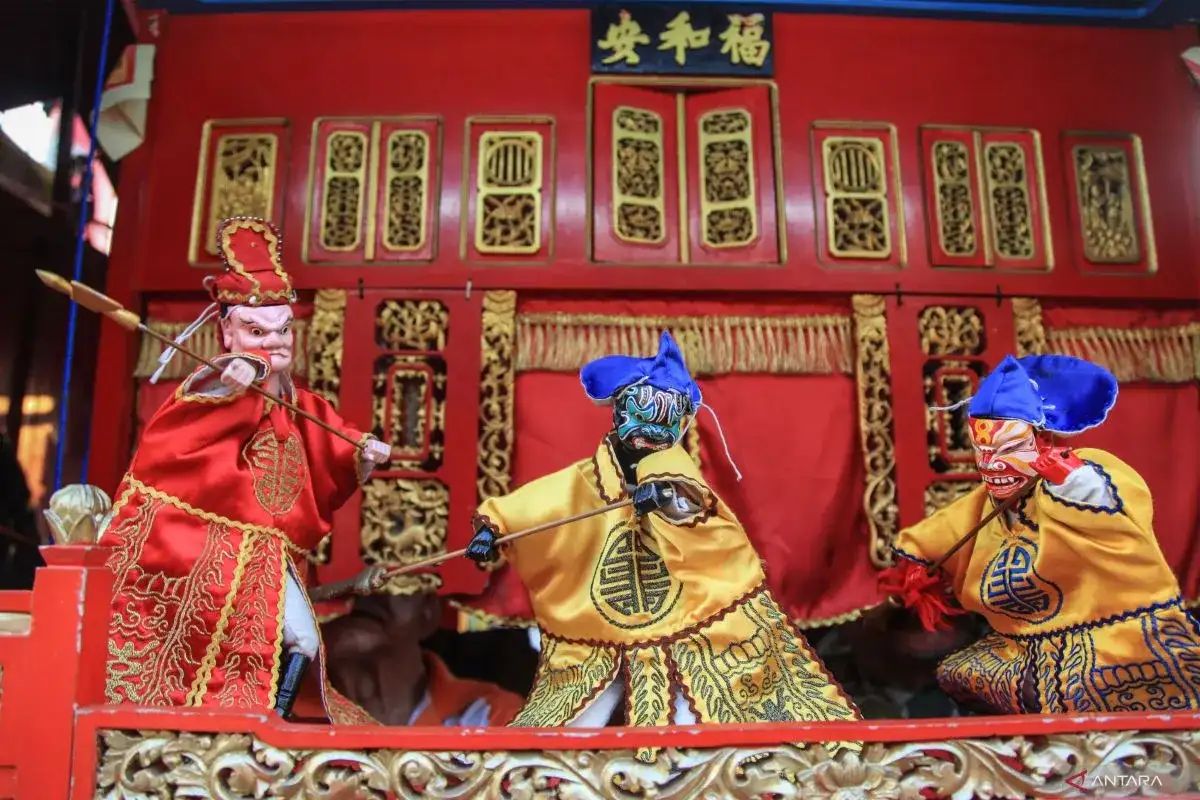
RRI.CO.ID, Semarang – Wayang Potehi (Chinese shadow puppet) is a Chinese art form that developed in Java. Existing since the 16th century AD, wayang potehi has experienced ups and downs as an art form that has captured the hearts of the Indonesian people.
Wayang Potehi in Mandarin Chinese is written as 布袋戲 (Pinyin: bùdàixì), which literally means "cloth bag puppet show." The term originates from the Hokkien dialect: pou (cloth), te (bag), and hi (puppet). This traditional puppet art originates from Southern China (Fujian) and is popular throughout the Indonesian archipelago.
According to the International Journal of Academic Research in Business and Social Sciences (2019), this art form has existed since the Jin Dynasty (265–420 AD). Furthermore, some say that this art form has its roots in puppetry from the Han Dynasty in China (206–220 AD).
The existence of wayang potehi in the Indonesian archipelago is recorded in Javanese records, specifically the Malat and Nawaruci manuscripts. Both manuscripts were written during the Majapahit Empire, around the 16th century AD, concurrent with the Ming Dynasty in China.
In the performance, five individuals play the roles of musicians, puppeteers, and assistants. With such a small cast, the actors are required to understand the story to enliven the atmosphere.
Beyond being a form of entertainment, the stories convey valuable life lessons. This art form draws heavily from traditional Chinese tales, one of the most famous being the story of the sacred monkey.
After experiencing a period of prosperity, this art form, performed during Chinese New Year and Cap Go Meh, faded during the New Order. This decline was due not only to external factors originating outside the Chinese community, but also to internal factors.
Wayang potehi, rooted in Chinese culture, was inherited by the Javanese people. According to Melville J. Herskovits in the journal Cultural Anthropology and Cultural Change, the younger generation tends to be less interested in tradition due to social change and modernization.
Herskovits's research emphasizes that changes in the value orientations of the younger generation affect the sustainability of traditional culture. This impacts the process of passing on performing arts across generations.
In Semarang, wayang potehi still exists, despite declining interest and a lack of similar heritage. Several venues, such as the Tay Kak Sie Temple, the Semawis Chinese New Year Market, and the Sam Poo Kong Temple, still host performances. (Misni Parjiati/Bambang MBKA)
News Recomendation
Loading latest news.....