



BRIN Unveils Oldest Rock Art Found in Leang Metanduno, Sulawesi
- 22 Jan 2026 14:58 WIB
- Voice of Indonesia
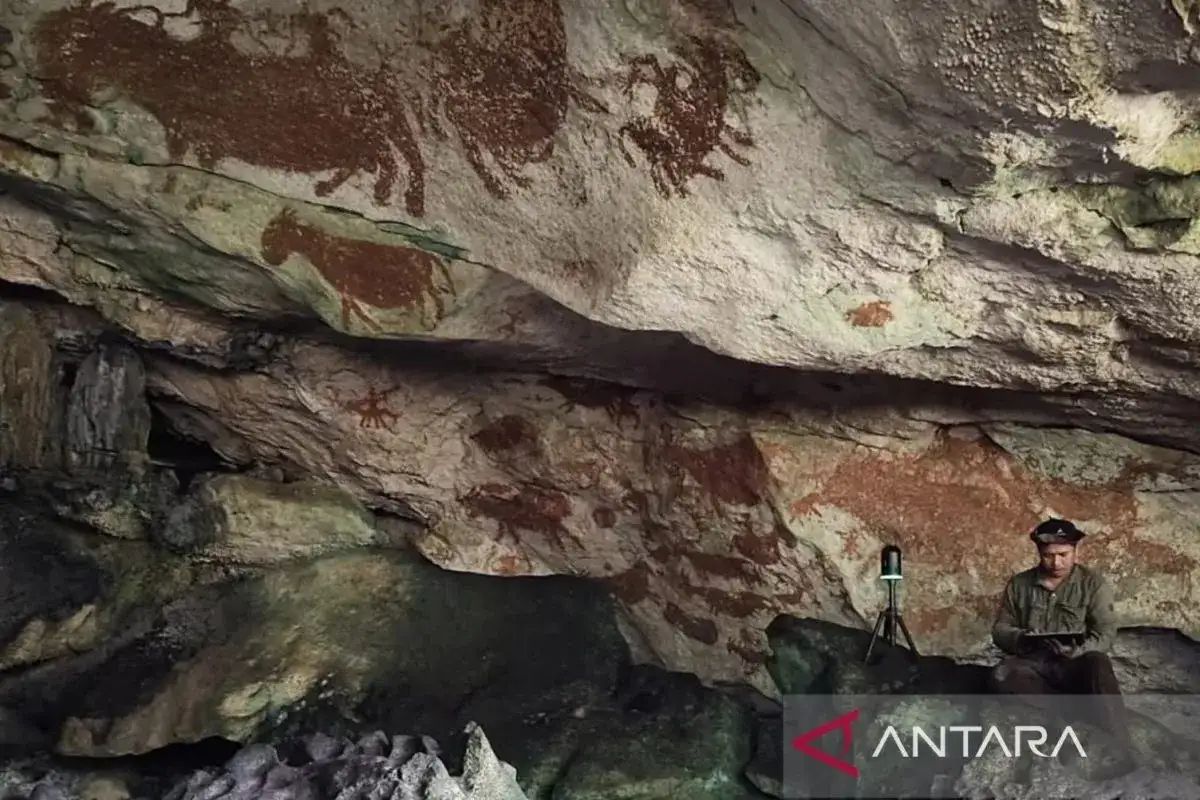
RRI.CO.ID, Jakarta - A recent publication in the journal Nature by the National Research and Innovation Agency (BRIN) revealed a significant archaeological discovery in Leang (cave) Metanduno, Muna Island, Southeast Sulawesi: 67,800-year-old human handprints. This finding marks a pivotal milestone in Indonesian archaeological research.
The Head of Research Center for Enviromental Archeology, Marine, and Sustainable Cultural at BRIN, Marlon Nicolay Ramon Ririmasse said that the publication in the journal Nature published was result from a collaboration research between BRIN and Griffith University, Australia. This research collaboration has been productive for several years.
"The publication, 'Rock Art From at Least Sixty-Five Thousand Years Ago in Sulawesi,' in the journal Nature, is the result of a multi-year research collaboration between the Research Organization for Archaeology, Language, and Literature of the Indonesian National Research Institute (BRIN) and Griffith University. This has resulted in at least 12 publications in various journals, including Nature," said Marlon at a press conference announcing the findings at the BJ Habibie Building in Jakarta, on Thursday, January 22, 2026, as quoted by BRIN's official website.
This collaboration has produced knowledge dissemination products and contributed to the development of museums and cultural platforms. One research result was used for the George Lucas Museum in the US via Google Arts & Culture.
Marlon emphasized that the research focuses on scientific results and strengthening human resource capacity development. "As part of this research, BRIN is also implementing a capacity development scheme through doctoral education funding, including for one of the lead authors," he said.
He continued by explaining that BRIN, along with its international partners and local administrations, plans to conduct additional research in Sulawesi, Maluku, and Papua. This research is expected to enrich Indonesia's prehistoric narrative and promote cross-regional research collaboration.
Adhi Agus Oktaviana, a BRIN researcher from the Archaeometric Research Center, revealed that the Muna Island rock art is at least 16,600 years older than the previously discovered Maros-Pangkep rock art.
"This rock art is also 1,100 years older than the handprints in Spain that were previously attributed to Neanderthals and considered the oldest cave art in the world," Oktaviana said in a statement in Jakarta on Thursday, January 22, 2026, as quoted by Antara.
Oktaviana explained that the research team used laser ablation uranium series (LA-U series) dating techniques on the microscopic calcite layer covering the cave paintings.
The analysis revealed an age of 71,600 ± 3,800 years, providing a minimum age limit of 67,800 years for the handprints at Liang Metanduno on Muna Island. This is the oldest rock art ever reliably dated, providing direct evidence that humans intentionally crossed the ocean nearly 70,000 years ago.
"It's very likely that the artists of these paintings were part of a population that later spread further east and eventually reached Australia," Oktaviana said.
Oktaviana said that this discovery strengthens the long chronology model, which posits that humans reached the Sahul mainland (present-day Australia and Papua) around 65,000 years ago.
According to Oktaviana, this research provides the oldest direct evidence of the presence of modern humans along the northern migration route to Sahul. This route involved maritime exploration between Kalimantan (Borneo) and Papua, a region that remains relatively unexplored archaeologically.
Adam Brumm, a researcher at the Australian Research Centre for Human Evolution (ARCHE) at Griffith University, explained that the handprints in the Muna Island rock art also have unique characteristics. The modifications narrow the finger shape, giving them a claw-like appearance and reflecting mature symbolic expression.
"However, this art could also symbolize the idea that humans and animals share a very close relationship. This is evident in the earliest paintings in Sulawesi, including a scene that we interpret as a half-human, half-animal creature," Adam said.
Hadi Wahyudi, head of the cultural division of the Muna Regency Education and Culture Agency, expressed his appreciation for the research findings, which he believes make the local community proud.
"The Muna Regency Administration is very proud of the results of this research, as they bring pride to us as members of the Muna people. This is an ancestral heritage that we will certainly continue to preserve," he said.
He explained that the discovery is located in a cave area that has been designated a provincial cultural heritage site. "We hope that in the future, its status can be elevated to national cultural heritage or even a UNESCO World Heritage Site," he said.
The discovery of Pleistocene rock art sites distributed throughout the karst region of Sulawesi carries significant responsibility for preserving this irreplaceable cultural heritage. ***
News Recomendation
Loading latest news.....