



Belu Regency and UNICEF Strengthen Polio Immunization to Protect Children
- 03 Sep 2026 20:40 WIB
- Voice of Indonesia
Key Points
- Belu Regency, NTT, and UNICEF are strengthening polio immunization efforts amid low coverage and high population mobility along the Indonesia–Timor-Leste border.
- The initiative aims to prevent polio transmission and permanent paralysis among children while helping Indonesia meet national immunization targets.
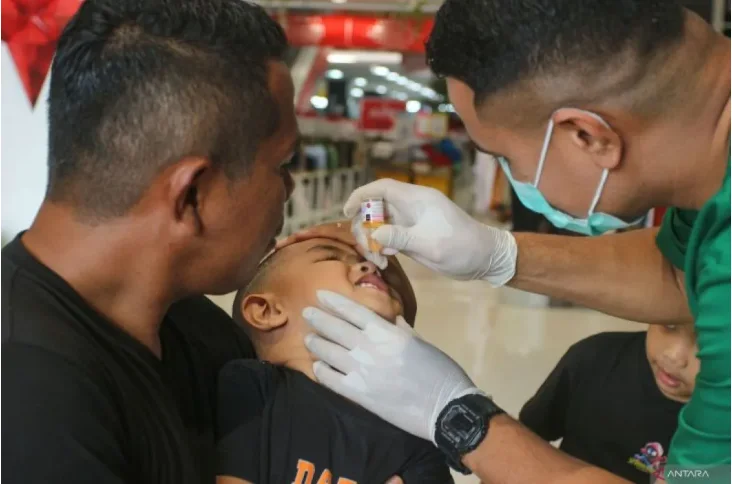
RRI.CO.ID, Atambua - Low basic immunization coverage in Indonesia–Timor-Leste border area has triggered a national health security alarm. The Belu Regency Administration in East Nusa Tenggara (NTT), together with the United Nations Children’s Fund (UNICEF), is now reinforcing defenses against the threat of childhood paralysis by accelerating polio immunization amid high cross-border population mobility.
This strengthening effort was carried out through the Cross-Sectoral Socialization and Advocacy for Strengthening Polio Immunization at Belu Regency Level in 2026, held at the Betelalenok Women’s Building in Atambua, Belu Regency, NTT, on Thursday, 3 September 2026.
The move is part of an acceleration drive to meet national immunization targets while protecting children from the threat of permanent paralysis caused by the polio virus.
Acting Belu Regional Secretary and chairperson of the organizing committee, Elly Ch. Rambitan, said current health development is directed toward strengthening promotive and preventive efforts, including through immunization. This aligns with Article 44 of Law Number 17/2023 on Health, which affirms that every infant and child has the right to receive immunization.
Although the national polio outbreak was declared over in November 2025, the risk of transmission remains in some areas. This situation is influenced by factors including children who have not received complete immunization, uneven coverage, and high population mobility.
Belu Regency itself continues to face immunization coverage gaps. As of August 2026, complete basic immunization coverage in Belu reached only 34.2 percent, while polio doses 1–4 stood at 37.2 percent, far below the national minimum target of 85 percent sustained for three consecutive years.
To address this issue, the meeting focused on three objectives. First, strengthening cross-sectoral roles in increasing demand for and access to immunization services. Second, identifying factors behind low immunization coverage and determining priority target groups for intervention. Third, formulating joint commitments and concrete follow-up action plans (RTL) for the next 30 to 90 days in each community health center (puskesmas) working area.
UNICEF Provincial Representative for NTT and NTB, Dr. Alfian Muntha, said the meeting received direct support from the US Department of State. In NTT Province, four regencies are receiving program strengthening, such as Belu, Nagekeo, Kupang, and Southwest Sumba.
He emphasized the importance of the no child left behind principle in the polio immunization program. According to him, the previous success in handling COVID-19 demonstrates the importance of synergy between the government and all elements of society.
“Preventing this infectious disease is very straightforward. Let’s complete four doses of oral polio drops for 80 percent protection, then complete it with two doses of injectable polio vaccine (IPV),” said Dr. Alfian.
In addition to immunization coverage, he stressed the importance of maintaining vaccine cold chain quality, from the regency level down to community health posts (Posyandu), to ensure vaccine effectiveness.
According to him, Belu’s position directly bordering Timor-Leste makes achieving immunization status a critical barrier to preventing potential outbreaks.
Although Belu’s polio coverage ranks fifth out of 22 regencies in NTT, a gap remains between coverage of oral polio vaccine and injectable polio vaccine. Meanwhile, provincial-level coverage is reported to have reached only 40 percent of the period target of 66 percent.
Acting Regional Secretary Elly appreciated UNICEF’s support and that of the NTT Provincial Health Agency in strengthening immunization in Belu Regency.
She affirmed that immunization is a cost-effective essential service designed to reduce morbidity, disability, and mortality from Vaccine-Preventable Diseases (PD3I). These include critical conditions such as polio, measles, rubella, diphtheria, pertussis, tetanus, hepatitis B, tuberculosis, pneumonia, meningitis, and encephalitis.
Elly presented Belu Regency’s Oral Polio Vaccine fourth-dose (OPV4/drops) coverage, which remains fluctuating: 64.59 percent in 2024, 67.35 percent in 2025, and 35.87 percent as of July 2026.
Meanwhile, first-dose Inactivated Polio Vaccine (IPV1/injectable) coverage was recorded at 65.97 percent in 2024, 67.94 percent in 2025, and 33.39 percent as of July 2026.
“This low coverage is an alarm we must be concerned about due to the high potential for polio virus transmission. We face real challenges in the field, such as community refusal or hesitancy, geographical access limitations, and suboptimal cross-sectoral coordination,” said Elly, as quoted by infopublik.id.
Elly urged subdistrict heads, community health center heads, and all related sectors not to treat the meeting as merely ceremonial. According to her, the main focus after the meeting is ensuring real action in the field to raise public awareness and achieve the 100 percent immunization coverage target. ***
News Recomendation
Loading latest news.....