



Merauke Farmers Trained to Produce Export Quality Copra
- 08 Apr 2026 16:25 WIB
- Voice of Indonesia
Key Points
- Farmers in Semangga, Merauke, are transitioning from selling raw coconuts to producing export-standard copra to increase their profit margins.
- The EcoNusa Foundation training addresses the unreliability of traditional sun-drying, which often leads to mold and inconsistent quality.
- Participants were trained to meet premium market criteria, specifically achieving a moisture content below 6% and maintaining a clean white or light brown color.
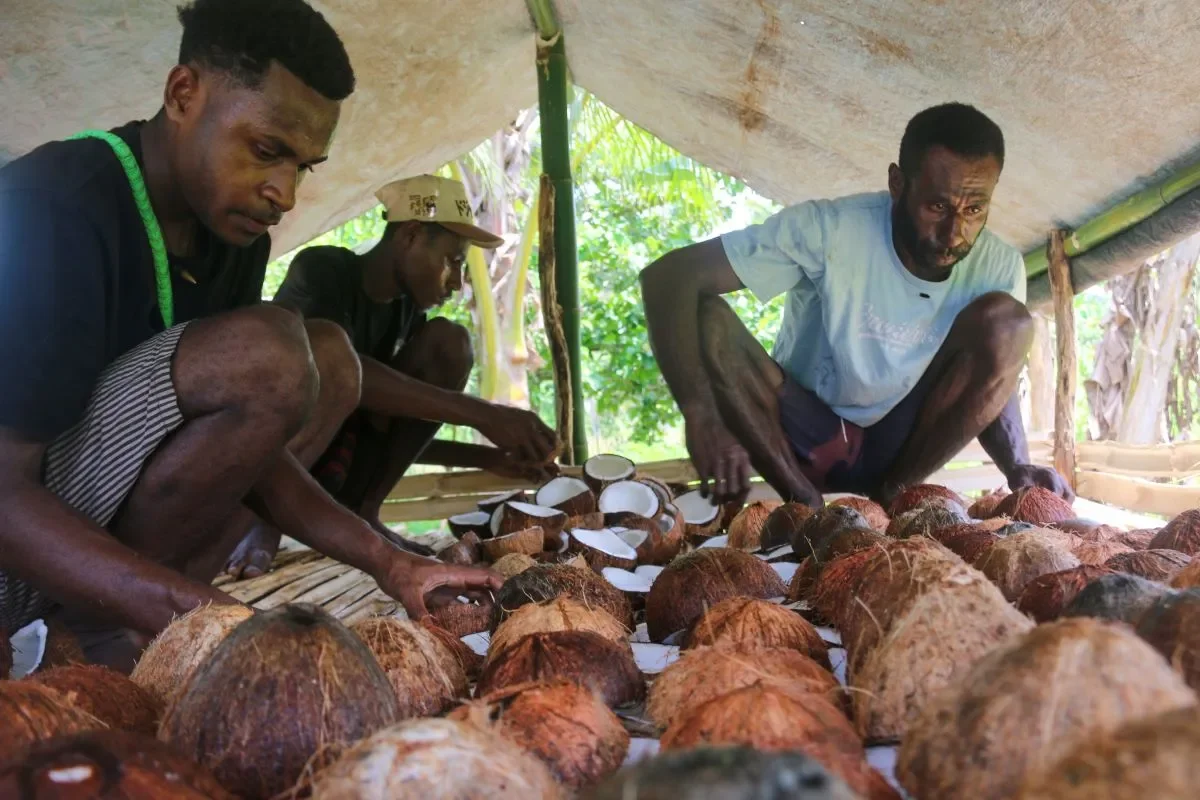
RRI.CO.ID, Jakarta - The traditional coconut industry in South Papua is poised for a significant economic upgrade as local residents transition from selling raw fruit to producing export-standard copra.
The EcoNusa Foundation is organizing a specialized training program for farmers in the Semangga Subdistrict of Merauke Regency. This initiative equips them to bypass the limitations of traditional drying methods in favor of high-value processing techniques that meet global market demands.
The initiative, held in Urumb Village from March 18 to 24, 2026, brought together participants from the villages of Urumb, Matara, Sidomulyo, and Waninggap Nanggo. For many attendees, the training addressed a long-standing hurdle: the unreliability of sun-drying.
Resident Robert M.B. noted that relying solely on sunlight often led to inconsistent results and rapid spoilage. “Sometimes, after just two days, the copra is already moldy,” he explained in an official statement released by EcoNusa in Jakarta on Wednesday, April 8, 2026.
This push for technical excellence is driven by the desire to secure better profit margins for the community. The chairperson of the Sinai Micro, Small, Medium, Enterprises (MSME), Sumarni, expressed hope that these new skills would directly translate into higher income for local families.
“We have been making copra for a long time, but we still need to learn more so that the results are better and can sell at a good price,” she said, as quoted by Antara.
The curriculum focused on strict quality standards, covering physical, chemical, and hygiene aspects. Participants learned that premium copra must be clean white or light brown, free of impurities, and maintain a moisture content below six percent.
EcoNusa Program Associate Moses Ramsis Boi highlighted that collective adherence to these standards is the key to collective prosperity. “If we work together and follow the correct methods, the quality of the village copra will rise, and the price will surely follow,” he remarked.
Beyond theoretical knowledge, the workshop involved hands-on practice in selecting, splitting, washing, and smoking the coconuts. Facilitator Jamina Rumbewas warned that poor processing not only lowers the selling price but can also lead to the development of dangerous substances like aflatoxins.
To ensure the sustainability of these methods, residents were taught to build drying racks using accessible local materials such as bamboo and wood.
The results of the training were immediate, with evaluation sessions showing that the majority of the copra produced reached an optimal dryness level between two and seven percent. This technical shift is vital for Semangga, a subdistrict where nature is the primary provider. In Matara Village alone, approximately 6,000 coconut trees stand as an underutilized goldmine, previously sold mostly as whole fruits rather than processed goods.
By standardizing production, EcoNusa aims to replicate the success seen in its other assisted regions. In 2025, coconut-based commodities from EcoNusa-backed areas achieved significant market penetration, with 69 tons of copra coming from Kaimana, 44 tons from Sarmi, and 5.1 tons from East Seram.
The foundation hopes that by refining the quality of copra in Semangga, the local community will finally strengthen its economy through the sustainable management of its own natural resources. ***
News Recomendation
Loading latest news.....