



The First Radio Station in Indonesia: How Bataviase Radio Vereniging (BRV) Began
- 08 Sep 2026 20:38 WIB
- Voice of Indonesia
Poin Utama
- Archival records reveal the Batavian Radio Association (Bataviase Radio Vereniging, or BRV) launched via an improvised 1925 home broadcast in Weltevreden, challenging standard claims that it originated inside Hotel des Indes.
- Batavia's pioneering civilian broadcaster transitioned from private homes and hotel rooms into a dedicated, purpose-built studio complex on Koningsplein Zuid by 1931.
- The pioneering network operated intercity relay lines and scheduled cultural programming until the March 1942 Japanese invasion abruptly dissolved civilian radio associations and seized transmission facilities.
RRI.CO.ID, Jakarta - Ahead of National Radio Day (Hari Radio Nasional), standard accounts frequently describe early civilian broadcasting across the archipelago. Conventional histories often locate the first broadcasts of the Batavian Radio Association, or BRV (Bataviase Radio Vereniging), inside Hotel des Indes.
However, detailed retrospective records indicate that the inaugural demonstration took place at the private residence of Willem van der Horst. Sukabumi tea planter Alexander Constant de Groot provided an improvised home-built transmitter using receiver honeycomb coils to air gramophone music.
That historic 1925 test broadcast gathered four thousand guilders in midnight phone pledges from captivated local radio enthusiasts. The newly founded association then operated its initial two years inside the private Noordwijk residence of Mr. Wolzak.
As membership expanded, the amateur organization moved its broadcasting operations into a small two-by-three-meter room inside Hotel des Indes. Technicians operated inside precarious quarters where four thousand volts of bare wiring remained exposed across makeshift control tables.
Acoustic conditions required improvisation, prompting organizers to string twenty horse blankets with iron wire for a visiting Pavlova ballet concert. Seeking expanded accommodations, the growing association transferred its operational base into a double room inside Hotel der Nederlanden.
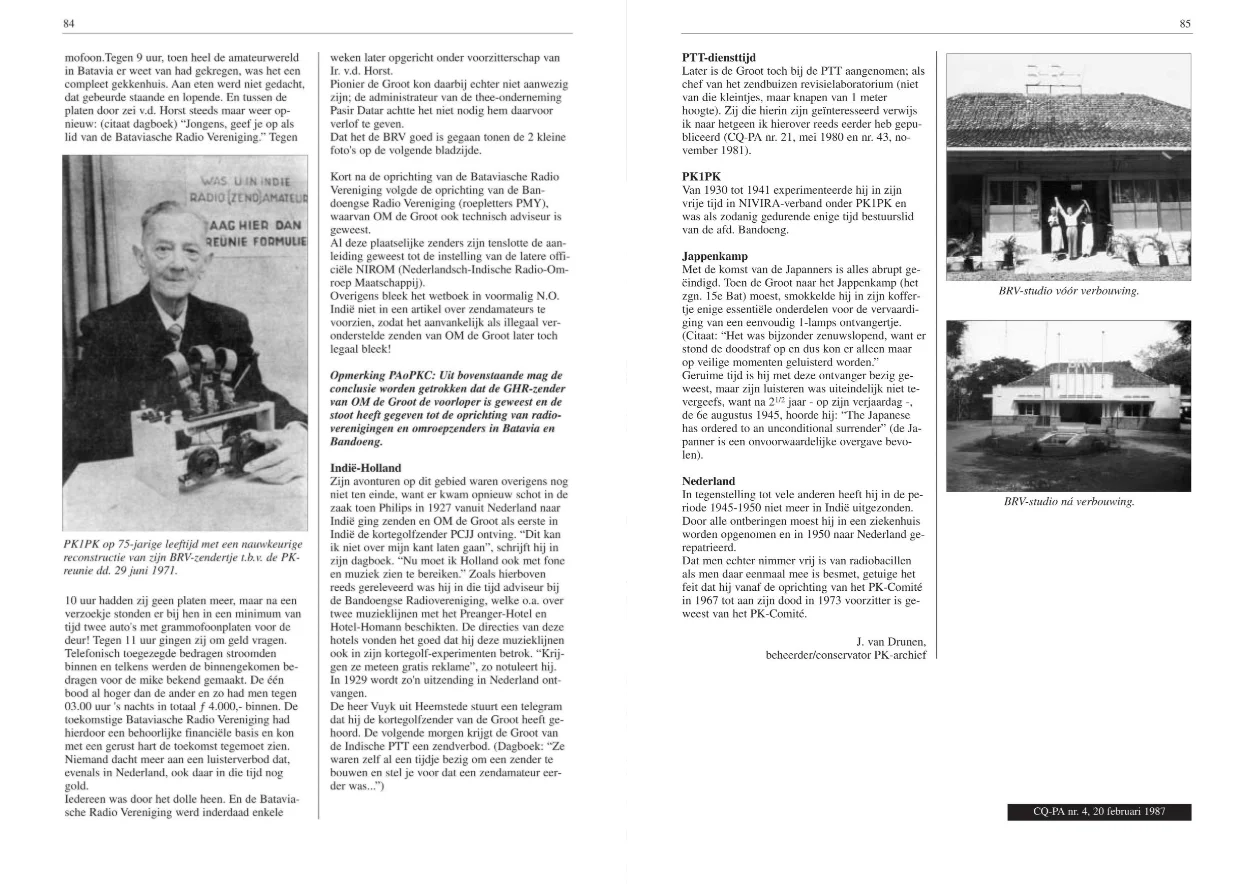
Civilian broadcasting gained momentum, allowing the association to establish its own dedicated premises on Koningsplein Zuid in 1931. Archival photographs document the BRV's later premises at this Batavia site, developed into a dedicated broadcasting facility.
The association expanded further, establishing phone-line relays to provincial transmission links across Buitenzorg, Sukabumi, and Cheribon with PTT cooperation. Station operators even outpaced the heavily privileged dominant broadcaster NIROM to report historic international aviation landings live from the runway.
This pioneering civilian venture ended abruptly when Imperial Japanese military forces took control of Java in March 1942. Wartime authorities suspended private broadcasting clubs, placing transmission facilities under centralized military control while interning European personnel in camps.
Though BRV disappeared before national independence, it served as a genuine public broadcasting precursor in the East Indies. Its pioneering programming demonstrated the potential of regular cultural broadcasting to reach audiences across the vast archipelago. (Fauzan)
(This account draws upon the retrospective history and 10th-anniversary records of the Bataviase Radio Vereniging published in Film, Radio en Televisie, incorporating archival materials and recollections from early radio pioneers preserved by the PK-Comité.)
News Recomendation
Memuat berita terbaru.....