



Indonesia Commemorates World Wetlands Day 2026 at Jakarta Car Free Day
- 08 Feb 2026 17:41 WIB
- Voice of Indonesia
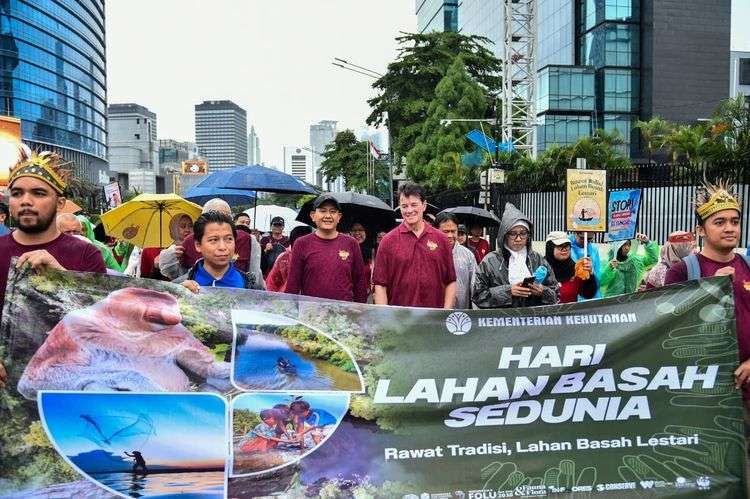
RRI.CO.ID, Jakarta - A public commemoration of World Wetlands Day (WWD) 2026 was spearheaded by the Ministry of Forestry (Kemenhut) during the Car Free Day event in Jakarta on Sunday, February 8, 2026, to reinforce the importance of wetland conservation.
This outreach effort provided the public with essential insights into how wetlands function as natural climate controllers and protective barriers that shield communities from environmental catastrophes. By integrating this mission into the city’s social hub, the Ministry successfully highlighted the inextricable link between healthy wetland ecosystems and the safety, balance, and climatic health of the entire nation.
The event, held amidst the morning exercise activities of Jakarta residents, featured a fun walk, environmental education campaigns, free seedling distribution, and various educational activities. Carrying the theme "Nurturing Traditions for Sustainable Wetlands," this year's celebration emphasizes the importance of strengthening local wisdom and the active role of the community in maintaining the sustainability of Indonesia's wetlands.
Deputy Minister of Forestry Rohmat Marzuki, attending on behalf of the Minister of Forestry, emphasized that wetlands play a vital role as carbon sinks, climate regulators, and natural protectors against disasters. He highlighted that Indonesia's vast wetland ecosystems are essential assets for both the nation and the global environment.
"Wetlands are the kidneys of the earth. Like kidneys, they work silently; they filter pollution or contamination, protect the coastlines, and they are also climate defense fortresses that absorb more carbon than tropical forests," stated Rohmat, as quoted on Kemenhut's official website.
He further asserted that he and the Ministry of Forestry, who are mandated to manage forest areas, will always strive to the maximum to preserve the extensive wetlands in Indonesia, including mangroves, peatlands, and swamps. He also mentioned the importance of the eight world-recognized Ramsar sites located within the country.
"These are strategic assets that we must guard and preserve for climate control and protection from disasters," he remarked.
Through the 2026 World Wetlands Day commemoration, the Ministry of Forestry invites all levels of society to continue strengthening their concern and taking real action in guarding wetlands as a key part of climate change mitigation. This effort is also aimed at preserving biodiversity and improving the quality of a sustainable environment.
"Let us ensure that the wetlands in Indonesia remain a legacy for our children, our grandchildren, and the future of Indonesia," the Deputy Minister concluded.
Latest data shows that out of the total 3.4 million hectares of national mangrove coverage, 80% is located within forest areas. Meanwhile, regarding the peat swamp ecosystem, 74% of the total 20.7 million hectares are situated inside forest regions.
These figures confirm that Indonesia's success in mitigating the climate crisis depends heavily on the effectiveness of wetland ecosystem governance, where the Ministry of Forestry serves as the leading sector. The global mandate through the Ramsar Convention has awakened world awareness regarding the importance of wetland ecosystems.
Born from a global agreement on February 2, 1971, in Iran, the Ramsar Convention is the oldest international treaty in the environmental field focusing on the conservation and wise use of wetlands. This convention requires member countries to designate wetland sites of international value and guarantee their preservation.
Indonesia ratified the Ramsar Convention through Presidential Decree Number 48/1991, with the Directorate General of Natural Resources and Ecosystem Conservation (KSDAE) acting as the Administrative Authority. As of 2026, Indonesia has registered eight Ramsar Sites totaling over 1.3 million hectares, all of which are located within Sanctuary Reserves (KSA) and Nature Conservation Areas (KPA).
These wetlands include Berbak National Park in Jambi, Sembilang National Park in South Sumatra, and Rambut Island Wildlife Sanctuary in Jakarta. Further inland and across the islands, the list extends to Lake Sentarum National Park in West Kalimantan, Tanjung Puting National Park in Central Kalimantan, and Rawa Aopa Watumohai National Park in Southeast Sulawesi, Wasur National Park in South Papua and Menipo Nature Tourism Park in East Nusa Tenggara.
Beyond these sprawling wild reserves, Indonesia’s excellence in urban wetland management has earned global acclaim through the Wetland City Accreditation. This prestigious international honor was successfully achieved by the City of Surabaya in East Java Province and East Tanjung Jabung Regency in Riau Islands Province, highlighting the nation's success in integrating conservation with urban development. ***
News Recomendation
Memuat berita terbaru.....