



Global Experts at CAITEC 2026 Tackle Climate & Ecotourism
- 17 Agt 2026 09:42 WIB
- Voice of Indonesia
Poin Utama
- Ecotourism in Bali must provide measurable contributions to environmental conservation and local community welfare, rather than merely commodifying natural beauty.
- CAITEC 2026 in Sanur, Bali, brought together researchers and universities to discuss sustainable agriculture and ecotourism amid climate change.
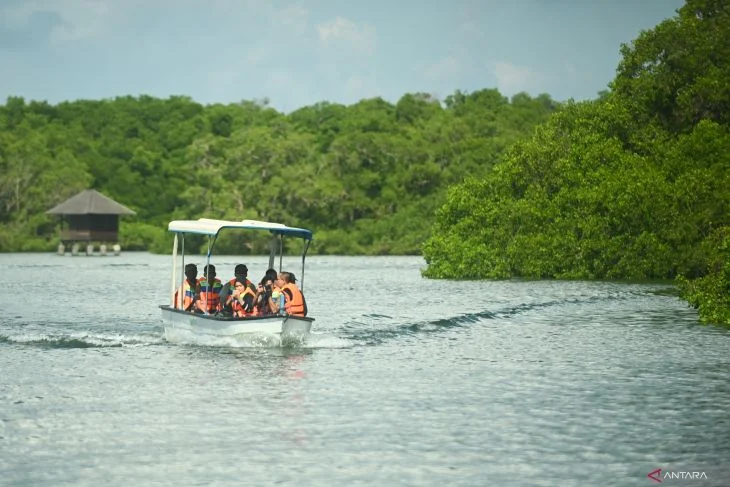
RRI.CO.ID, Denpasar - Ecotourism must not be reduced to a marketing slogan or the commodification of natural beauty for short-term economic gain. The development of ecotourism in Bali must deliver measurable, sustainable contributions to environmental conservation and the well-being of local communities.
This was emphasized by the Chairperson of the Shri Kesari Warmadewa Foundation, Anak Agung Gede Oka Wisnumurti during the opening of the International Conference on Agricultural Innovation and Ecotourism Environment (CAITEC 2026) in Sanur, Bali, on Friday, August 14, 2026.
The international conference carried the theme Improving Food Security through Sustainable Agriculture and Ecotourism Practices in the Issue of Climate Change hosted by the Faculty of Agriculture, Science and Technology at Warmadewa University in Denpasar, Bali.
The collaborative event was co-hosted by several partner institutions: Bali Institute of Technology and Health, Dhyana Pura University, Markandeya University, Dwijendra University, and Pelita Bangsa University. Wisnumurti stressed the need to integrate conservation principles into environment-based tourism and local agricultural systems.
He argued that, amid increasingly tangible global climate change threats, the ecotourism and sustainable agriculture sectors must advance in tandem to support food security while safeguarding Bali’s ecological carrying capacity.
“Ecotourism and agriculture are two vital, mutually reinforcing sectors. Ecotourism development must be rooted in the preservation of nature and culture, so that it delivers measurable ecological benefits and directly strengthens community economies,” he explained on Friday.
CAITEC 2026 served as a strategic forum for researchers from various countries and partner universities to formulate ideas, agricultural technology innovations, and ecotourism governance models adaptive to climate change.
Through this cross-academic collaboration, the outcomes of CAITEC 2026 are expected to go beyond mere academic discourse. Instead, they are intended to be implemented in concrete policies and field practices to ensure the sustainability of Bali’s, and the world’s, environment.
A member of the Bali Governor’s Expert Group, Anak Agung Putu Agung Suryawan Wiranatha, underscored the importance of policy direction and regulations for sustainable agriculture grounded in Balinese local wisdom.
“The development of organic farming systems in Bali aims not only to increase the value and quality of agricultural products, but also to protect natural ecosystems and biodiversity. This is firmly regulated through Bali Provincial Regulation No. 8/2019 on the Organic Farming System,” he said.
Suryawan highlighted the Bali Provincial Administration’s commitment to controlling the conversion of productive land under Provincial Regulation No. 4/2026. This regulation prohibits converting productive land for tourism facilities and property developments to preserve Subak and achieve food sovereignty.
In addition, protection of water sources, such as lakes, springs, rivers, and the sea, has been strengthened through Bali Governor Regulation No. 24/2020.
Dean of the Faculty of Environmental and Conservation Science at Murdoch University in Australia, Michael van Keulensoroti, pointed to a fundamental challenge in modern environmental conservation, which is shifting baseline syndrome. According to Van Keulen, modern science often suffers from a memory problem, with measurable scientific data available only for roughly the last 100 years.
Yet human impacts on marine ecosystems have occurred over a much longer timescale. As a result, each generation of scientists and communities sets standards for natural/normal conditions that are progressively lower than the original state.
“If we forget the true baseline conditions of ecosystems, we risk setting inappropriate conservation and environmental restoration targets that are wrong or too low,” warned Van Keulen.
He cautioned against creeping normality, the gradual acceptance of degraded environments as normal, and conservation complacency, which can cause threats to species extinction to be recognized too late.
To address these issues, Van Keulen emphasized the need to integrate historical records, long-term data, and local knowledge and stories, such as anecdotal records, into scientific research. Scientists are also urged to simplify public communication so that awareness of the importance of preserving original ecosystems can be widely built across society. (Annaila Azzahra-EN)
News Recomendation
Memuat berita terbaru.....