



Indonesia Stocks Fall as Foreign Funds Shift to Commodities
- 12 Sep 2026 00:05 WIB
- Voice of Indonesia
Poin Utama
- The JCI fell 1.33 percent to 6,589, accompanied by net foreign selling of IDR 748 billion in the regular market.
- Foreign investors are reducing exposure to blue-chip stocks and shifting funds into several commodity counters.
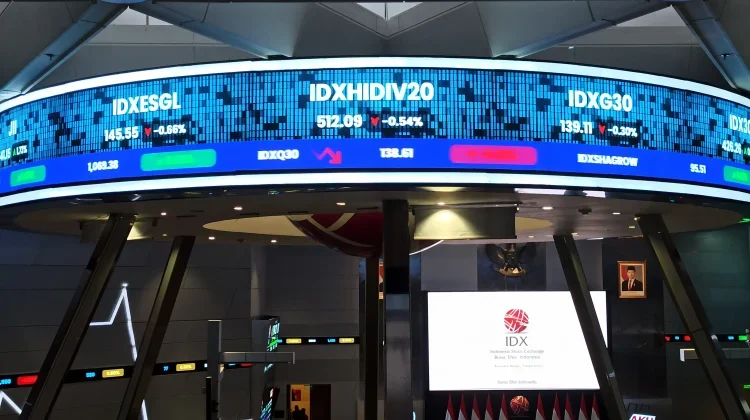
RRI.CO.ID, Jakarta - Global pressures are once again testing Indonesia’s financial markets. Foreign investors are reducing exposure to blue-chip stocks and rotating funds into several commodity counters.
The Jakarta Composite Index (JCI) fell 1.33 percent to 6,589, accompanied by net foreign selling of IDR 748 billion (approximately USD 42.5 million) in the regular market on Friday, September 11, 2026.
Banking stocks, particularly BBCA and BBRI, became a source of pressure after previously supporting the index.
Head of Research & Chief Economist at Mirae Asset Sekuritas Indonesia, Rully Arya Wisnubroto, said investors need to remain selective by monitoring issuers’ fundamentals and domestic liquidity.
“Global sentiment remains challenging as the US 10-year yield approaches 5 percent, the ECB rate rises sharply to 2.5 percent, and oil prices stay elevated. However, the impact on the domestic market has so far been relatively limited,” Rully said in Jakarta on Friday, September 11, 2026, as quoted by Antara.
Amid the sell-off, foreign investors continued accumulating ANTM, AADI, CUAN, and PTBA, indicating a partial rotation toward commodity-related stocks.
The rupiah stood at around IDR 17,547 per USD, while the 10-year Government Securities (SBN) yield reached 7.11 percent. The absence of Bank Indonesia’s Rupiah Securities (SRBI) auctions throughout September also prompted banks to shift liquidity toward SBN.
The strengthening rupiah gives BI more room to ease liquidity in the short term. However, high oil prices and elevated global yields continue to limit the scope for adjusting the BI policy rate.
On the consumption front, the Consumer Confidence Index (CCI) rose to 118.5 in August from 116.8 in July. The Current Economic Conditions Index (CECI/IKE) reached 109.4, while the Consumer Expectations Index (CEI/IEK) climbed to 127.6. The 18.2‑point gap shows consumers remain more optimistic about future conditions than the present.
Research Analyst Novani Karina Saputri at Mirae Asset Sekuritas Indonesia said consumer confidence is beginning to improve, although the recovery remains uneven.
“The IDR 4.1–5 million spending group was actually the only segment to record a decline in confidence, while perceptions of the labor market weakened among respondents with university and graduate degrees,” Novani said.
The savings rate fell the most among households with expenditures of IDR 1–4 million, even as consumption increased across nearly all groups. With inflation at 3.19 percent, these trends indicate that financial buffers for some households are becoming increasingly thin.
“Therefore, we are maintaining a selective portfolio strategy with a preference for stocks with strong fundamentals and solid cash flow. Money Market Funds (RDPU) remain the preferred liquidity anchor, while Fixed Income Mutual Funds (RDPT) remain favorable for gradual accumulation as opportunities in the bond market improve,” Novani said. ***
News Recomendation
Memuat berita terbaru.....