



Wildfires Could Cost Indonesia Up to IDR 123.1 Trillion: CELIOS
- 07 Sep 2026 21:24 WIB
- Voice of Indonesia
Poin Utama
- The Center for Economic and Law Studies (CELIOS), in its latest report, stated that Indonesia’s potential losses due to wildfires.
- This figure doesn't account for wildfires spreading through the end of the year, so that the potential losses could be even greater.
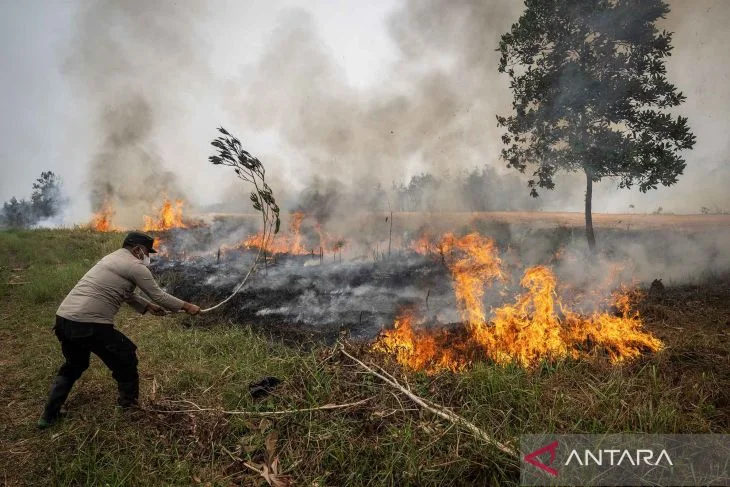
RRI.CO.ID, Jakarta – The Center for Economic and Law Studies (CELIOS), in its latest report, stated that Indonesia’s potential losses due to wildfires amount to IDR 39.29–123.1 trillion (USD 2.22–6.97 billion). This figure represents the total economic and health costs resulting from wildfires during January-August 2026.
“This figure of IDR 123.1 trillion is equivalent to 49.1 percent of Central Kalimantan’s projected Regional Gross Domestic Product (RGDP) for 2026,” said CELIOS Director of Economics, Nailul Huda, as quoted on Sunday, September 6, 2026.
He emphasized that this figure doesn't account for wildfires spreading through the end of the year, so that the potential losses could be even greater.
CELIOS used an approach developed by Kiely et al. (2021) in the journal “Nature Communications” to calculate the potential losses. This approach was combined with historical data from the World Bank regarding the 2015 and 2019 crises.
CELIOS estimates that total economic losses resulting from the loss of physical assets and economic activity amount to IDR 29.54 trillion. This figure is equivalent to 0.23 percent of the national GDP.
“That figure isn’t merely the value of burned timber or land, but rather a broader contraction in economic activity. Sectors ranging from trade and agriculture to accommodation, as well as food and beverages, also experienced a contraction due to haze and production disruptions,” said Nailul.
Regionally, West Kalimantan recorded the largest nominal impact, amounting to IDR 5.7 trillion. West Papua followed with IDR 4.3 trillion, and East Nusa Tenggara (NTT) with IDR 2.8 trillion.
“This indicates that wildfires are no longer just an issue for Kalimantan and Sumatra but have spread to Eastern Indonesia,” said Nailul.
The impact of wildfires, he added, also has the potential to reduce State Revenue. According to Nailul, in total, approximately IDR 269.86 billion in potential net local tax revenue was lost due to this year’s wildfires. East Java suffered the largest loss in potential net tax revenue, amounting to IDR 93.8 billion, followed by West Kalimantan at IDR 28.9 billion.
The fiscal impact of wildfires is not limited to the provinces directly affected; it also spreads to other provinces through linkages in downstream sectors. Nailul mentioned the wood processing, pulp and paper, and furniture sectors as examples.
In addition to the economic impact, the CELIOS report also highlights the surge in healthcare costs caused by the wildfires. CELIOS presented two calculation scenarios: people diagnosed with Acute Respiratory Infections (ARI) by healthcare professionals, and people diagnosed with ARI plus additional symptoms.
For the scenario involving individuals who were actually diagnosed, the potential number is 1.78 million, with total healthcare costs of IDR 9.75 trillion. This figure comprises direct healthcare costs (inpatient and outpatient care) totaling IDR 7.13 trillion and indirect healthcare costs totaling IDR 2.63 trillion.
If people who are symptomatic but unable to seek medical care are included in the calculation, the potential number jumps to 17.4 million people. Consequently, total healthcare costs would reach IDR 93.56 trillion, equivalent to 67.6 percent of the total health budget allocation in the 2026 state budget.
“Interestingly, the provincial rankings for healthcare costs do not align with the rankings for the area of land burned. East Java, West Nusa Tenggara (NTB), and Riau are actually the three provinces with the highest healthcare cost impacts,” said Nailul.
East Java requires IDR 13.65 trillion in healthcare costs, NTB requires IDR 19.01 trillion, and Riau requires IDR 10.31 trillion. In fact, in these three regions, the area burned was not as extensive as in West Kalimantan.
“This is because the high population density in these provinces results in a much larger number of residents at risk. East Java Province, which has the largest population in Indonesia, needs to be aware of hotspots in its region,” said Nailul.
According to data from the Ministry of Environment and Forestry’s Early Warning and Monitoring System for Wildfires (SiPongi KLHK), the total area burned from January to August reached 202,010.96 hectares nationwide. West Kalimantan dominated with an area of 38,310.86 hectares—nearly 1.5 times that of the second-highest province, South Papua, with an area of 25,838.53 hectares.
This year’s wildfires are no longer concentrated in the classic Sumatra-Kalimantan peat belt; a surge in wildfires has also occurred in South Papua. Meanwhile, non-peat provinces such as East Nusa Tenggara (NTT), West Nusa Tenggara (NTB), and East Java are among the regions most significantly affected. (Gusti Panji-EN)
News Recomendation
Memuat berita terbaru.....