



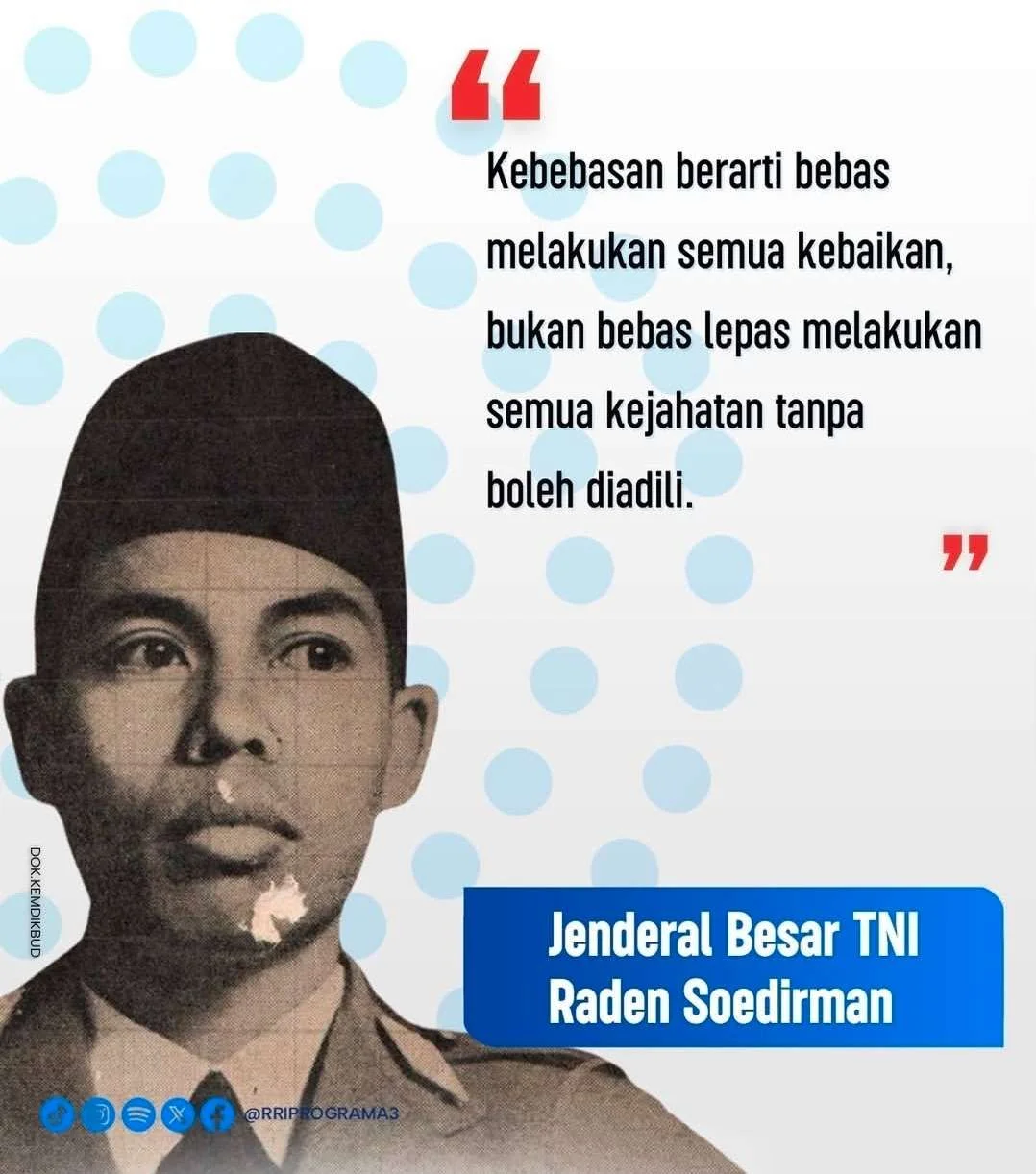
RRI.CO.ID, Jakarta - General Sudirman is one of the important figures in the struggle to defend Indonesia's independence. He is known as the Grand Commander of the Indonesian National Armed Forces (TNI) who led the resistance against the Allied and Dutch forces, including through guerrilla warfare during the Dutch Military Aggression II.
Sudirman was born in Purbalingga, Central Java, on 24 January 1916. He was the son of Karsid Kartawiraji, a worker at the Kalibagor sugar factory in Banyumas, and Siyem, who was a descendant of the Wedana of Rembang. Since childhood, Sudirman was raised by Raden Cokrosunaryo, a sub-district head whom he only discovered was not his biological father when he was 18 years old.
Sudirman pursued his education at Hollandsch Inlandsche School (HIS), then continued to Taman Siswa Secondary School and Wirotomo Secondary School. He later attended HIK Muhammadiyah in Solo, although he did not complete it. During his education, Sudirman was active in the Hizbul Wathan scouting organization, which helped shape his discipline and leadership.
After returning to Cilacap, Sudirman dedicated himself as a teacher at HIS Muhammadiyah. He was also active as a mentor in Hizbul Wathan. As a teacher, he was known to be close to the community and his students. During the Japanese occupation, Sudirman joined the Defenders of the Homeland (PETA) in 1944 and received military training until he was trusted to become a battalion commander.
After Indonesia proclaimed its independence in 1945, Sudirman was involved in efforts to seize Japanese troops' weapons in Banyumas. He was then entrusted to lead the 5th Division of Banyumas and was involved in battles against Allied forces in Ambarawa. The victory in the battle of Ambarawa became one of the important milestones in his military career before he was appointed as the Supreme Commander of the TKR in December 1945.
One of Sudirman's greatest feats occurred when the Dutch launched Military Aggression II in December 1948. In deteriorating health due to tuberculosis, Sudirman continued to lead the guerrilla warfare, moving from one region to another for months. The resistance became an important part of defending the sovereignty of the Republic of Indonesia amidst the Dutch efforts to regain control over Indonesian territory.
After the Netherlands recognized Indonesia's sovereignty on 27 December 1949, Sudirman's health continued to decline. He passed away in Magelang, Central Java, on 29 January 1950, at the age of 34. His body was then buried at the Semaki Heroes Cemetery in Yogyakarta, and his passing was reported through a special broadcast by Radio Republik Indonesia (RRI). General Sudirman's legacy is now remembered as an important part of the history of Indonesia's struggle and defense of independence.
News Recomendation
Loading latest news.....