



After 12 Years, Giant Corpse Flower Expected to Bloom at Bogor Botanical Gardens
- 02 Feb 2026 11:19 WIB
- Voice of Indonesia
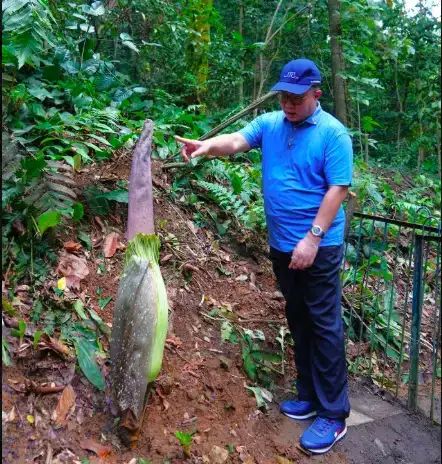
RRI.CO.ID, Bogor - The giant corpse flower (Amorphophallus titanum) is expected to bloom fully on 3 February 2026, at the Bogor Botanical Gardens in West Java, Indonesia. The moment is considered rare, as the flower last bloomed at the same location in 2014.
Head of Indonesia’s National Research and Innovation Agency (BRIN), Arif Satria, who visited the Bogor Botanical Gardens on Saturday, 31 January 2026, said the Amorphophallus titanum is a protected species and is listed as an Endangered Species by the International Union for Conservation of Nature (IUCN). According to him, its blooming pattern remains unpredictable so far.
“When we observe its blooming pattern, it is still irregular. Researchers are continuing to study it because sometimes it blooms every three years, sometimes every two years, and the last bloom was in 2014. This time, it is expected to bloom around 3 February, and this will be a very important moment for biodiversity enthusiasts in Indonesia,” Arif said during the visit, as quoted from BRIN’s official website.
At the time of the visit, Arif noted that the giant corpse flower had reached a height of around 120 centimeters, with a bud diameter of approximately 21 centimeters, indicating it was nearing its peak blooming phase. He stated that this moment, particularly at the Bogor Botanical Gardens, is important for the public to witness, especially younger generations, to better understand Indonesia’s rich biodiversity.
“I think this is a great place to learn about plants, trees, and various rare plant species. These rare plants must be conserved, and the botanical garden is part of the government’s program to conserve them,” he stated.
Arif also expressed hope that the Bogor Botanical Gardens will continue to be developed as a center for research as well as a destination for educational conservation tourism. He believes such efforts can increase public awareness of sustainable biodiversity conservation, including that found at the Bogor Botanical Gardens.
“Once again, Indonesia has extraordinary biodiversity, and it must be truly protected. Our ability to safeguard it will greatly determine Indonesia’s position on the global stage, whether we are a country that not only possesses this wealth, but is also capable of caring for and managing it,” Arif said.
News Recomendation
Loading latest news.....