



Equator Monument Stands as Scientific and Cultural Landmark in Pontianak
- 17 Agt 2026 22:11 WIB
- Voice of Indonesia
Key Points
- The Equator Monument in Pontianak, West Kalimantan, marks the city's unique location directly on the equator at zero degrees latitude.
- The monument serves as an accessible global educational and cultural attraction.
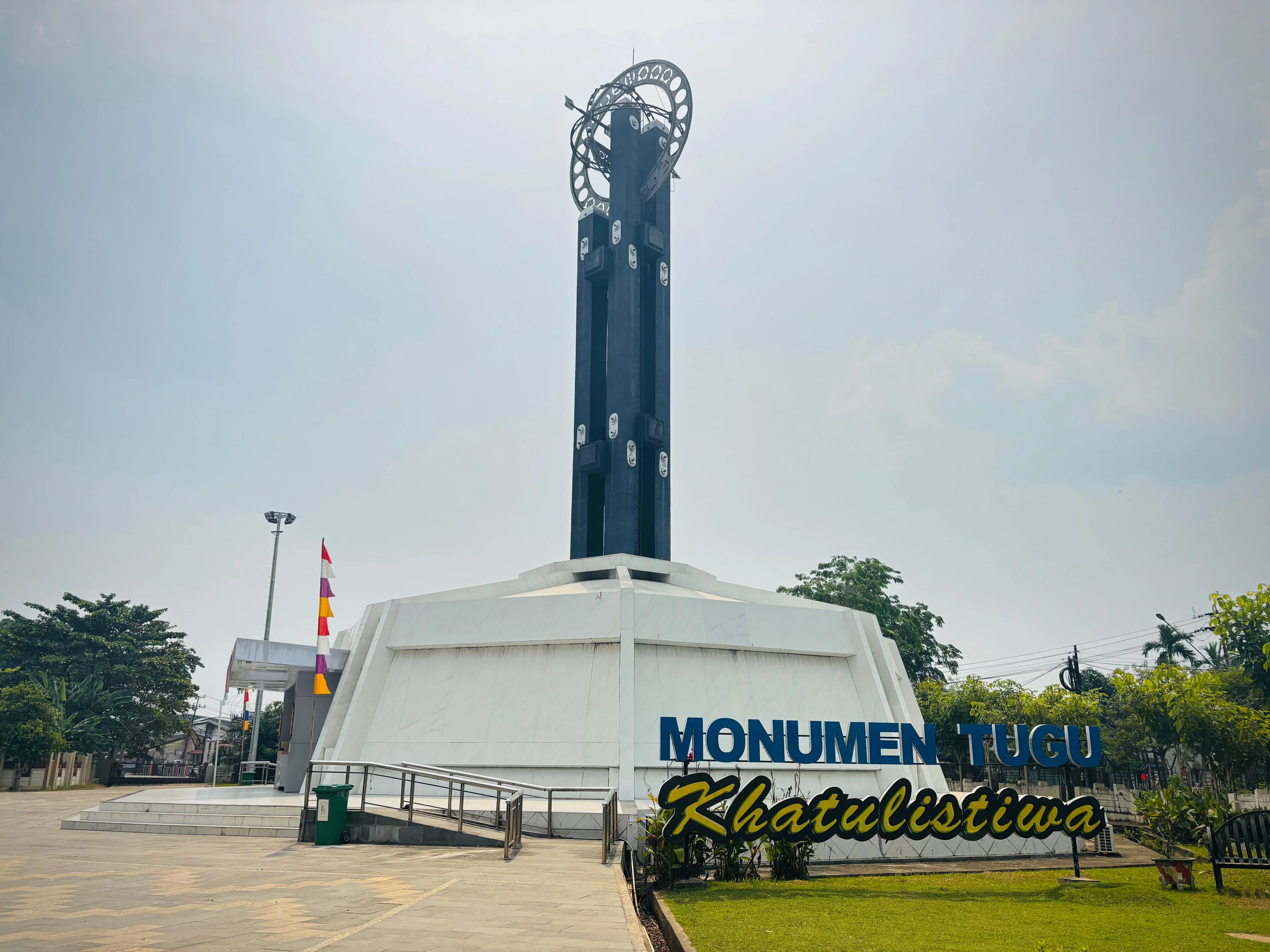
RRI.CO.ID, Pontinanak – The Equator Monument (Monumen Tugu Khatulistiwa) in Pontianak, West Kalimantan, is more than a geographic marker; it is a cultural and scientific landmark that highlights the city’s unique position as the only major Indonesian city crossed by the equator.
Located about 12 kilometers from the Sebelas Digulis Monument or roughly 25 minutes from the city center, it has become a proud local icon and an international attraction.
Twice every year, between 21–23 March and September, the monument becomes the stage for the culmination phenomenon, also known as istiwa or transit, when the sun reaches its zenith and upright objects cast no shadow.
This occurs because the sun’s declination matches the observer’s latitude, placing the sun directly overhead at the zero-degree latitude line, and the event is celebrated locally as the “day without shadows.”
Built in 1928 following a Dutch-led international expedition, the monument has undergone several reconstructions, including major renovations in 1930, 1938, and 1990, when a protective dome and a replica five times larger than the original were added. Inside, the original belian (ironwood) pillars remain preserved, offering testimony to its nearly century-old legacy.
The monument also holds scientific importance, with Indonesian and Japanese researchers conducting gravity measurements here in 2005. Based on repeated measurements taken 9,320 times over four days, the gravity value recorded at this point was 978079.1179 ± 2.1 miligal.
This historic survey marked the first time such measurements were conducted in a city located directly on the equator at zero degrees latitude, and the findings were later published by Takemoto et al. in the Journal of the Geodetic Society of Japan (Vol. 52, No. 1, 2006, pp. 51–95).
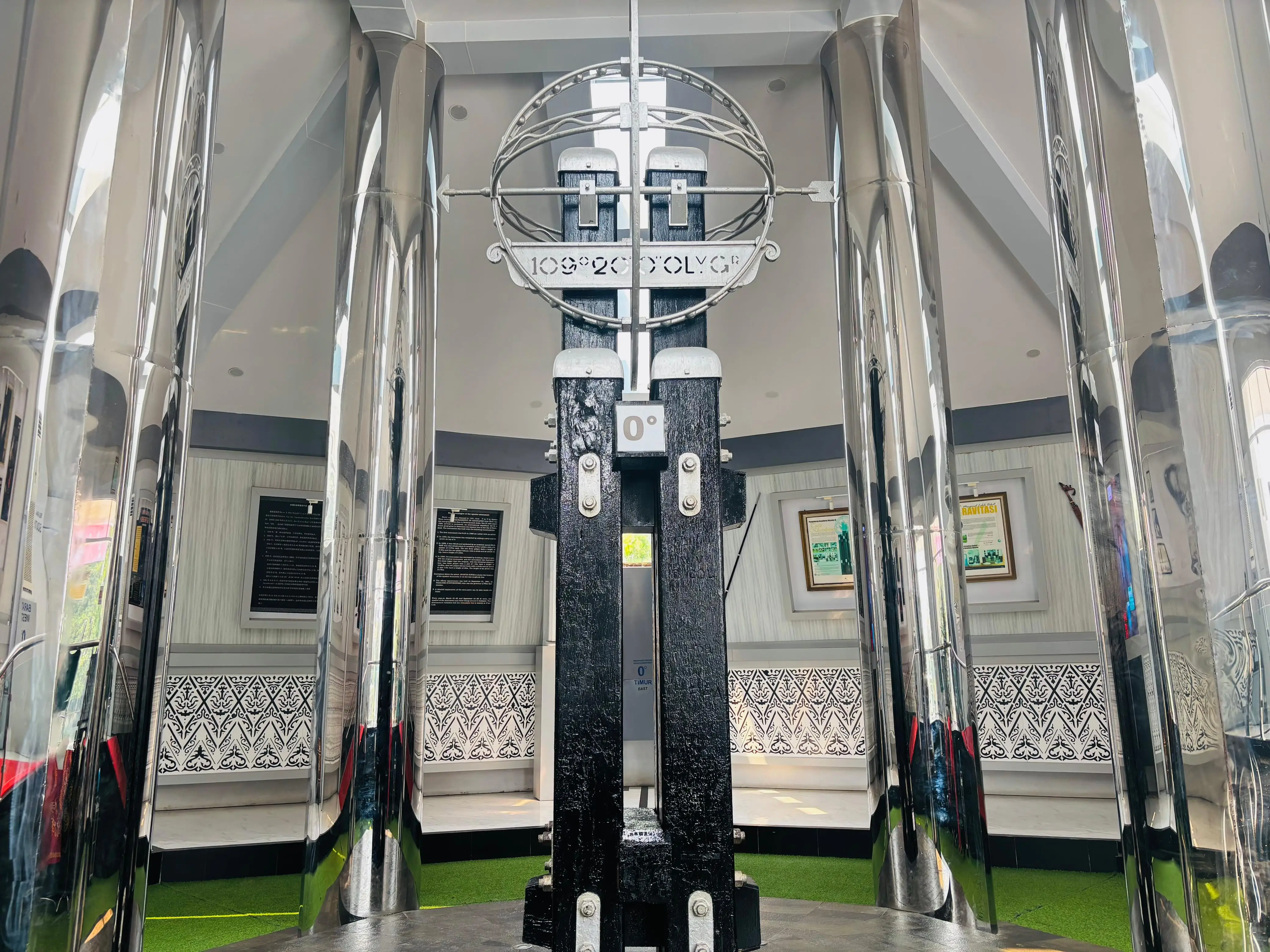
Museum educator Tika recalled the monument’s early condition. "The Equator Monument was first built in 1928 with international agreement, using belian wood, but for decades it stood uncovered and even bore graffiti from visitors before being protected by the dome in the 1990s,” she explained, recently.
She also reflected on its symbolic meaning, sharing that the monument marks the intersection of latitude and longitude and represents the middle of the world between the northern and southern hemispheres, showing that visitors are standing at the very center of the Earth.
“Around the monument you see the large circle inscribed with the word evenaar, the Dutch term for equator, along with arrows pointing north and south which remind us that Pontianak is uniquely positioned at zero degrees latitude where east and west also meet,” Tika noted.
She highlighted another detail of its geographic precision, explaining that the inscription 109° 20' OLvGr (Ooster Lengte van Greenwich) signifies 109 degrees 20 minutes East Longitude from the Greenwich meridian, a marker that confirms the monument’s exact position on the Earth’s coordinate system and reinforces its role as both a cultural symbol and a scientific landmark.
Before the protective dome was built, the monument endured decades of exposure to rain and heat without cover, leaving its wooden pillars vulnerable to weather and graffiti.
“For 63 years the monument stood exposed to rain and heat without any cover, and only in the 1990s was the protective dome built to preserve it, so now it has lasted nearly 98 years and will soon reach a century,” she said.
Today, the Equator Monument continues to draw tourists, scientists, and educators who come to witness the culmination event, explore its exhibits, and reflect on Pontianak’s unique place in global geography.
Open daily from 8 a.m. to 4:30 p.m. local time, entry fees remain modest -- IDR 10,000 (USD 0,56) for domestic adults, IDR 5,000 for children and students, and IDR 20,000 for foreign adults, and IDR 10,000 for foreign children -- making it accessible to all.
Interestingly, visitors can also receive a free certificate of equator crossing as a keepsake, a unique souvenir that officially states they have set foot at the zero-degree latitude of the Earth.
By combining celestial events, historical legacy, and scientific research, the Equator Monument remains a rare destination where geography, culture, and human curiosity converge at the very center of the world. ***
News Recomendation
Loading latest news.....