


The Beauty of Batu Angus: A Trace of Mount Gamalama’s Fiery Eruption
- 03 Nov 2025 16:03 WIB
- Voice of Indonesia
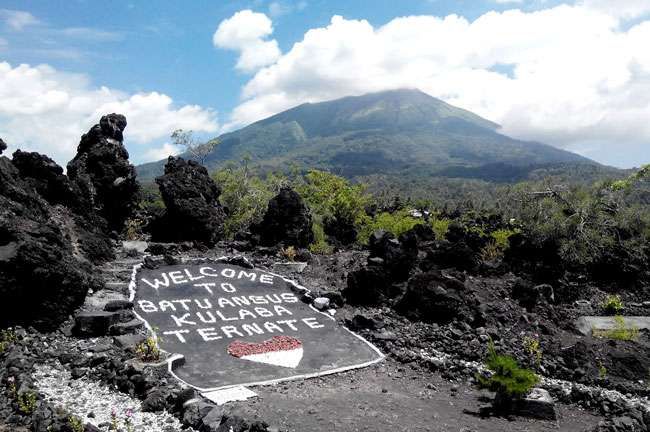
KBRN, Jakarta: The Batu Angus Sea, nestled on the slopes of Mount Gamalama in West Ternate, North Maluku, is one of the many natural treasures that make Ternate a destination of geological and ecological significance.
Batu Angus gets its name from the vast stretch of black volcanic rock that appears scorched or “angus” (burnt), formed by hardened lava flows from Mount Gamalama’s eruption in 1907. The dramatic landscape extending from the volcano’s slopes to the coast now serves as a place of education, adventure, and recreation.
Mount Gamalama is an active stratovolcano that dominates the island of Ternate, rising to 1,715 meters above sea level. Known for its frequent eruptions, it has shaped the island’s landscape and cultural history for centuries.
Visitors can trek through the western region to enjoy sweeping views of Ternate city from above. Batu Angus also features a beach along the Kulaba coast, offering a blend of volcanic terrain and coastal serenity.
According to Rustam Pandjab Mahli, Head of the Ternate City Tourism Agency, the 1773 eruption of Mount Gamalama is not only a historical event but also a scientific record. The area has since been recognized as a geoheritage site, supporting both educational and research activities.
“We’re working to promote the Batu Angus region, which was shaped by the eruption and now showcases vast and unique topography. Toward the end of this year, we’ve seen an extraordinary number of visitors drawn to the Kulaba subdistrict,” Rustam said on Sunday, November 2, 2025.
In 2025, Energy and Mineral Resources Minister Bahlil Lahadalia officially designated Ternate as a geological heritage site. The recognition has paved the way for further development of the area into a hub for tourism, education, and scientific exploration.
Beyond Ternate, another example of educational tourism can be found in Tolitoli Regency, where the Kima (giant clam) Conservation Program is raising awareness about marine biodiversity.
Giant clams, belonging to the genus Tridacna, are large shellfish native to warm seas. Their ability to filter tens of tons of water daily makes them vital to ocean health, earning them the nickname “ocean saviors.” Yet these creatures are now facing extinction.
Habib Nadjar Buduha, Head of the Tolitoli Labengki Giant Clam Conservation Team, noted that while some tropical countries fund giant clam conservation, Indonesia has yet to provide dedicated government support.
“In 2016, the Ministry of Marine Affairs and Fisheries (KKP) launched a National Action Plan for the Conservation of Indonesian Giant Clams, aiming for at least one conservation site. But by the end of 2020, nothing materialized. It still hasn’t happened,” Habib said.
Driven by concern for the species’ survival, Habib began independent research and eventually identified a native Indonesian species: the Bole giant clam.
The conservation site enforces strict regulations and limits visitor access. Entrance fees are set at IDR 100,000 for foreign tourists and IDR 40,000 for domestic visitors. (Misni Parjiati/Ed. Lasti Martina)
News Recomendation
Loading latest news.....