


Umbul Sigedhang-Kapilaler's Pristine Waters Draw Tourists
- 08 Mei 2025 13:19 WIB
- Voice of Indonesia
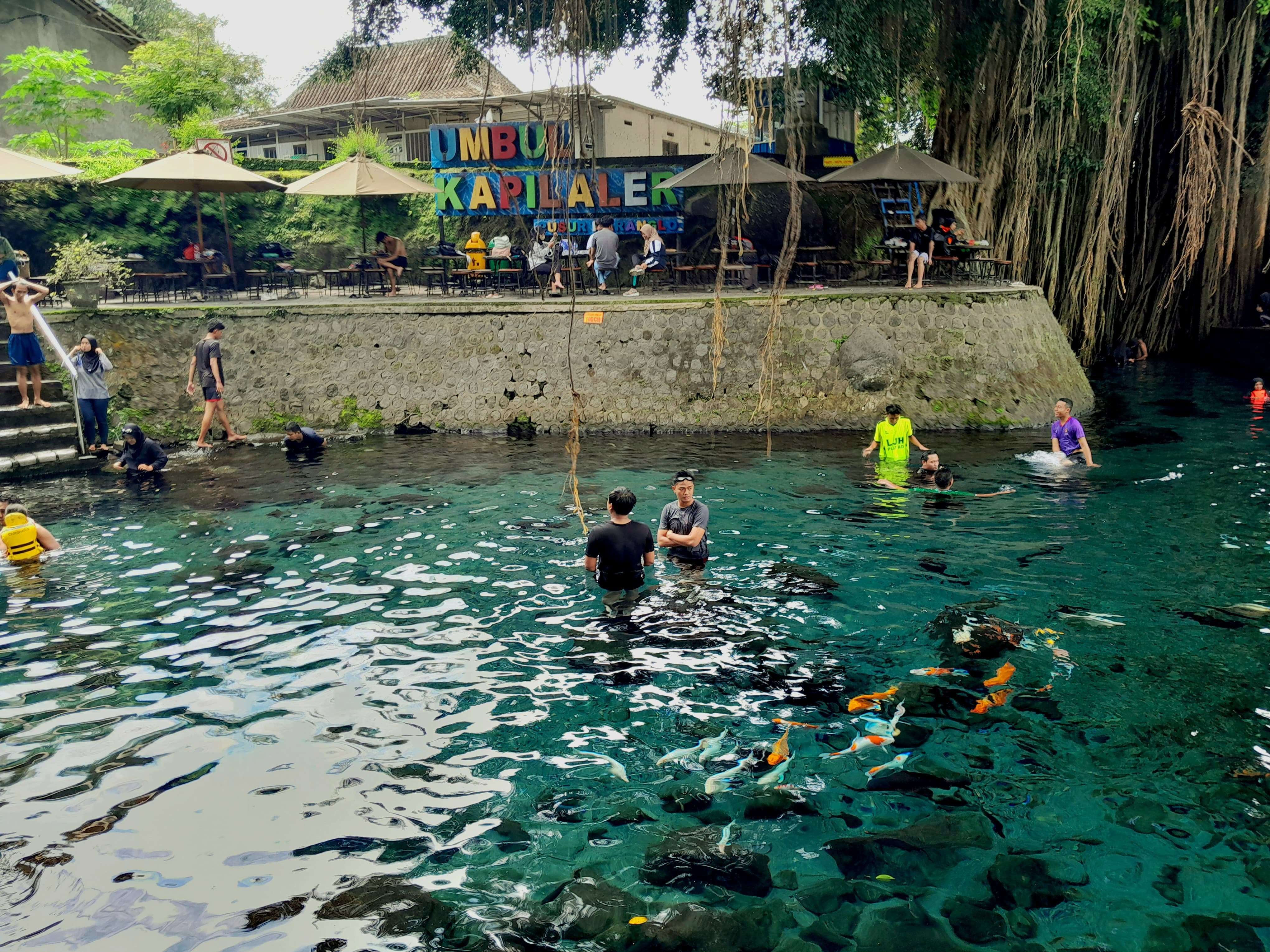
KBRN, Klaten: Before 2009, Ponggok Village in Polanharjo Subdistrict, Klaten Regency, Central Java, languished as the poorest and most underdeveloped among the subdistrict's 18 villages, a stark contrast to its current prosperity.
Now, a palpable air of progress and opportunity permeates Ponggok, fueled by the successful management of village funds generated from the inviting natural swimming pools (umbul) that have become a magnet for tourism.
Triyono, Head of the village's Tourism Awareness Group (Pokdarwis), said that Ponggok was once categorized as an underdeveloped village that required special assistance from the government.
"Yet, in 2024 the village's revenue reached IDR 3 billion from ticket sales, SME, and rental businesses,” said Triyono, who is also Head of Ponggok Village Community-Owned Productive Business Institution (LUPMMDes).
The development of the tourism sector in Ponggok began in 2009 with the conversion of Umbul Ponggok from merely a bathing place into a tourist destination managed by the Village-Owned Enterprise (BUMDes).
This strategic step yielded very encouraging results, as evidenced by the achievement of the highest revenue of IDR 16 billion in 2016.
Seeing this great potential, in 2015, tourism development was expanded to Umbul Sigedhang-Kapilaler. Although administratively Umbul Sigedhang is in Ponggok Village and Umbul Kapilaler is in Karanglo Village, both natural springs are located at the same site.
This geographical uniqueness has encouraged the two villages to work together in managing their tourism potential as these two springs not only provide economic benefits to the surrounding community, but also become a unique tourist attraction.
In addition, both umbul have the slogan “Feel the sensation of bathing in thousands of gallons of mineral water” which successfully lures visitors to feel the sensation of swimming in mineral-rich water.
“In 2002, a bottled drinking water company with a well-known brand in Indonesia established a factory and took the spring water from around Umbul Sigedhang,” said Triyono.
Triyono further said that Umbul Sigedhang and Kapilaler have become silent witnesses to the history and beliefs of the community, the name Sigedhang itself is taken from the word gedhang which means banana, referring to the many banana trees that grow around this spring.
In the past, before becoming a popular tourist destination, Umbul Sigedhang-Kapilaler was believed to be the resting place of the first King of Ancient Mataram Kingdom. The discovery of numerous statues from the Ancient Mataram era in the area in the 1980s further strengthens this belief.
Restoration works in 2017 in the umbul area revealed interesting historical traces. The footprints of a sacred buffalo named Kyai Slamet were found carved on a stone. Yet, to preserve the area and prevent misuse, the footprints were not widely publicized, Triyono said.
Located some an hour drive from Surakarta City, this umbul covers an area of 10 hectares, with each spring occupying an area of two hectares, with varying depths of water sources.
In Umbul Sigedhang, the original water source has a depth of 1.8 meters, while the area separated by a chain has a depth of 80 cm. In Umbul Kapilaler, the water depth on the west side reaches 1.2 meters and on the east side (original source) reaches 1.8 meters.
Umbul Kapilaler has an equally interesting story. There are two versions of the origin of the name “Kapilaler”. The first version is attributed to a myth about a monkey that died and was swarmed by flies around the spring, so it is believed to cure skin diseases. The second version refers to the Dutch term capillair meaning water channel, which was later adopted and adapted into kapilaler by local people.
“Umbul sigedhang used to be called Umbul Lanang, while Umbul Kapilaler was called Umbul Wedok, because in the past when there was no clean water in people's homes, Umbul Sigedhang was a bathing place for men and Umbul Kapilaler for women,” he added.
Triyono further said that the water flow from the two springs is united and has been utilized since the Dutch colonial era to irrigate the sugar factory in Ceper, Klaten Regency but stopped operating in 1998.
The water from this springs continues being used for irrigation, flowing from Umbul Kapilaler in Ponggok Village, Polanharjo Subdistrict, and extending to Ceper Subdistrict.
“But the water seems to be getting smaller due to sedimentation. When the factory was still active there used to be officers from the factory who guarded or cleaned the water channel," said Triyono, adding that the spring is now for both irrigation and fish farming.
There are various types of fish that adorn these two ponds, the result of natural stocking and breeding efforts. The Ministry of Environment once release spotted barb fish into the ponds in a move of restoring the habitat's original fish population. Unfortunately, the fish has now disappeared.
On the other hand, nilem fish (Osteochilus vittatus), commonly used in fish therapy, experienced a sharp increase. However, due to their behavior, which disrupted visitors, they were eventually released into the river. In contrast, koi fish and other ornamental species, accustomed to human interaction, tend to remain in the spring and are less likely to swim away.
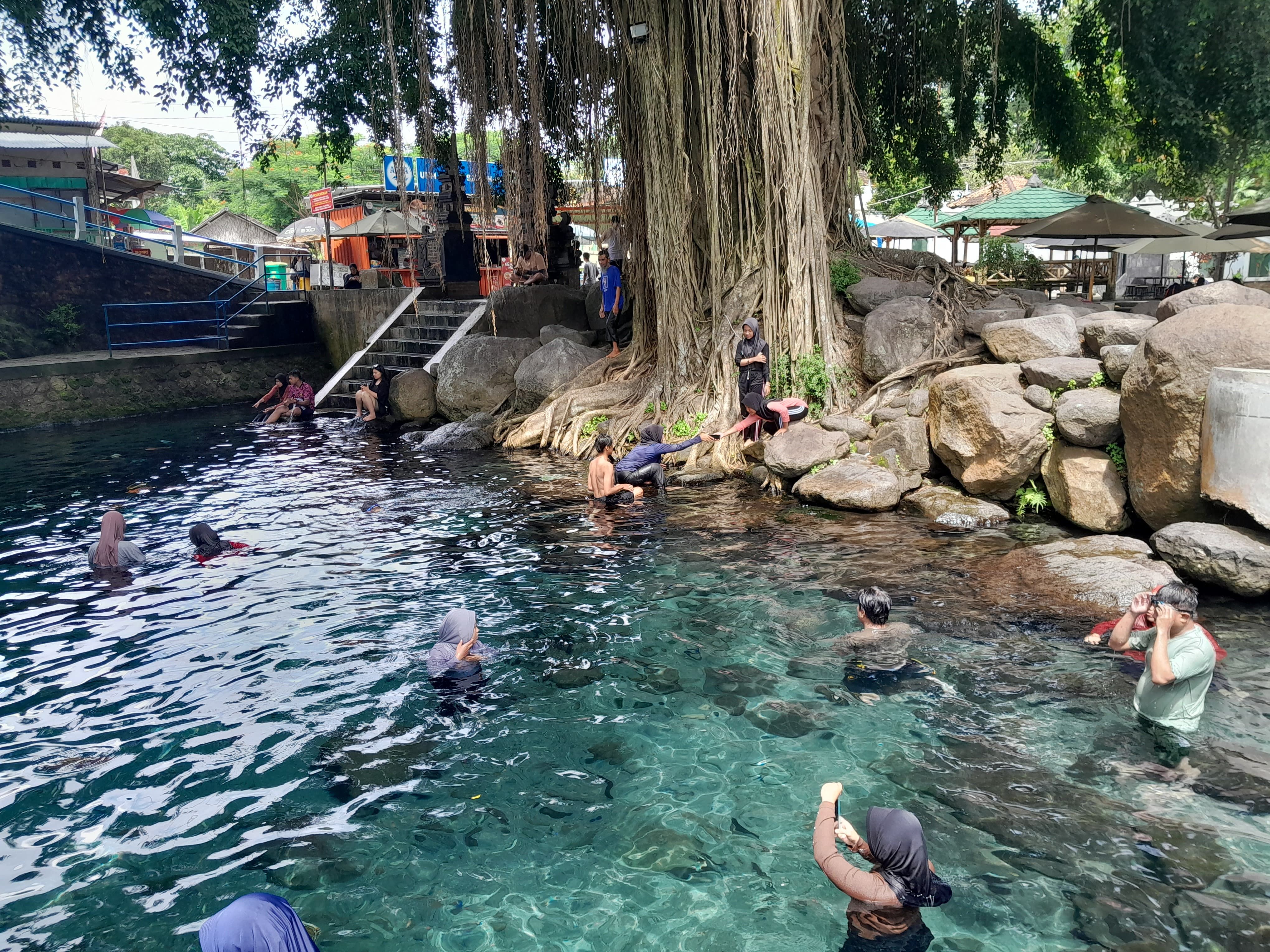
The iconic, centuries-old banyan trees of Umbul Kapilaler, sprouted from the remains of a parent tree, stretched their ancient roots across the river, creating a majestic and timeless natural gateway. (Photo: RRI English/Diva Rifdah Rizkia Puspitaningnala)
“Because there is a canal connecting Umbul Sigedhang and Umbul Kapilaler, the fish move to and from both springs. At night the fish swim in Umbul Sigedhang. During the day they move to Umbul Kapilaler,” said Triyono.
This springs have turned into a very popular tourist destination, attracting an average of 12,000 to 20,000 visitors each month. On weekdays, the number of visitors reaches 300 to 500, while on weekends it can reach more than 1,000.
Triyono claimed that the water of the springs is very suitable for drinking, because its mineral content is the second highest in Indonesia. This accounts why, next to the site there is a water source used by bottled drinking water companies.
"We have sent water samples to the lab to verify that the water at Umbul Sigedhang-Kapilaler is safe for drinking. Additionally, we are assessing whether the water quality remains suitable after leaving the pool. We are currently awaiting the lab results," said Triyono.
Umbul Sigedhang and Kapilaler pulsed with youthful energy, drawing crowds of teenagers primarily from neighboring cities of Surakarta, Yogyakarta, and of course Klaten.
The rising excitement around exploration has drawn visitors from farther afield, including the Central Java cities of Semarang and Kudus, as well as East Java, and even distant islands like Sumatra and Kalimantan. Among them is a growing number of international travelers, some already captivated by the springs' allure.
"We chose to visit this place during our vacation because, aside from being an affordable travel destination, we love the fresh and crystal-clear water. Here, we can swim alongside the fish, enjoy the refreshing experience, and it's conveniently close to Solo," said visitor Fitri, referring to the popular nickname of her hometown, Surakarta, Central Java.
The air hummed with the excited chatter of new discoveries and shared experiences around the crystal-clear waters, a vibrant blend of local enthusiasm and the quiet wonder of first-time visitors.
For Monday to Friday entrance ticket, visitors get a bundling price of IDR 10,000 (USD 0.60) plus a free 220ml mineral water per person. On Saturday, Sunday, and public holidays, the entrance tickets are also priced at IDR 10,000 it exclude the bottled drinking water. "The operating hours are 7 a.m. to 5 p.m. local time,” Triyono concluded. ***
News Recomendation
Loading latest news.....