



Glodok: Monaco of Dutch East Indies Minus Monte Carlo
- 17 Jan 2025 16:36 WIB
- Voice of Indonesia
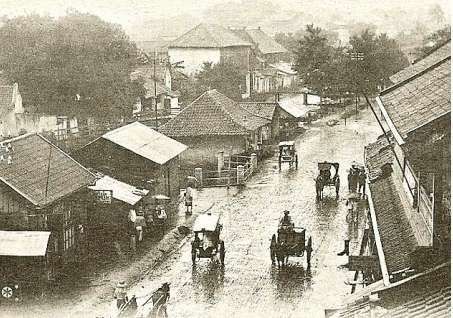
KBRN, Jakarta: A massive fire struck Glodok Plaza in Tamansari, West Jakarta, on Wednesday, January 15, 2025, drawing public attention due to several dramatic events that occurred alongside it.
Behind this disaster, Glodok Plaza has a long history as one of the iconic shopping centers in Jakarta's Chinatown. As reported by rri.co.id, here is the brief history of Glodok Plaza which is still visited by many tourists when they are in Jakarta:
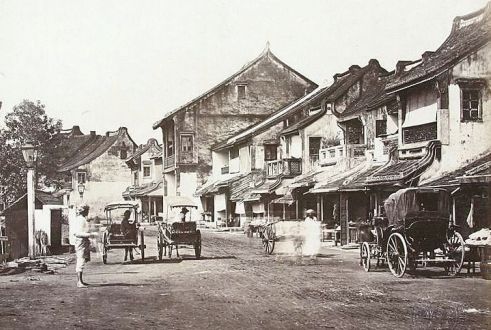
The atmosphere of Glodok in 1872 (Photo: West Jakarta Toponymy book/geheugenvannederland.nl)
Origin of the Name Glodok
There are many speculations about the origin of the name Glodok. One theory suggests it comes from "galodog," a word in Sundanese meaning stairs—specifically three steps leading to a house.
According to the book "Toponimi Jakarta Barat," there is no record of Sundanese people residing in the area now known as Glodok, making this speculation seem implausible.
Another theory proposes that Glodok comes from the word "grojok," which refers to the sound of water falling, such as from a fountain or waterfall.
A humorous novelist from Amsterdam, Justus van Maurik, described Glodok in his 1965 book "Indrukken van een Tòtòk" as "the Monaco of the Dutch East Indies, minus Monte Carlo."
The History of Glodok
During the era of the Vereenigde Oostindische Compagnie (VOC), the Dutch trading company established to dominate the spice trade in Asia and Indonesia, the Glodok area was known for its waterspout, which served as a primary source for sailors and traders to refill their drinking water supplies.
This spout was located around what is now Jalan Pancoran, near Kali Besar. At that time, the waterspout was not only a strategic location for logistics, but also for trade transactions.
However, not all activities proceeded smoothly. Conflicts frequently arose between foreign sailors and local traders competing for access to the waterspout. Furthermore, this area became known as a center for spice smuggling by foreign traders who exploited the crowds to evade VOC oversight.
In 1740, a major tragedy struck the Chinese community in Batavia where thousands of Chinese were massacred. Those who survived were relocated by the VOC outside the city walls, including to the Glodok area. This area later became known as Chineesche Kamp or Chinatown, as recorded on maps from 1810.
The name Glodok is believed to have existed before the 1740 tragedy, although it had not yet developed into a large settlement. The transformation of the word "grojok" to "glodok" is thought to be due to language adaptation, where the pronunciation of "r" by the Chinese community changed to "l." In a short time, this term became the official name of the area.
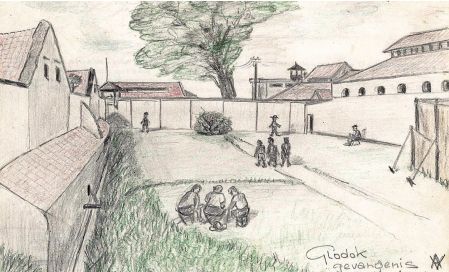
The inside of Glodok Prison painted in pencil by a prisoner (Photo: West Jakarta Toponymy book/geheugenvannederland.nl)
The Transformation of Glodok
Over time, Glodok rapidly developed as a trading area. The canals that once served as water distribution routes gradually lost their function, such as Sirihgracht became Jalan Tongkangan, while Areeksgracht is now known as Perniagaan Timur.
The historical traces of Glodok are also embedded in street names such as Gang Kalimati, believed to be a tribute to the victims of the 1740 tragedy.
Blandongan, part of Glodok, stands witness to the acculturation of Chinese culture. The name Blandongan comes from the Hokkien term "landung," meaning winding road, which describes the area's topography.
To this day, Glodok remains a symbol of Chinese culture in Jakarta, featuring traditional markets, temples, and various historical buildings. ***
News Recomendation
Loading latest news.....