



BRIN Sees Sugar Palm Sap as Key to Indonesia’s Bioethanol Future
- 27 Jun 2026 09:16 WIB
- Voice of Indonesia
Key Points
- BRIN says sugar palm sap offers strong potential for bioethanol production due to its simple processing, high octane value, and long-term productivity.
- Researchers recommend expanding dedicated energy plantations as Indonesia develops bioethanol infrastructure to reduce reliance on fossil fuels.
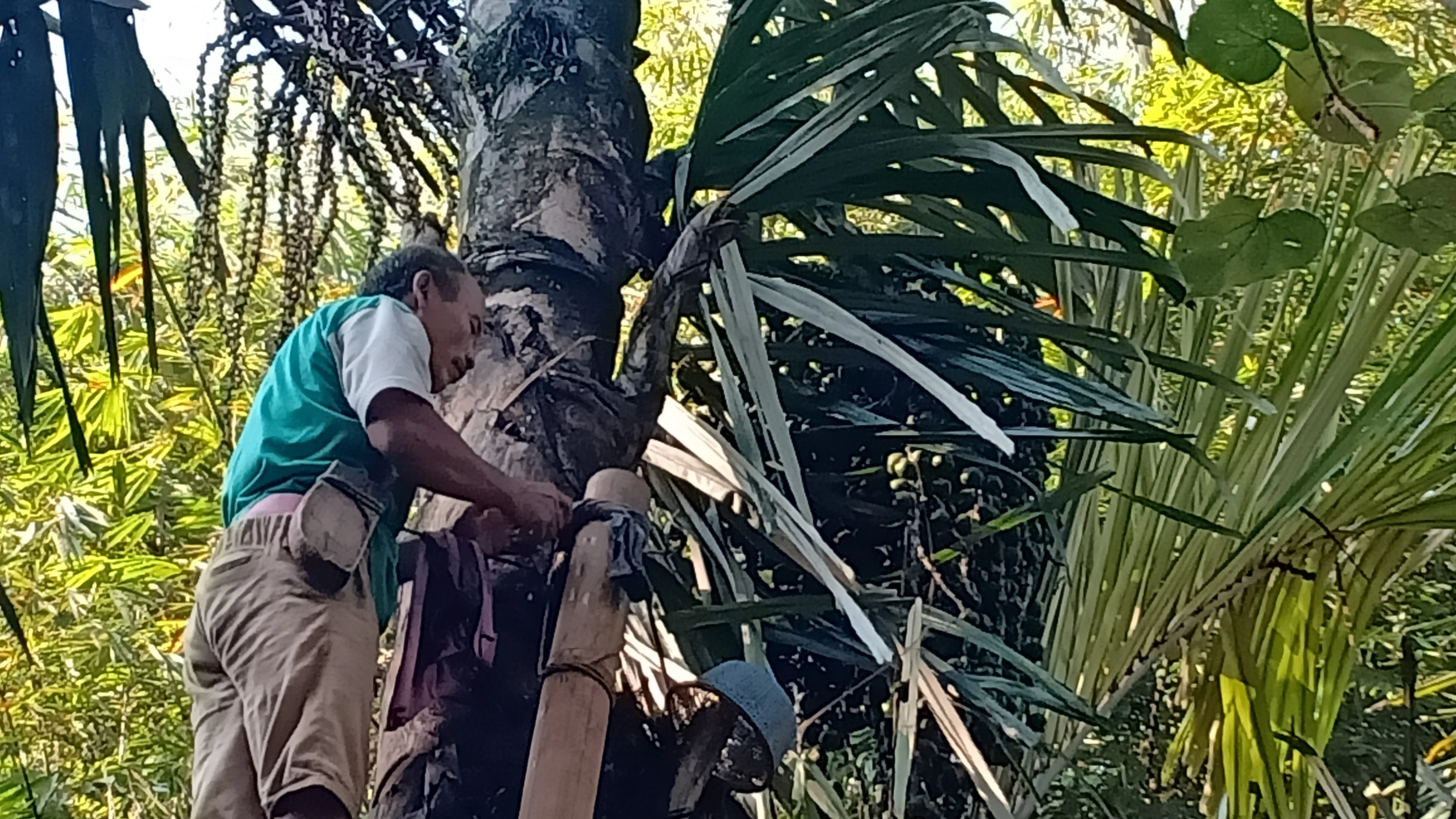
RRI.CO.ID, Jakarta - The sugar palm tree (Arenga pinnata, or aren) is uniquely positioned to become a cornerstone of Indonesia’s renewable energy portfolio due to its straightforward distillation process, multi-decade sustainability, and capability to thrive on marginal land, according to a researcher from the National Research and Innovation Agency (BRIN).
Speaking at the Sustainable Forest Development Center in Bogor on Friday, June 26, 2026, Researcher at the Biomass and Bioproduct Research Center of the National Research and Innovation Agency (BRIN), Saptadi Darmawan, explained that sugar palm sap (nira) offers a significantly less complex production cycle than starch- or wood-based biomass. Because the raw sap is naturally rich in sucrose, glucose, and fructose, it can be directly converted into bioethanol using basic fermentation and distillation.
Furthermore, fuel-grade bioethanol derived from sugar palm sap boasts an impressive octane rating of approximately 108, outperforming premium commercial gasoline. A single sugar palm tree can be tapped consistently for up to 20 years, providing a highly reliable and sustainable stream of green energy.
"Its economic value is quite good. It's also renewable," Saptadi said on Friday, June 26, 2026, as quoted by Antara.
Ecologically, the tree's extensive root systems anchor vulnerable soil to prevent erosion, conserve water tables, and yield nectar that supports local bee populations.
Despite these clear benefits, broad commercialization faces unique structural and cultural hurdles. In several regions, energy production competes directly with traditional traditional liquor industries, which often offer higher short-term economic returns for local farmers.
To eliminate raw material friction, Saptadi argued that the sector must be cleanly split into two separate supply networks. Under this approach, community-led palm farming would continue to serve the culinary market, while dedicated, industrial-scale cultivation zones would be established to guarantee steady, long-term sap volumes for the energy sector.
"For its development, we must create two clusters: sugar palm for food and sugar palm for energy. If we don't separate them, development won't run smoothly," Saptadi warned.
Financially, BRIN's feasibility models suggest that sugar palm bioethanol ventures are highly lucrative for cooperative systems and small-scale industries. The research team calculated the Cost of Goods Sold (HPP) to be between IDR 8,500 (USD 0.48) and IDR 10,000 per liter, with estimated market prices reaching IDR 14,000 to IDR 16,000 per liter, yielding a healthy gross margin of 35 to 45 percent.
Saptadi also recommended a total-utilization approach to maximize profit margins. Beyond utilizing the sap for bioethanol, processing facilities can package the fruit into kolang-kaling (palm fruit preserves), sell the tough black fibers (ijuk) for heavy industrial manufacturing, and press left-over organic waste into high-density bio-pellets or bio-briquettes.
Data from the Central Bureau of Statistics (BPS) notes that sugar palms are distributed across the archipelago, with West Java holding the largest cultivation acreage, followed closely by North Sumatra and South Sulawesi. However, Saptadi raised concerns over a gradual shrinkage in national sugar palm territory.
BPS data revealed that total acreage dropped from 64,544 hectares in 2019 to 60,557 hectares in 2023, causing a corresponding production dip from 107,415 tons in 2021 to 100,273 tons in 2023.
To counter this decline and accelerate the national green transition, the government has begun rolling out physical production infrastructure. In December 2025, the Ministry of Forestry inaugurated the Sugar Palm Bioethanol Pilot Project at Pertamina Geothermal Energy (PGE) Kamojang in Garut, West Java.
During the launch, Forestry Minister Raja Juli Antoni hailed the project as a critical milestone for the state's renewable energy roadmap, noting that sugar palms are ideal for reforestation and energy security because they stabilize sloping, mountainous forest terrain.
The PGE Kamojang pilot facility processes raw sap supplied by the Baru Bojong Social Forestry Business Group (KUPS) in Garut. The plant has an operational capacity of 300 liters of bioethanol per day, consuming roughly 300 to 500 kilograms of raw sap daily. Forestry Ministry estimates show that one hectare of dedicated sugar palm cultivation can yield up to 24,000 liters of bioethanol per year. ***
News Recomendation
Loading latest news.....