



Researchers at Brawijaya University Discover Four New Beetle Species
- 26 Jun 2026 18:52 WIB
- Voice of Indonesia
Key Points
- UB co-hosted with University of Florida, strengthening its international scientific profile.
- Four beetles identified are Crossotarsus gunung api, Cosmoderes arjuno, Cosmoderes opacus, and Amasa brawijaya.
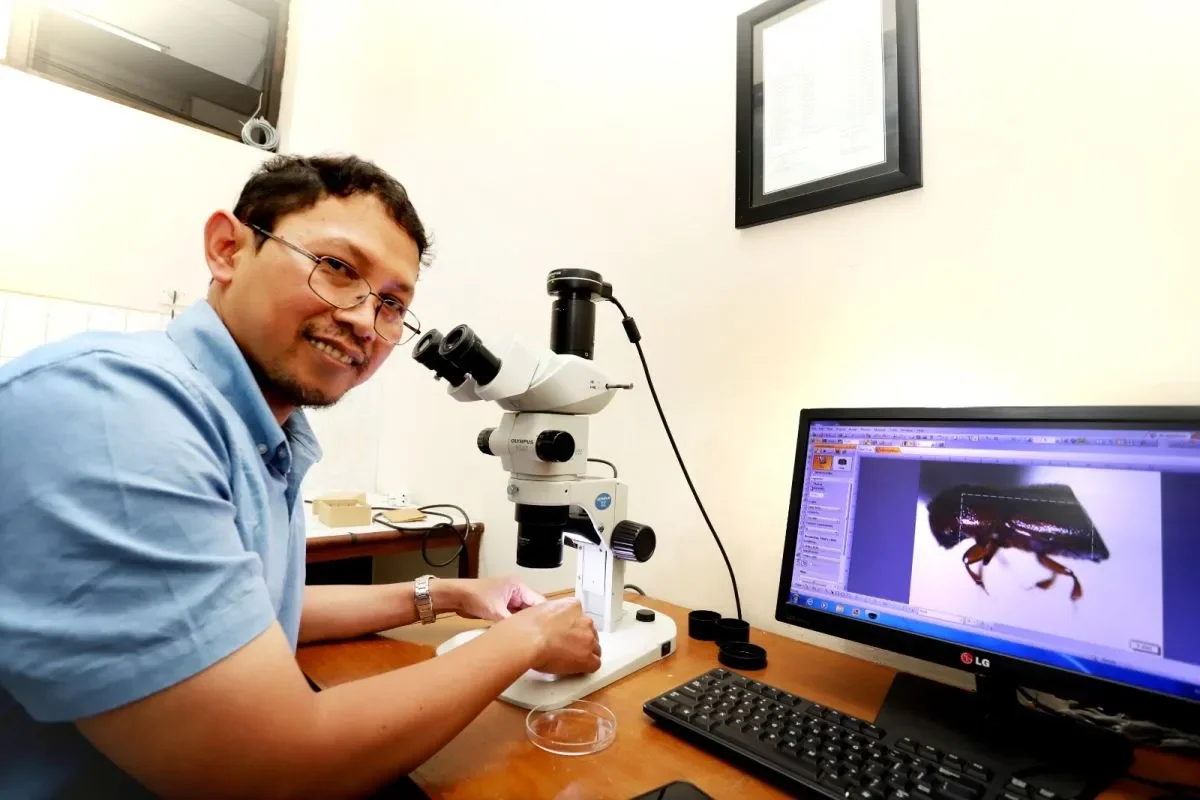
RRI.CO.ID, Malang - Brawijaya University (UB) has strengthened its standing in the international scientific community after hosting the global “Bark and Ambrosia Beetles Academy” together with the University of Florida. The collaboration not only brought together leading taxonomists from around the world but also discover four new ambrosia and bark beetle species in the UB Forest area, Malang Regency, East Java.
The discoveries are the outcome of an international research collaboration between Brawijaya University, the National Innovation and Research Agency (BRIN), the University of Florida, and Michigan State University from United States (US). Team leader, Hagus Tarno, said samples were collected from fallen twigs and dry wood on the forest floor.
“Ambrosia beetles were found on various types of wood, such as pine, coffee, sonokembang, ficus, and other tree species that host the fungi they feed on,” he said in a statement received in Malang on Friday, 26 June 2026.
He explained that ambrosia beetles are unique because they live in symbiosis with fungi. They tunnel into wood and cultivate the fungi as their food source.
“That is why we collected many samples from different kinds of twigs and wood in UB Forest,” said the professor from UB’s Department of Plant Pests and Diseases, Faculty of Agricultural and Forestry Bio-Industry.
He was accompanied in the study by Yogo Setiawan, who is currently pursuing a doctoral degree at Kagoshima University, Japan. Data collection in the UB Forest area began in October 2024.
The research ran alongside the University of Florida’s “Bark and Ambrosia Beetles Academy,” an international forum that gathered taxonomic experts to study the diversity of Indonesia’s tropical forest beetles.
The team identified four new species, which are Crossotarsus gunung api Hulcr, Tarno and Levia; Cosmoderes arjuno Johnson; Cosmoderes opacus Johnson; and Amasa brawijaya Smith.
One species was given a special name, Amasa brawijaya, chosen to honor Brawijaya University and to reference the historical legacy of the Majapahit Kingdom. Hagus added that the designation is expected to raise UB’s profile in the international scientific community.
“We want the name Brawijaya to be known not only as a university, but also as part of the history of science. When people look up or study this species, they will know it was discovered through research conducted at Brawijaya University,” he said, as quoted by Antara.
The naming also recognizes local identity and underscores that Indonesia’s forests still harbor high-value biodiversity for global science.
For identification, the team used two main approaches, which are morphological analysis and DNA-based molecular analysis. Through morphology, researchers compared the specimens’ physical characteristics with collections housed in insect museums worldwide.
They then performed molecular analysis by extracting DNA to compare the specimens’ genetic sequences with international databases. “We compared morphological traits with species stored in various insect museums. We also conducted DNA analysis to confirm genetic differences. If results show significant differences from known species, the specimen can be designated as a new species,” he said.
Specimens of Amasa brawijaya are now deposited at the Museum Zoologicum Bogoriense (MZB), managed by BRIN, as part of Indonesia’s scientific collections and biodiversity research references.
The discovery of four new species highlights the potential of Indonesia’s tropical forests, including UB Forest, as natural laboratories for biodiversity research.
With growing global attention on biodiversity conservation, studies like this strengthen the scientific database on insect species, especially groups that remain little known to the public. For UB, the research not only produced international scientific publications but also reinforced the university’s position as a center for ambrosia beetle research in Indonesia.
Hagus said studies on ambrosia beetles remain limited, offering UB a major opportunity to pioneer the field. “In the future we want to build wider research networks, both nationally and internationally. We hope anyone who wants to study ambrosia beetles will come and collaborate with Brawijaya University,” he said.
The findings were published on 21 June 2026 in the Journal of the Coleopterists Bulletin in an article titled Checklist of the Bark and Ambrosia Beetle Species (Coleoptera: Curculionidae: Platypodinae and Scolytinae) Collected at the Universitas Brawijaya Forest Properties, East Java, Indonesia with Descriptions of New Species. ***
News Recomendation
Loading latest news.....