



ITS Launches Unmanned Vessel to Tackle Marine Pollution
- 13 Jun 2026 01:52 WIB
- Voice of Indonesia
Key Points
- The Sepuluh Nopember Institute of Technology (ITS) develops unmanned vessel to combat marine pollution.
- Double‑hull design ensures stability and easy community operation.
- Innovation funded by Dikti and LPDP, tested in Bali and Kalimantan.
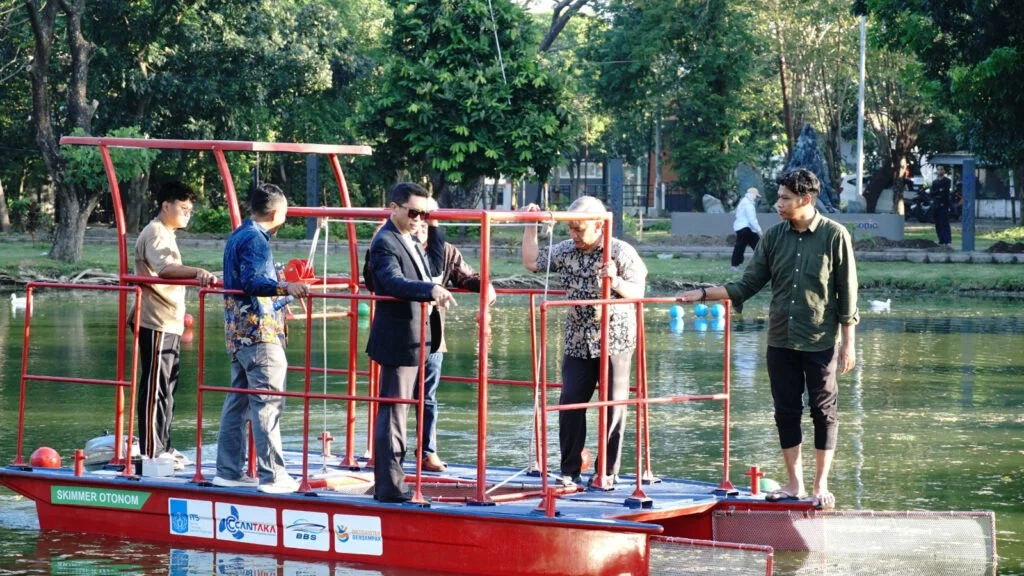
RRI.CO.ID, Surabaya - Marine pollution continues to threaten Indonesia’s coastal ecosystems, prompting researchers at the Sepuluh Nopember Institute of Technology (ITS) to develop an innovative unmanned waste‑cleaning vessel.
The project, led by Hasanudin from the Department of Naval Architecture, Faculty of Marine Technology (FTK), was officially launched at the Amphitheatre InfinITS on Thursday, June 11, 2026.
ITS Rector Bambang Pramujati stressed that waste management must also be a priority for academics. “This technology is simple but, insya Allah, its benefits will be significant. It reflects ITS’s vision as a campus that creates real impact,” he said during the launch, as quoted on the university’s official website.
Hasanudin explained that the vessel was designed to address rising microplastic pollution in coastal ecosystems. “Waste carried into coastal areas poses a serious threat to biodiversity. If not handled immediately, our marine ecosystem is at stake,” he noted.
The vessel uses a double‑hull design for stability and is intentionally kept simple so local communities can operate and maintain it. “We designed a system that is straightforward yet strong, because it is targeted for coastal communities,” he added.
Front fins guide floating waste into a central collection basket, while a remote‑control system allows operation from up to one kilometer away. “Sometimes overly advanced technology becomes idle due to high maintenance costs and limited expertise in coastal areas,” Hasan explained.
Funded by the Directorate General of Higher Education (Dikti) and the Indonesia Endowment Fund for Education (LPDP) through downstreaming programs, the innovation has already produced two new units that have been tested in Bali’s coastal waters.
These larger vessels, measuring eight meters, are more resilient against open‑sea waves. “We equipped them with shredders, CCTV monitoring systems, and solar‑powered energy supply,” Hasan said, adding that community readiness is ensured through SOP documentation and collaboration with local organizations.
Trials have also been conducted in Bali and Kalimantan through cooperation between ITS’s Science Techno Park (STP), Maritime/Nasdec, and PT Pertamina (Persero). Hasan revealed plans to integrate AI and IoT systems to automatically detect areas of high waste density. “We want this maritime technology to have sustainable value for society,” he emphasized.
The project aligns with global sustainability goals, particularly SDG 6 (Clean Water and Sanitation) and SDG 14 (Life Below Water). ITS hopes the innovation will spark wider collaboration among academics, industry, and communities to safeguard Indonesia’s maritime environment. ***
News Recomendation
Loading latest news.....