



Government Promotes Standardization of Exported Fruit Irradiation Using Mango
- 20 Mei 2026 14:48 WIB
- Voice of Indonesia
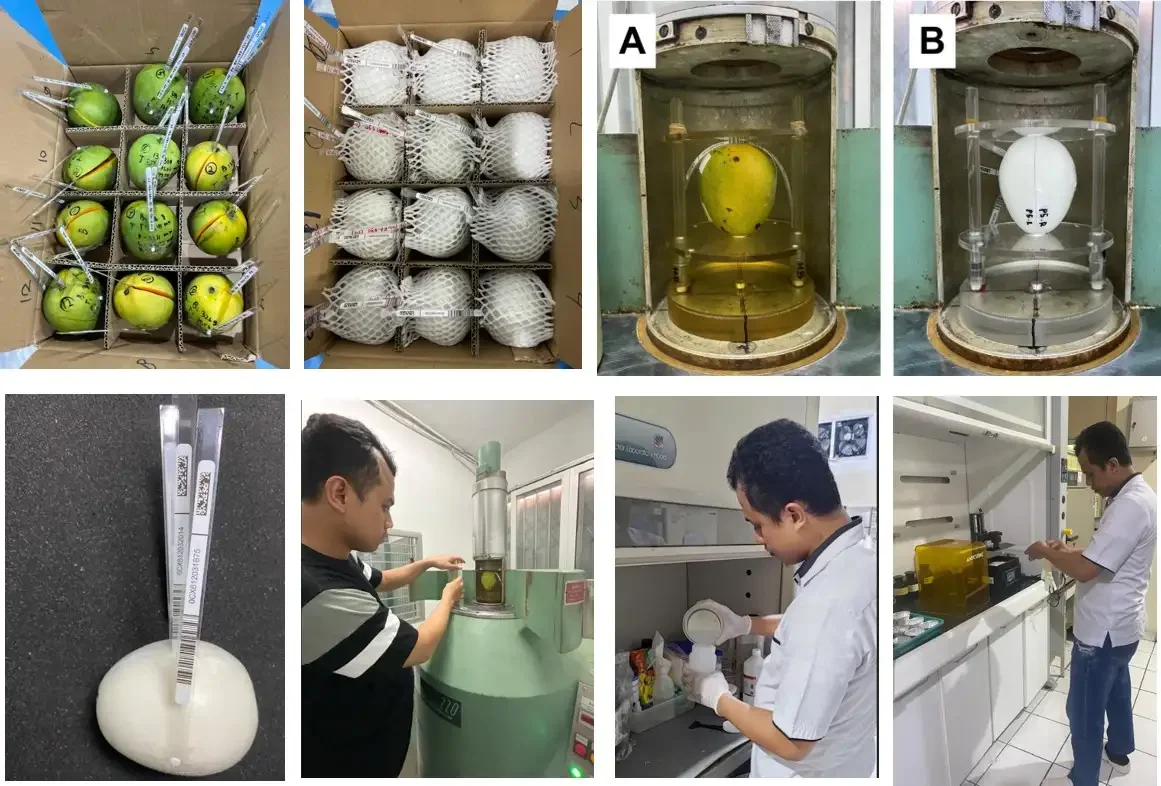
RRI.CO.ID, Tangerang - The Indonesia's National Research and Innovation Agency (BRIN), through the Nuclear Technology, Safety, Metrology, and Quality Research Center, has developed a phantom-based radiation dose measurement method, or fruit substitute material, to support the phytosanitary irradiation process for Gedonng mango varieties.
This innovation is expected to strengthen Indonesia's fruit export quality assurance system, particularly in meeting the requirements of fresh export destination countries such as Australia.
In a statement received by RRI VOI from the National Research and Innovation Agency on Tuesday, May 19, 2026, a researcher at the Nuclear Technology, Safety, Metrology, and Quality Research Center, Okky Agassy Firmansyah, explained that the research focuses on developing mango phantoms as a representative medium for radiation dose measurement during the pre-irradiation and quality control stages.
The phantoms are designed to mimic the characteristics of radiation interactions with real mangoes, allowing them to be used as substitute fruit samples for dose mapping during the off-season. "This phantom is an artificial fruit designed to have radiation absorption characteristics similar to those of a real mango. This way, audits, dose mapping, and irradiation testing at the facility can still be carried out even when fresh fruit is unavailable, especially during off-season," Okky explained.
According to him, the research results have been published in the journal Radiation Physics and Chemistry, under the tit(le "Development and Characterization of a 3D-Printed Gedong Mango Phantom for Dose Measurement in Gamma Ray Phytosanitary Irradiation." Furthermore, the mango phantom innovation has also received Intellectual Property Rights (IPR) protection under the registration number 000845287.
Phytosanitary irradiation is a quarantine method to ensure that exported fruit is free from plant pests (OPTs), such as fruit flies, mango seed weevils, red-banded mango caterpillars, and mealybugs. Export destination countries implement strict requirements to prevent pests from the country of origin from being introduced and disrupting their domestic agricultural sectors.
"In practice, irradiation facilities must be able to ensure that all parts of the fruit receive a minimum dose of 400 gray (Gy), and not exceed 1,000 Gy. The minimum dose is needed to mitigate insect pests, while the maximum limit is set to maintain the fruit's quality and nutritional content," he explained.
To ensure this dose distribution, the research team measured three representative points within the fruit: the surface, middle, and bottom. This measurement is important because some insect species only live on the surface, while seed borer pests can develop deep into the fruit.
"Through this phantom, we can determine whether the radiation dose has reached all parts of the fruit as standard. If the dose distribution is not appropriate, the irradiation configuration in the facility can be adjusted before the actual fruit is treated," he said.
The mango phantom was developed using liquid resin material based on 3D printing technology. The development approach adapts the principles of medical physics, utilizing the similarity of radiation interaction characteristics between the phantom material and the real fruit.
Okky added that this innovation is part of an effort to address dosimetry challenges in developing fruit irradiation services in Indonesia. "Going forward, this phantom is expected to become the standard medium for dose measurement in radiation phytosanitary research. This will make facility audits more effective, consistent, and feasible at any time," Okky said.
News Recomendation
Loading latest news.....