



BRIN Develops AI Control System for Wave Simulators
- 07 Apr 2026 14:09 WIB
- Voice of Indonesia
Key Points
- BRIN has developed an advanced control system for ocean wave simulators using Artificial Intelligence to replicate sea conditions with high precision.
- The simulator serves as a strategic solution to the high costs and operational complexities associated with direct maritime testing in the open sea.
- The system utilizes trajectory generation to create motion paths from wave models and inverse kinematics to drive the platform's mechanical legs.
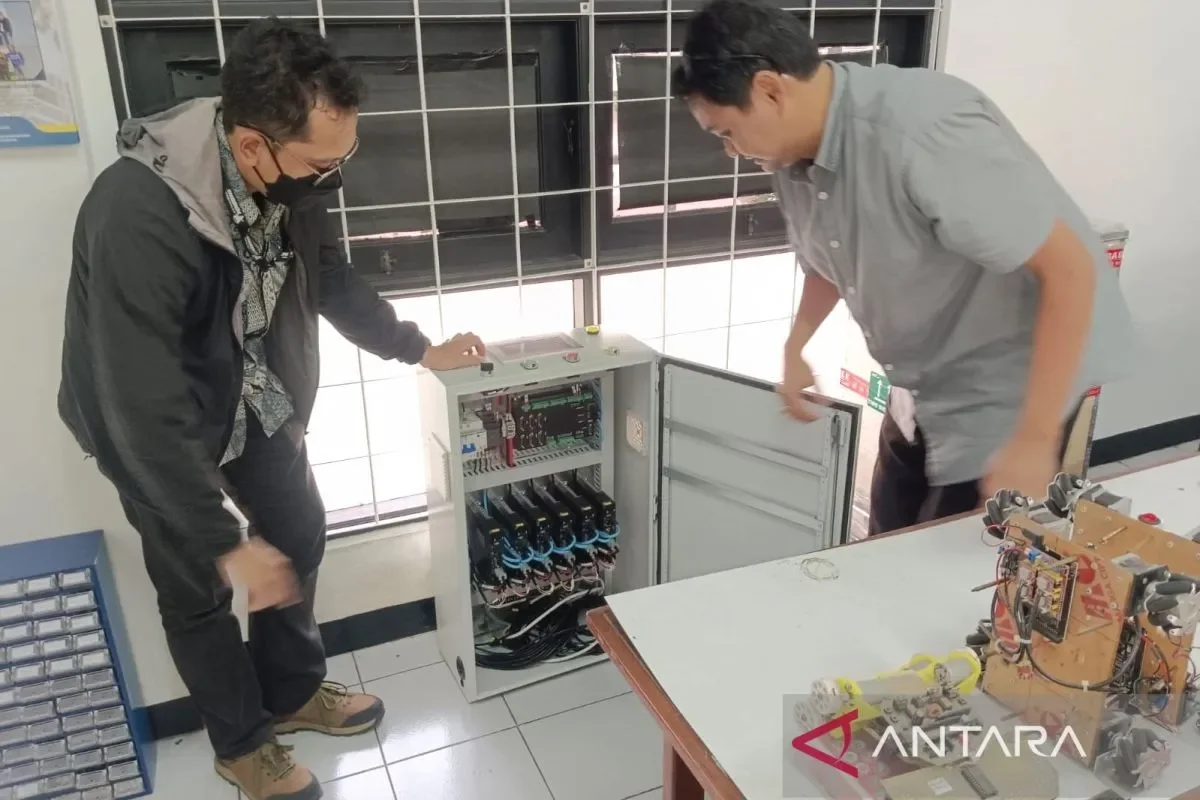
RRI.CO.ID, Jakarta - The high costs and operational headaches of open-sea maritime testing may soon be a thing of the past thanks to a new breakthrough in laboratory-based simulation. Indonesia’s National Research and Innovation Agency (BRIN) has successfully pioneered an AI-powered control system for ocean wave simulators, designed to replicate the unpredictable nature of the sea with unprecedented precision.
Developed through a collaboration between the Research Center for Satellite Technology and the Research Center for Hydrodynamics Technology, the system addresses the inherent limitations of traditional maritime research. Chairperson of the Marine and Offshore Building Technology Research Group, Wibowo Harso Nugroho, highlighted that testing at sea presents massive challenges in terms of both budget and operational complexity.
"With this simulator, we can accurately replicate wave conditions in the laboratory, allowing research to be conducted more efficiently and in a controlled manner," said Wibowo in Jakarta on Tuesday, 7 April 2026.
As reported by Antara, the technical core of the simulator relies on transforming ocean wave models into motion paths via trajectory generation. These paths are then converted into the movement of platform legs using inverse kinematics.
To ensure these movements remain fluid and accurate, the team utilized a Proportional-Integral-Derivative (PID) control system optimized by the Salp Swarm Algorithm (SSA). This AI-driven approach allows the platform to follow complex wave patterns with minimal error.
Rigorous testing has proven the superiority of this AI-integrated method over older optimization techniques. Results indicated that the SSA method achieved the highest performance with a significantly lower fitness value, registering 16.8 percent less error than Genetic Algorithms and 8.7 percent less than Particle Swarm Optimization.
Wibowo noted that the SSA approach allows for the acquisition of optimal control parameters that other methods simply cannot match.
Beyond the lab, the implications for the maritime industry are vast, ranging from refining ship designs to enhancing offshore technology and wave compensation systems. Looking ahead, BRIN plans to evolve the research toward nonlinear control methods to maintain system stability under even more complex dynamic conditions.
Wibowo believes this development serves as a critical bridge for future maritime innovation, offering a safer and more cost-effective pathway for offshore engineering. ***
News Recomendation
Loading latest news.....