


Solar-Powered Water Purification Brings Relief to Disaster-Hit Aceh
- 05 Jan 2026 11:08 WIB
- Voice of Indonesia
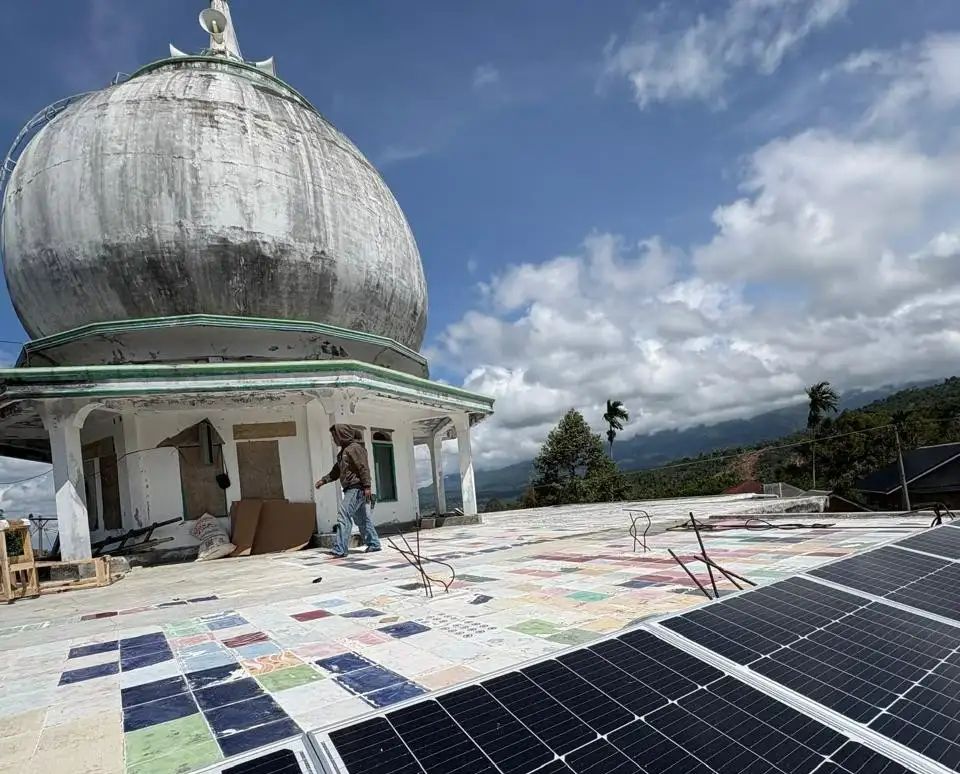
KBRN, Jakarta: Efforts to restore clean water and healthcare services in disaster-affected areas of Aceh are gaining momentum, thanks to a solar-powered purification system installed by a volunteer team from Gadjah Mada University (UGM). Working hand in hand with volunteers from Teuku Umar University (UTU) and Lhokseumawe State Polytechnics (PNL), the initiative aims to strengthen medical facilities and improve living conditions in Lhoksukon, North Aceh, and Bener Meriah.
The UGM team, part of the Health Reserve Team - Emergency Medical Team, Academic Health System (TCK-EMT AHS), is led by lecturer Muhammad Nurhadi Rahman of UGM’s Faculty of Medicine, Public Health, and Nursing. Nurhadi noted that one of the biggest challenges in the current disaster response is disrupted access.
“Water supply is cut off from 10 a.m. until around 7 p.m., which severely affects healthcare services,” he said on Friday, January 2, as quoted on UGM's official website.
To address this, UGM launched a cross-disciplinary program involving civil engineering lecturer Adhy Kurniawan from the Vocational School. The team has already installed a simple solar-powered water purification system at Bener Meriah Regional Hospital (RSUD) as a first step.
Based on initial assessments, priority sites for further installations include Pantan Kemuning evacuation post, Mesidah Community Health Center, and Simpur village’s maternity clinic.
Adhy explained that clean water and electricity are fundamental needs, and solar panels reduce reliance on conventional power and fuel. “The system has a capacity of 500 to 1,000 gallons per day, equivalent to 1,900 to 3,800 liters. It can meet the drinking and hygiene needs of hundreds of residents, especially those in evacuation shelters,” he said.
At Bandar Health Center and Muyang Kute Hospital, the team inspected operating rooms, maternity wards, and water availability. Coordination with the National Disaster Mitigation Agency (BNPB) revealed that four of eight local water sources are damaged, leaving residents dependent on the remaining four.
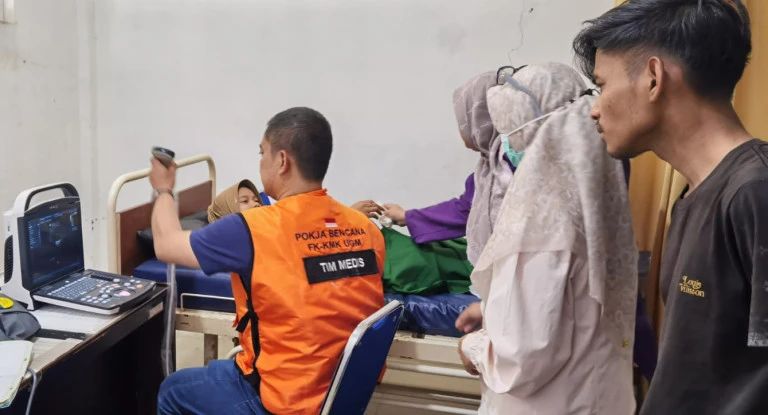 Volunteers from UGM, UTU, and PNL provide health checks, antenatal care, and hygiene education at evacuation shelters and community health centers in flood-affected Bener Meriah and Lhoksukon, North Aceh, January 2026. (Photo: UGM)
Beyond healthcare support, volunteers also reached Pantan Kemuning evacuation post in Timang Gajah, where about 30 families share one village head’s house. Facilities are limited, with only one communal kitchen and bathroom. Here, the team provided hygiene education and monitored both communicable and non-communicable diseases.
Nurhadi reported cases of respiratory infections, acute gastroenteritis, scabies, and other skin conditions. Non-communicable illnesses included hypertension, hyperglycemia, dyspepsia, muscle pain, arthritis, dental caries, and stomatitis. “We also identified one patient with suspected bipolar disorder,” he added.
Meanwhile, UGM, UTU, and PNL volunteers led by UTU’s Research and Community Service Institute head Herri Darsan visited Simpur, an isolated area with inadequate water supply at its health center. The team conducted general health checks, antenatal care, and ultrasound examinations for pregnant women.
“Simpur and Mesidah will be priority sites for solar-powered water purification systems,” Herri said.
At Muyang Kute Hospital, UGM has already delivered two borehole systems, water tanks with capacities of 5,000 and 3,000 liters, and a functioning purification unit. Nurhadi emphasized that the community service program was made possible through funding support from the Indonesian Ministry of Higher Education, Science, and Technology. ***
News Recomendation
Loading latest news.....