


BRIN Advances Thermal Storage and Low-Emission Hydrogen Technologies
- 13 Nov 2025 13:35 WIB
- Voice of Indonesia
KBRN, Jakarta: On Tuesday, November 11, 2025, Indonesia’s National Research and Innovation Agency (BRIN) highlighted ongoing advancements in energy research, focusing on phase change materials (PCM) for efficient heat storage and regulation, as well as solid oxide cells (SOC) for low-emission hydrogen production.
Laboratory experiments and international collaborations support the research.
Anggito Pringgo Tetuko, a senior researcher at BRIN’s Energy Materials Research Center, explained that heat transfer in PCMs typically begins with conduction, followed by convection, and ultimately a phase change from solid to liquid. “PCMs are increasingly used as thermal management media in fuel cell systems and lithium batteries,” he said during the 75th ORNAMAT forum, as quoted by BRIN’s official website.
In proton exchange membrane fuel cells (PEMFC), PCMs help maintain operating temperatures between 60–80°C to prevent overheating. They can also serve as thermal energy storage integrated into concrete or building walls, reducing heating and cooling energy consumption.
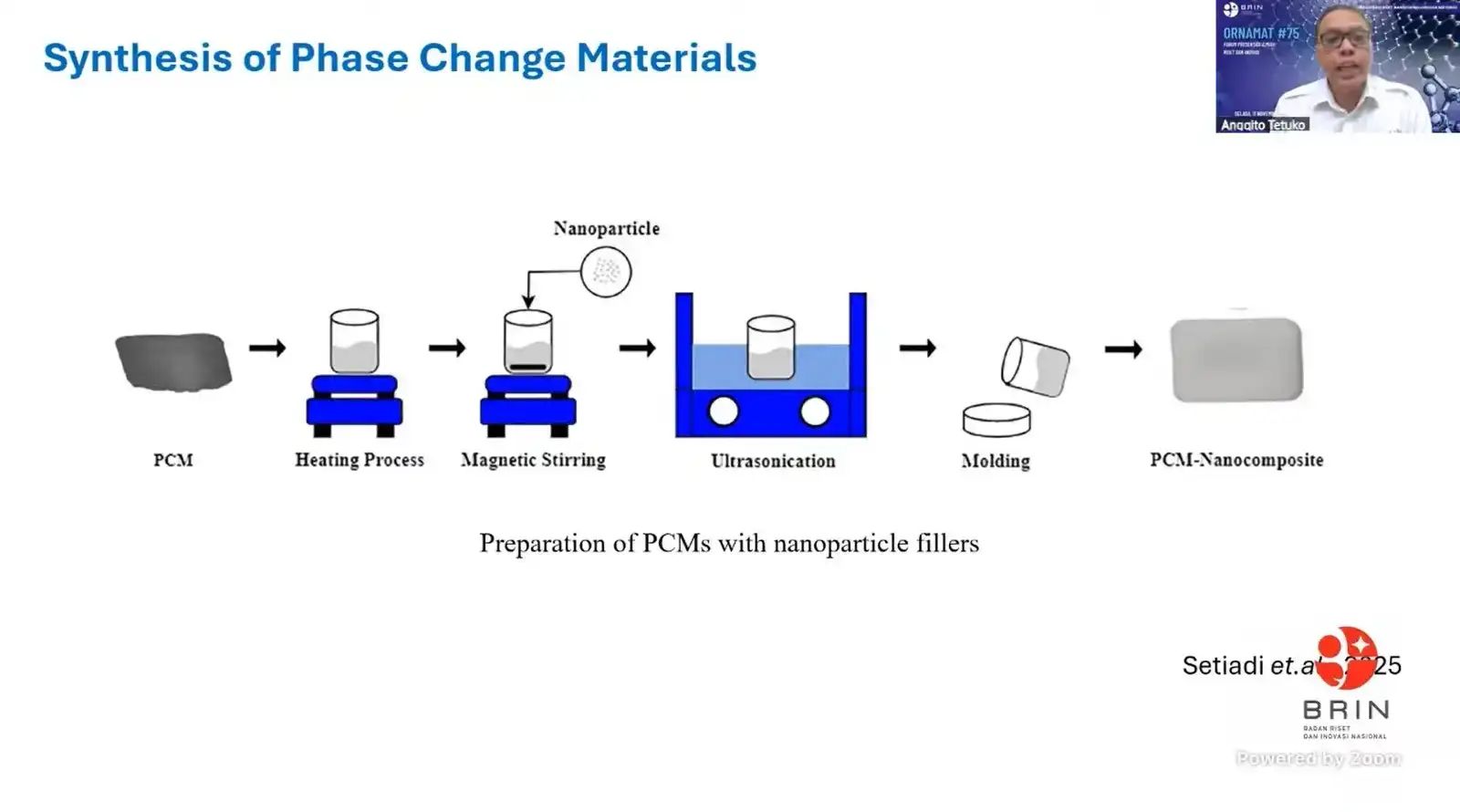
“One of the challenges of PCMs is their low thermal conductivity. To address this, we add Fe₃O₄ magnetic nanoparticles to enhance heat transfer without reducing latent heat capacity,” Anggito added.
This research is supported by the Australian government, LPDP, BRIN’s ORNM Innovation House Program, and Japan’s NEDO, involving collaborations with universities in Australia, China, Korea, Vietnam, and Indonesia.
Meanwhile, Riyan Achmad Budiman, a junior researcher at BRIN’s Energy Materials Research Center, highlighted the principles of solid oxide fuel cells (SOFC) and solid oxide electrolysis cells (SOEC).
SOFCs generate electricity through reactions between oxygen and hydrogen, producing water and electricity, whereas SOECs reverse the process, using electrical energy to split water into hydrogen.
Both systems share similar material compositions, including lanthanum-strontium-cobalt-iron-oxide-based electrodes, gadolinium-doped ceria (GDC), and yttria-stabilized zirconia (YSZ) electrolytes.
“SOFC technology has been commercialized in Japan for over a decade through industrial consortia, such as ENE-FARM Type S, producing up to 0.7 kilowatts for households and 5 kilowatts for commercial buildings,” Riyan noted.
The development of SOECs is currently focused on large-scale industrial applications. Companies such as Topsoe in Denmark are building SOC plants in Europe with efficiencies 20–30 percent higher than low-temperature electrolysis technologies, offering more cost-effective hydrogen production.
Recent research also explores co-electrolysis SOEC technology, combining water vapor and carbon dioxide to produce liquid synthetic fuels. “This approach enables CO₂ recycling and improved energy conversion efficiency,” Riyan said.
One pilot project, developed by Japan’s New Energy and Industrial Technology Development Organization (NEDO) and the Institute of Advanced Science and Technology (IAST), integrates co-electrolysis technology with the Fischer–Tropsch reaction to produce synthetic fuels suitable for vehicles and power plants.
Researchers are also examining factors that reduce cell performance, such as nickel agglomeration, particle migration, and carbon deposition on electrodes. Tests indicate that enlarged nickel particles increase resistance and lower cell capacitance, impacting long-term efficiency.
“The main goal of this research is to enhance SOC durability and long-term stability so that the cells can operate for more than ten years with performance degradation under 15 percent,” Riyan explained.
Japan's NEDO supports this research under its fundamental R&D program for liquid synthetic fuel production, which combines renewable energy-based synthetic gas production with Fischer–Tropsch reactions. ***
News Recomendation
Loading latest news.....