



Deputy Speaker Calls for Broader Transport Access in Frontier, Remote Areas
- 10 Sep 2026 08:25 WIB
- Voice of Indonesia
Key Points
- The DPD Deputy Speaker has urged transportation SOEs to strengthen national connectivity, including in frontier, outermost, and underdeveloped (3T) regions.
- Strengthening national connectivity requires more than infrastructure development and must ensure safe, affordable, sustainable, and integrated transport access.
RRI.CO.ID, Jakarta - Deputy Speaker of Committee II of the Regional Representative Council (DPD), Angelius Wake Kako, has called on state‑owned enterprises (SOEs) in the transportation sector to strengthen national connectivity, extending it to frontier, outermost, and underdeveloped regions (3T).
He said connectivity should be measured not only by infrastructure development but also by the availability of safe, affordable, sustainable, and integrated transportation services.
Angelius noted that transportation SOEs occupy a strategic position because they operate and manage infrastructure while carrying out government mandates and public service obligations, especially in areas that are not yet commercially viable.
“We want to ensure that transportation development and operations genuinely address regional needs. Therefore, through this meeting, we aim to objectively examine the gap between policy and implementation,” Angelius said during a hearing held by DPD RI Committee II with transportation SOEs to discuss the implementation of transportation laws in Jakarta on Tuesday, September 8, 2026.
Connectivity challenges are evident in the toll road sector. State-owned toll road operator PT Jasa Marga President Director Rivan Achmad Purwantono said toll roads serve as the backbone of land connectivity. They accelerate public mobility and logistics distribution while linking economic hubs, industrial estates, ports, airports, and other transportation nodes.
However, toll road development still faces issues such as over‑dimension overloading (ODOL) vehicles, land‑use planning, conversion of road reserve areas, and uneven traffic distribution.
To address these challenges, Jasa Marga is advocating stronger toll road supervision and management through technologies such as Weight‑in‑Motion (WIM) and Radio Frequency Identification (RFID), as well as data integration, pavement engineering, and traffic management.
“Toll roads do more than just connect locations. They also link multimodal transportation systems, economic centers, and logistics chains,” Rivan said.
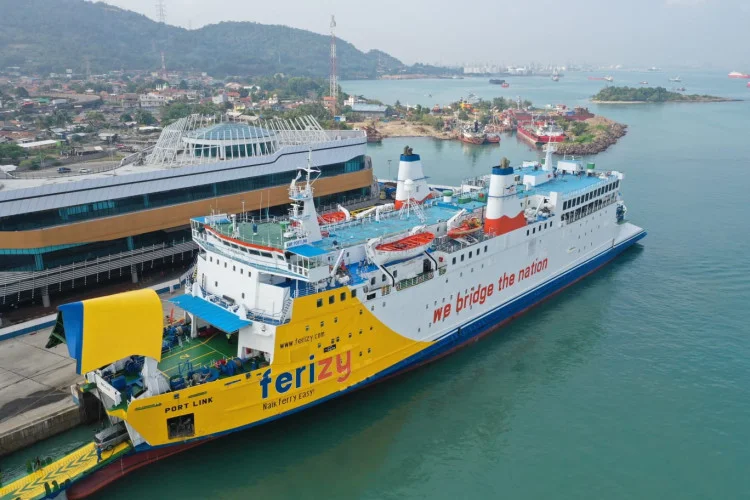
In the ferry sector, Director of Operations and Transformation at state-owned ferry operator PT ASDP Indonesia Ferry, Rio Theodore Natalianto Lasse, said ferry services play a vital role in connecting islands, economic hubs, and 3T regions.
ASDP currently manages 37 ports, 343 routes, and 225 vessels. To strengthen connectivity and reduce logistics costs, the company is promoting a shift in freight transport from land to sea through Roll‑on/Roll‑off (Ro‑Ro) and Roll‑on/Roll‑off Passenger (Ro‑Pax) services.
Rio said shifting logistics transport to sea routes can reduce the burden on roads and improve transport safety, but success requires integrated policy support.
“Policies are needed to align fuel quotas with new routes and ensure the sustainability of pioneer services through the Public Service Obligation (PSO) scheme. Furthermore, integrating data and national multimodal transport network planning is essential,” he said.
State-owned ship operator PT PELNI is also working to maintain inter‑island connectivity. PELNI’s Director of Passenger Transport Business, Nuraini Dessy W., said the company plays a vital role in maintaining sea transport access for communities across Indonesia, including those in remote areas.
PELNI operates a network comprising 43 branches, 306 terminal points, 357 ports of call, and 1,111 route segments.
The PSO scheme serves as a key instrument for maintaining sea transport services in regions that are not yet commercially viable. Through this scheme, PELNI can continue serving communities in 3T regions at affordable rates.
“The PSO enables PELNI to continue serving commercially unviable 3T regions while maintaining national connectivity,” Nuraini said.
Meanwhile, air connectivity is being strengthened through expanded flight networks. Commercial Director of state-owned airport operator PT Angkasa Pura Indonesia, Very Y. Setiady, said that as of July 2026, 104 new routes had been realized, comprising 79 domestic and 25 international routes.
Very emphasized that strengthening air connectivity goes beyond adding routes. Flight capacity, service quality, and airport infrastructure readiness must also be enhanced to support growing mobility and open access to various regions.
“Strengthening connectivity is not just about adding flight routes; it is also about ensuring that capacity, service quality, and airport infrastructure can support mobility growth and open access to various regions,” he said.
These measures show that addressing national transport connectivity challenges requires an integrated approach. Strengthening road, ferry, maritime, and air networks must be paired with intermodal integration, technology adoption, financial and Public Service Obligation (PSO) support, and policies that keep transport services available in areas that are not yet commercially attractive. (Misni Parjiati)
News Recomendation
Loading latest news.....