



Gus Dur: The Unconventional Cleric Who Became Indonesia's Fourth President
- 03 Sep 2026 16:12 WIB
- Voice of Indonesia
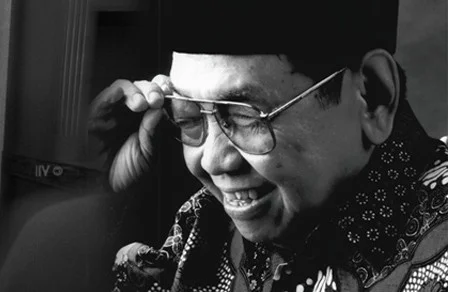
RRI.CO.ID, Jakarta - Abdurrahman Wahid, a Muslim leader widely known by his nickname Gus Dur, served as the fourth President of Indonesia from October 20, 1999, to July 24, 2001, the highest office in the country with the world's largest Muslim population. What set him apart from most heads of state was his path to power: he did not rise through the military or business, but through religious leadership, as head of Indonesia's largest Islamic organization, Nahdlatul Ulama (NU), which counts tens of millions of members.
Based on an official statement from the National Library, he was born on August 4, 1940, in the village of Denanyar in Jombang, East Java, the eldest of six siblings. He came from a prominent religious family. His father, KH. Wahid Hasyim, was one of the founders of NU, while his mother, Hj. Sholehah, was the daughter of the founder of a pesantren, a traditional Islamic boarding school that serves as a center of religious education in Indonesia, also in Jombang. This family background would go on to shape his life as both a cleric and a politician.
From a young age, Gus Dur was known as an avid reader who frequented his father's private library as well as public libraries in Jakarta. But he was far from a purely serious figure: as a teenager he also loved football, chess, and music, and he even worked as a football commentator on television. His passion for cinema led him to chair the jury of the Indonesian Film Festival in 1986 and 1987, an unusual role for a leader of a religious organization.
His teenage years were spent moving between Yogyakarta, Tegalrejo, and the Tambak Beras pesantren in Jombang, before he went on to study in Egypt. Before he left, his uncle arranged his engagement to Sinta Nuriyah, whom he married while still in Egypt. The couple had four daughters: Alissa Qotrunnada Munawaroh, Zannuba Arifah Chafsoh, Annita Hayatunnufus, and Inayah Wulandari.
After returning to Jombang, Gus Dur taught at the Faculty of Ushuluddin at Tebuireng University starting in 1971, before becoming secretary of the local pesantren three years later. This period also marked the start of his career as a writer and columnist, through which his ideas began to reach a wider audience. He went on to work with several non-governmental organizations, including the research institute LP3ES alongside a number of prominent intellectuals, before founding P3M, an organization dedicated to pesantren development.
A turning point in his career came in 1984, when he was elected by acclamation as chairman of NU's central board, known as PBNU, the organization's top leadership position, at a congress in Situbondo, East Java. His leadership was reaffirmed at congresses in Yogyakarta in 1989 and West Java in 1994, making him one of the most influential Islamic figures in Indonesia for a decade before he entered national politics.
As Indonesia entered a new era of democracy in the late 1990s, Gus Dur was elected president in October 1999 and stepped down from his post at PBNU. During his time in office, he became known for views that were often controversial and out of step with the majority, and his term ended earlier than planned on July 24, 2001. Despite its brevity, his presidency is still remembered as a period that opened up space for tolerance and freedom of expression in Indonesia.
News Recomendation
Loading latest news.....